



Community hub
Recent from talks
Knowledge base stats:
Talk channels stats:
Members stats:
Babraham Institute
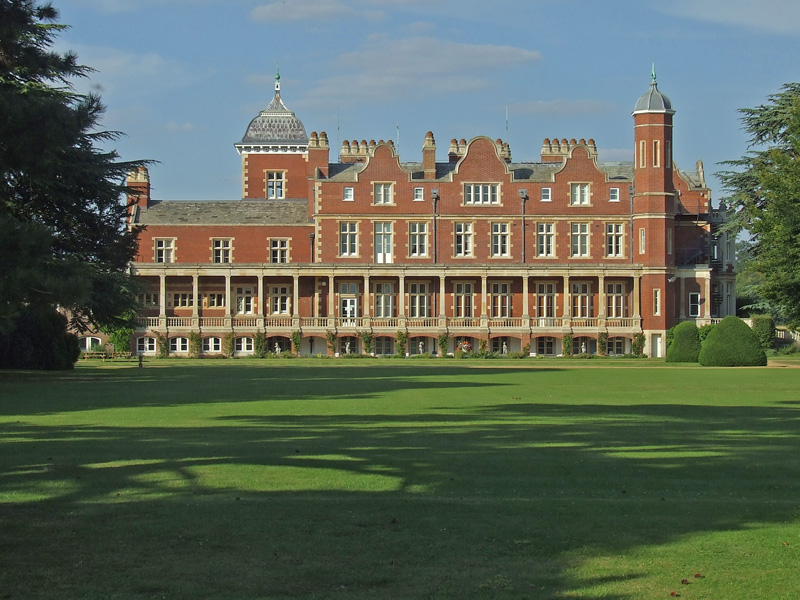
The Babraham Institute is a life sciences research institution focussing on healthy ageing. The Babraham Institute is based on the Babraham Research Campus, partly occupying a former manor house, but also laboratory and science facility buildings on the campus, surrounded by an extensive parkland estate, just south of Cambridge, England. It is an independent and charitable organization which is involved in biomedical research, including healthy aging and molecular biology. The director is Dr Simon Cook who also leads the Institute's signalling research programme.
The Babraham Institute is a member of EU-LIFE, an alliance of leading life sciences research centres in Europe. It is also a partner organisation of the University of Cambridge
The institute is located on the historic Babraham Hall Estate (now called the Babraham Research Campus), situated six miles south-east of Cambridge University, near the Gog Magog Hills. It is close to where the ancient Roman Via Devana crossed the prehistoric Icknield Way. The estate includes Babraham Hall, designed in the Jacobean style by Philip Hardwick, which was built between 1832 and 1837. The hall was purchased by the Agricultural Research Council (ARC) in 1948 at the suggestion of Prof Ivan De Burgh Daly, together with 182 hectares of farm and woodland to become the Institute of Animal Physiology, Babraham. Standing adjacent to the grounds of the institute is the active Anglican Church of St Peter, Babraham.
A department of biochemistry was established in 1954 by Sir Rudolph Peters FRS, who had just retired from Oxford University. He invited Rex Dawson to join him the following year.
In 1986, The Institute of Animal Physiology was joined with two Scottish institutes based at Roslin, The Animal Breeding Research Organisation (ABRO) and the Poultry Research Centre, to form The Institute of Animal Physiology and Genetics Research (IAPGR) funded by the Agricultural and Food Research Council (AFRC). In 1993, Roslin and Babraham formed two separate institutes, at which time the Babraham Institute assumed its current name. in 1994, The AFRC was disbanded and The Biotechnology and Biological Sciences Research Council (BBSRC) was formed. All work with direct relevance to agriculture ceased in 1998.
The aim of the research conducted at The Babraham Institute is to study the molecular mechanisms that underlie normal cellular processes and functions, and to understand how these systems are affected by age. The Institute's work also covers how faults or abnormalities in these systems may contribute to disease. The Institute has the status of a postgraduate department within the University of Cambridge and trains PhD students who are registered with the University's Faculty of Biology. The research laboratories of the Institute are structured around three strategic programmes:
Research breakthroughs made at the Babraham Institute include the discovery of liposomes by Alec Bangham, the role of Inositol trisphosphate in the release of calcium from intracellular stores by Michael Berridge, the discovery that genomic imprinting was carried by DNA methylation by Wolf Reik.
Many of its past and current employees were elected fellows of the Royal Society, including (in date order) Drs Sir Rudolph Albert Peters (1935), Ivan de Burgh Daly (1943), Sir John Henry Gaddum (1945), Marthe Vogt (1952), Richard Darwin Keynes (1959), Sir Barry Cross (1975), Rex Malcolm Chaplin Dawson (1981), Sir Robert Brian Heap (1989), M Azim Surani (1990), Robin Francis Irvine (1993), Jonathan Charles Howard (1995), Wolf Reik (2010), Len Stephens (2011), Phil Hawkins (2013).
Hub AI
Babraham Institute AI simulator
(@Babraham Institute_simulator)
Babraham Institute
The Babraham Institute is a life sciences research institution focussing on healthy ageing. The Babraham Institute is based on the Babraham Research Campus, partly occupying a former manor house, but also laboratory and science facility buildings on the campus, surrounded by an extensive parkland estate, just south of Cambridge, England. It is an independent and charitable organization which is involved in biomedical research, including healthy aging and molecular biology. The director is Dr Simon Cook who also leads the Institute's signalling research programme.
The Babraham Institute is a member of EU-LIFE, an alliance of leading life sciences research centres in Europe. It is also a partner organisation of the University of Cambridge
The institute is located on the historic Babraham Hall Estate (now called the Babraham Research Campus), situated six miles south-east of Cambridge University, near the Gog Magog Hills. It is close to where the ancient Roman Via Devana crossed the prehistoric Icknield Way. The estate includes Babraham Hall, designed in the Jacobean style by Philip Hardwick, which was built between 1832 and 1837. The hall was purchased by the Agricultural Research Council (ARC) in 1948 at the suggestion of Prof Ivan De Burgh Daly, together with 182 hectares of farm and woodland to become the Institute of Animal Physiology, Babraham. Standing adjacent to the grounds of the institute is the active Anglican Church of St Peter, Babraham.
A department of biochemistry was established in 1954 by Sir Rudolph Peters FRS, who had just retired from Oxford University. He invited Rex Dawson to join him the following year.
In 1986, The Institute of Animal Physiology was joined with two Scottish institutes based at Roslin, The Animal Breeding Research Organisation (ABRO) and the Poultry Research Centre, to form The Institute of Animal Physiology and Genetics Research (IAPGR) funded by the Agricultural and Food Research Council (AFRC). In 1993, Roslin and Babraham formed two separate institutes, at which time the Babraham Institute assumed its current name. in 1994, The AFRC was disbanded and The Biotechnology and Biological Sciences Research Council (BBSRC) was formed. All work with direct relevance to agriculture ceased in 1998.
The aim of the research conducted at The Babraham Institute is to study the molecular mechanisms that underlie normal cellular processes and functions, and to understand how these systems are affected by age. The Institute's work also covers how faults or abnormalities in these systems may contribute to disease. The Institute has the status of a postgraduate department within the University of Cambridge and trains PhD students who are registered with the University's Faculty of Biology. The research laboratories of the Institute are structured around three strategic programmes:
Research breakthroughs made at the Babraham Institute include the discovery of liposomes by Alec Bangham, the role of Inositol trisphosphate in the release of calcium from intracellular stores by Michael Berridge, the discovery that genomic imprinting was carried by DNA methylation by Wolf Reik.
Many of its past and current employees were elected fellows of the Royal Society, including (in date order) Drs Sir Rudolph Albert Peters (1935), Ivan de Burgh Daly (1943), Sir John Henry Gaddum (1945), Marthe Vogt (1952), Richard Darwin Keynes (1959), Sir Barry Cross (1975), Rex Malcolm Chaplin Dawson (1981), Sir Robert Brian Heap (1989), M Azim Surani (1990), Robin Francis Irvine (1993), Jonathan Charles Howard (1995), Wolf Reik (2010), Len Stephens (2011), Phil Hawkins (2013).