




Community hub
Recent from talks
Contribute something to knowledge base
Content stats: 0 posts, 0 articles, 1 media, 0 notes
Members stats: 0 subscribers, 0 contributors, 0 moderators, 0 supporters
Subscribers
Supporters
Contributors
Moderators
Beat (music)
In music and music theory, the beat is the basic unit of time, the pulse (regularly repeating event), of the mensural level (or beat level). The beat is often defined as the rhythm listeners would tap their toes to when listening to a piece of music, or the numbers a musician counts while performing, though in practice this may be technically incorrect (often the first multiple level).[clarification needed] In popular use, beat can refer to a variety of related concepts, including pulse, tempo, meter, specific rhythms, and groove.
Rhythm in music is characterized by a repeating sequence of stressed and unstressed beats (often called "strong" and "weak") and divided into bars organized by time signature and tempo indications.
Beats are related to and distinguished from pulse, rhythm (grouping), and meter:
Meter is the measurement of the number of pulses between more or less regularly recurring accents. Therefore, in order for meter to exist, some of the pulses in a series must be accented—marked for consciousness—relative to others. When pulses are thus counted within a metric context, they are referred to as beats.
— Leonard B. Meyer and Cooper (1960)
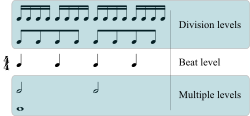
Metric levels faster than the beat level are division levels, and slower levels are multiple levels. Beat has always been an important part of music. Some music genres such as funk will in general de-emphasize the beat, while other such as disco emphasize the beat to accompany dance.
As beats are combined to form measures, each beat is divided into parts. The nature of this combination and division is what determines meter. Music where two beats are combined is in duple meter, music where three beats are combined is in triple meter. Music where the beat is split in two are in simple meter, music where the beat is split in three are called compound meter. Thus, simple duple (2
4, 4
4, etc.), simple triple (3
4), compound duple (6
8), and compound triple (9
8). Divisions which require numbers, tuplets (for example, dividing a quarter note into five equal parts), are irregular divisions and subdivisions. Subdivision begins two levels below the beat level: starting with a quarter note or a dotted quarter note, subdivision begins when the note is divided into sixteenth notes.
The downbeat is the first beat of the bar, i.e. number 1. The upbeat is the last beat in the previous bar which immediately precedes, and hence anticipates, the downbeat. Both terms correspond to the direction taken by the hand of a conductor.
Beat (music)
In music and music theory, the beat is the basic unit of time, the pulse (regularly repeating event), of the mensural level (or beat level). The beat is often defined as the rhythm listeners would tap their toes to when listening to a piece of music, or the numbers a musician counts while performing, though in practice this may be technically incorrect (often the first multiple level).[clarification needed] In popular use, beat can refer to a variety of related concepts, including pulse, tempo, meter, specific rhythms, and groove.
Rhythm in music is characterized by a repeating sequence of stressed and unstressed beats (often called "strong" and "weak") and divided into bars organized by time signature and tempo indications.
Beats are related to and distinguished from pulse, rhythm (grouping), and meter:
Meter is the measurement of the number of pulses between more or less regularly recurring accents. Therefore, in order for meter to exist, some of the pulses in a series must be accented—marked for consciousness—relative to others. When pulses are thus counted within a metric context, they are referred to as beats.
— Leonard B. Meyer and Cooper (1960)
Metric levels faster than the beat level are division levels, and slower levels are multiple levels. Beat has always been an important part of music. Some music genres such as funk will in general de-emphasize the beat, while other such as disco emphasize the beat to accompany dance.
As beats are combined to form measures, each beat is divided into parts. The nature of this combination and division is what determines meter. Music where two beats are combined is in duple meter, music where three beats are combined is in triple meter. Music where the beat is split in two are in simple meter, music where the beat is split in three are called compound meter. Thus, simple duple (2
4, 4
4, etc.), simple triple (3
4), compound duple (6
8), and compound triple (9
8). Divisions which require numbers, tuplets (for example, dividing a quarter note into five equal parts), are irregular divisions and subdivisions. Subdivision begins two levels below the beat level: starting with a quarter note or a dotted quarter note, subdivision begins when the note is divided into sixteenth notes.
The downbeat is the first beat of the bar, i.e. number 1. The upbeat is the last beat in the previous bar which immediately precedes, and hence anticipates, the downbeat. Both terms correspond to the direction taken by the hand of a conductor.
Recent media
Recent media