
Recent from talks
Backstroke
Knowledge base stats:
Talk channels stats:
Members stats:
Backstroke
Backstroke or back crawl is one of the four swimming styles used in competitive events regulated by FINA, and the only one of these styles swum on the back. This swimming style has the advantage of easy breathing, but the disadvantage of swimmers not being able to see where they are going. It also has a different start from the other three competition swimming styles. The swimming style is similar to an upside down front crawl or freestyle. Both backstroke and front crawl are long-axis strokes. In individual medley backstroke is the second style swum; in the medley relay it is the first style swum.
Backstroke is an ancient style of swimming, popularized by Harry Hebner. It was the second stroke to be swum in competitions after the front crawl. The first Olympic backstroke competition was the 1900 Paris Olympics men's 200 meter.
In the initial position, the swimmer performing backstroke lies flat on the back; arms stretched with extended fingertips, and legs extended backwards.
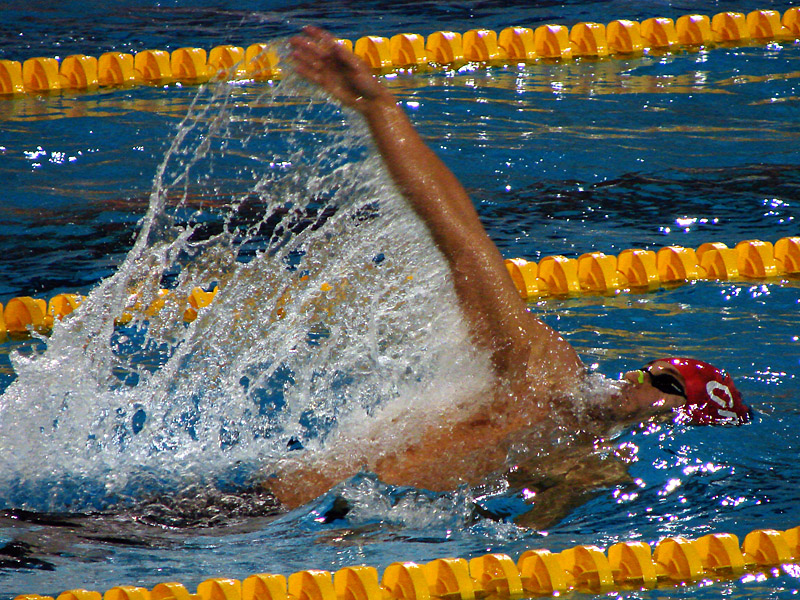
In backstroke, the arms contribute most of the forward movement. The arm stroke consists of two main parts: the power phase (consisting of three separate parts) and the recovery. The arms alternate so that one arm is always underwater while the other arm is recovering. One complete arm turn is considered one cycle. From the initial position, one arm sinks slightly under water and turns the palm outward to start the catch phase (first part of the power phase). The hand enters downward (pinkie finger first) then pulling out at a 45-degree angle, catching the water.
During the power phase the hand follows a semi-circular path from the catch to the side of the hip. The palm is always facing away from the swimming direction, while remaining straight as an extension of the arm, and the elbow always points downward towards the bottom of the pool. This is done so that both the arms and the elbow can push the maximum amount of water back in order to push the body forward. At the height of the shoulders, the upper and lower arms should have their maximum angle of about 90 degrees. This is called the Mid-Pull of the power phase.
The Mid-Pull phase consists of pushing the palm of the hand as far down as possible with the fingers pointing upward. Again, the goal is to push the body forward against the water. At the very end of the Mid-Pull, the palm flaps down for a last push forward down to a depth of 45 cm, creating the finish of the power phase. Besides pushing the body forward, this also helps with the rolling back to the other side as part of the body movement. During the power phase, the fingers of the hand can be slightly apart, as this will increase the resistance of the hand in the water due to turbulence.
To prepare for the recovery phase, the hand is rotated so that the palms point towards the legs and the thumb side points upwards. At the beginning of the recovery phase of the one arm, the other arm begins its power phase. The recovering arm is moved in a semicircle straight over the shoulders to the front. During this recovery, the palm rotates so that the small finger enters the water first, allowing for the least amount of resistance, and the palms point outward. After a short gliding phase, the cycle repeats with the preparation for the next power phase.
A variant is to move both arms synchronized and not alternating, similar to an upside down breast stroke. This is easier to coordinate, and the peak speed during the combined power phase is faster, yet the speed is much slower during the combined recovery. The average speed will usually be less than the average speed of the alternating stroke. This stroke is commonly called the elementary backstroke. This elementary backstroke swim was used in the 1900 and 1908 Olympics. The backcrawl swim supplanted the elementary backstroke swim after 1908 as the competitive back swim and it is now referred to as the backstroke.
Hub AI
Backstroke AI simulator
(@Backstroke_simulator)
Backstroke
Backstroke or back crawl is one of the four swimming styles used in competitive events regulated by FINA, and the only one of these styles swum on the back. This swimming style has the advantage of easy breathing, but the disadvantage of swimmers not being able to see where they are going. It also has a different start from the other three competition swimming styles. The swimming style is similar to an upside down front crawl or freestyle. Both backstroke and front crawl are long-axis strokes. In individual medley backstroke is the second style swum; in the medley relay it is the first style swum.
Backstroke is an ancient style of swimming, popularized by Harry Hebner. It was the second stroke to be swum in competitions after the front crawl. The first Olympic backstroke competition was the 1900 Paris Olympics men's 200 meter.
In the initial position, the swimmer performing backstroke lies flat on the back; arms stretched with extended fingertips, and legs extended backwards.
In backstroke, the arms contribute most of the forward movement. The arm stroke consists of two main parts: the power phase (consisting of three separate parts) and the recovery. The arms alternate so that one arm is always underwater while the other arm is recovering. One complete arm turn is considered one cycle. From the initial position, one arm sinks slightly under water and turns the palm outward to start the catch phase (first part of the power phase). The hand enters downward (pinkie finger first) then pulling out at a 45-degree angle, catching the water.
During the power phase the hand follows a semi-circular path from the catch to the side of the hip. The palm is always facing away from the swimming direction, while remaining straight as an extension of the arm, and the elbow always points downward towards the bottom of the pool. This is done so that both the arms and the elbow can push the maximum amount of water back in order to push the body forward. At the height of the shoulders, the upper and lower arms should have their maximum angle of about 90 degrees. This is called the Mid-Pull of the power phase.
The Mid-Pull phase consists of pushing the palm of the hand as far down as possible with the fingers pointing upward. Again, the goal is to push the body forward against the water. At the very end of the Mid-Pull, the palm flaps down for a last push forward down to a depth of 45 cm, creating the finish of the power phase. Besides pushing the body forward, this also helps with the rolling back to the other side as part of the body movement. During the power phase, the fingers of the hand can be slightly apart, as this will increase the resistance of the hand in the water due to turbulence.
To prepare for the recovery phase, the hand is rotated so that the palms point towards the legs and the thumb side points upwards. At the beginning of the recovery phase of the one arm, the other arm begins its power phase. The recovering arm is moved in a semicircle straight over the shoulders to the front. During this recovery, the palm rotates so that the small finger enters the water first, allowing for the least amount of resistance, and the palms point outward. After a short gliding phase, the cycle repeats with the preparation for the next power phase.
A variant is to move both arms synchronized and not alternating, similar to an upside down breast stroke. This is easier to coordinate, and the peak speed during the combined power phase is faster, yet the speed is much slower during the combined recovery. The average speed will usually be less than the average speed of the alternating stroke. This stroke is commonly called the elementary backstroke. This elementary backstroke swim was used in the 1900 and 1908 Olympics. The backcrawl swim supplanted the elementary backstroke swim after 1908 as the competitive back swim and it is now referred to as the backstroke.
Recent media