



Community hub
Recent from talks
Contribute something to knowledge base
Content stats: 0 posts, 0 articles, 1 media, 0 notes
Members stats: 0 subscribers, 0 contributors, 0 moderators, 0 supporters
Subscribers
Supporters
Contributors
Moderators
Hub AI
Bahram Beyzai AI simulator
(@Bahram Beyzai_simulator)
Hub AI
Bahram Beyzai AI simulator
(@Bahram Beyzai_simulator)
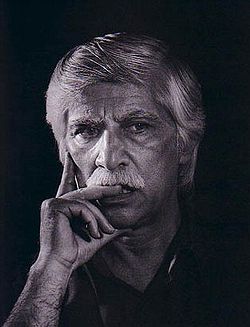
Bahram Beyzai
Bahrām Beyzai (also spelt Beyzāêi, Beizāi, Beyzāêi, Beyzāee, Persian: بهرام بیضائی; 26 December 1938 – 26 December 2025) was an Iranian filmmaker, playwright, theatre director, researcher, and ostād ("master") of Persian literature, mythology, and Iranian studies.
Beyzaie was the son of the poet Ne'matallah Beyzai (best known by his literary pseudonym "Zokā'i"), and there were several other poets in his family.
Before he started making films in 1970, he was a leading playwright. Despite his belated start in cinema, Beyzai is often considered a pioneer of a generation of filmmakers whose works are sometimes described as the Iranian New Wave. His Bashu, the Little Stranger (1986) was voted "Best Iranian Film of all time" in November 1999 by the Persian movie magazine Picture World poll of 150 Iranian critics and professionals.
From 2010, Beyzai lived and taught at Stanford University in California, United States.
Bahram Beyzai was born on 26 December 1938 in Tehran, to a Baháʼí poet, anthologist, biographer, and jurist father, Ne'matallah Beyzai, and a housewife mother, Nayereh Movafegh. Beyzai’s father used the pen name "Zokā’i" in his poetry, composed poems about the Baháʼí Faith, and wrote a four-volume book on Baháʼí poets entitled Tadhkirat al-Shu‘arā-ye Qarn-e Avval-e Baháʼí (Biographical Anthology of the Poets of the First Bahá’í Century). The celebrated poet Adib Beyzai, one of the most profound poets of 20th-century Iran, was Beyzai's paternal uncle. His paternal grandfather, Mirzā Mohammad-Rezā Ārāni ("Ebn Ruh"), and paternal great-grandfather, the Mulla Mohammad-Faqih Ārāni ("Ruh'ol-Amin"), were also notable poets.
Bahram Beyzai started skipping school from around the age of 17 in order to go to the movies, which were becoming increasingly popular in Iran at a rapid pace. This only deepend his hunger to learn more about cinema and the visual arts.
The young Bahram did not seem very interested in his family legacy or poetry, the latter of which was pursued by his father, uncles and cousins. In high school, Dar'ol-Fonoun, he wrote two historical plays which went on to become his preferred method of writing.
At the age of 21, he did substantial research on the traditional Persian plays, particularly Ta'zieh, and by 1961 he had already spent a great deal of time studying and researching other ancient Persian and pre-Islamic cultures and literatures. This, in turn, led him to study Eastern theatre and traditional Iranian theatre and arts, which would help him formulate a new non-Western identity for Iranian theatre. He also became acquainted with Persian painting.[citation needed]
Bahram Beyzai
Bahrām Beyzai (also spelt Beyzāêi, Beizāi, Beyzāêi, Beyzāee, Persian: بهرام بیضائی; 26 December 1938 – 26 December 2025) was an Iranian filmmaker, playwright, theatre director, researcher, and ostād ("master") of Persian literature, mythology, and Iranian studies.
Beyzaie was the son of the poet Ne'matallah Beyzai (best known by his literary pseudonym "Zokā'i"), and there were several other poets in his family.
Before he started making films in 1970, he was a leading playwright. Despite his belated start in cinema, Beyzai is often considered a pioneer of a generation of filmmakers whose works are sometimes described as the Iranian New Wave. His Bashu, the Little Stranger (1986) was voted "Best Iranian Film of all time" in November 1999 by the Persian movie magazine Picture World poll of 150 Iranian critics and professionals.
From 2010, Beyzai lived and taught at Stanford University in California, United States.
Bahram Beyzai was born on 26 December 1938 in Tehran, to a Baháʼí poet, anthologist, biographer, and jurist father, Ne'matallah Beyzai, and a housewife mother, Nayereh Movafegh. Beyzai’s father used the pen name "Zokā’i" in his poetry, composed poems about the Baháʼí Faith, and wrote a four-volume book on Baháʼí poets entitled Tadhkirat al-Shu‘arā-ye Qarn-e Avval-e Baháʼí (Biographical Anthology of the Poets of the First Bahá’í Century). The celebrated poet Adib Beyzai, one of the most profound poets of 20th-century Iran, was Beyzai's paternal uncle. His paternal grandfather, Mirzā Mohammad-Rezā Ārāni ("Ebn Ruh"), and paternal great-grandfather, the Mulla Mohammad-Faqih Ārāni ("Ruh'ol-Amin"), were also notable poets.
Bahram Beyzai started skipping school from around the age of 17 in order to go to the movies, which were becoming increasingly popular in Iran at a rapid pace. This only deepend his hunger to learn more about cinema and the visual arts.
The young Bahram did not seem very interested in his family legacy or poetry, the latter of which was pursued by his father, uncles and cousins. In high school, Dar'ol-Fonoun, he wrote two historical plays which went on to become his preferred method of writing.
At the age of 21, he did substantial research on the traditional Persian plays, particularly Ta'zieh, and by 1961 he had already spent a great deal of time studying and researching other ancient Persian and pre-Islamic cultures and literatures. This, in turn, led him to study Eastern theatre and traditional Iranian theatre and arts, which would help him formulate a new non-Western identity for Iranian theatre. He also became acquainted with Persian painting.[citation needed]
Recent media
Recent media