




Community hub
Recent from talks
Contribute something to knowledge base
Content stats: 0 posts, 0 articles, 1 media, 0 notes
Members stats: 0 subscribers, 0 contributors, 0 moderators, 0 supporters
Subscribers
Supporters
Contributors
Moderators
Balai Pemuda
Balai Pemuda or Alun-Alun Surabaya is a rich historical site in Surabaya. The site serves as a hub for cultural and artistic activities.
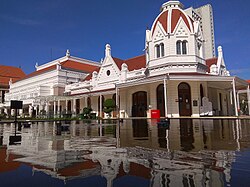
Originally built in 1907, it was known as Simpangsche Societeit or Simpangsche Club a nightlife venue for European elites, especially Dutch citizens. The locals affectionately called it “Roemah Kamar Bola” due to the billiards game held there. Designed by Dutch architect Westmaes, this heritage building features a distinctive dome resembling a crown. Today, Balai Pemuda hosts art events, houses the Surabaya Public Library, and includes Alun-alun Surabaya—an outdoor area with a food court and exhibition space12.
During the colonial era, Simpangsche Societeit served as an exclusive club where parties, informal meetings, dances, and other elite entertainment took place. It symbolized Western culture’s influence and the dominance of the colonial government. However, after Indonesia gained independence, Balai Pemuda transformed its purpose. It became a hub for youth activities, focusing on education, arts, and culture. Today, it continues to thrive as a cultural center, promoting heritage preservation and community engagement.
 Media related to Balai Pemuda at Wikimedia Commons
Balai Pemuda
Balai Pemuda or Alun-Alun Surabaya is a rich historical site in Surabaya. The site serves as a hub for cultural and artistic activities.
Originally built in 1907, it was known as Simpangsche Societeit or Simpangsche Club a nightlife venue for European elites, especially Dutch citizens. The locals affectionately called it “Roemah Kamar Bola” due to the billiards game held there. Designed by Dutch architect Westmaes, this heritage building features a distinctive dome resembling a crown. Today, Balai Pemuda hosts art events, houses the Surabaya Public Library, and includes Alun-alun Surabaya—an outdoor area with a food court and exhibition space12.
During the colonial era, Simpangsche Societeit served as an exclusive club where parties, informal meetings, dances, and other elite entertainment took place. It symbolized Western culture’s influence and the dominance of the colonial government. However, after Indonesia gained independence, Balai Pemuda transformed its purpose. It became a hub for youth activities, focusing on education, arts, and culture. Today, it continues to thrive as a cultural center, promoting heritage preservation and community engagement.
Media related to Balai Pemuda at Wikimedia Commons
Recent media
Recent media