


Community hub
Recent from talks
Knowledge base stats:
Talk channels stats:
Members stats:
Bandlimiting
Bandlimiting is the process of reducing a signal’s energy outside a specific frequency range, keeping only the desired part of the signal’s spectrum. This technique is crucial in signal processing and communications to ensure signals stay clear and effective. For example, it helps prevent interference between radio frequency signals, like those used in radio or TV broadcasts, and reduces aliasing distortion (a type of error) when converting signals to digital form for digital signal processing.
A bandlimited signal is a signal that, in strict terms, has no energy outside a specific frequency range. In practical use, a signal is called bandlimited if the energy beyond this range is so small that it can be ignored for a particular purpose, like audio recording or radio transmission. These signals can be either random (unpredictable, also called stochastic) or non-random (predictable, known as deterministic).
In mathematical terms, a bandlimited signal relates to its Fourier series or Fourier transform representation. A generic signal needs an infinite range of frequencies in a continuous Fourier series to describe it fully, but if only a finite range is enough, the signal is considered bandlimited. This means its Fourier transform or spectral density—which show the signal’s frequency content—has “bounded support”, meaning it drops to zero outside a limited frequency range.
A bandlimited signal theoretically must extend in time from minus infinity to plus infinity with at least occasional non-zero patches, which is not the case in practical situations (see lower down).
A bandlimited signal can be perfectly recreated from its samples if the sampling rate—how often the signal is measured—is more than twice the signal’s bandwidth (the range of frequencies it contains). This minimum rate is called the Nyquist rate, a key idea in the Nyquist–Shannon sampling theorem, which ensures no information is lost during sampling.
In reality, most signals aren’t perfectly bandlimited, and signals we care about—like audio or radio waves—often have unwanted energy outside the desired frequency range. To handle this, digital signal processing tools that sample or change sample rates use bandlimiting filters to reduce aliasing (a distortion where high frequencies disguise themselves as lower ones). These filters must be designed carefully, as they alter the signal’s frequency domain magnitude and phase (its strength and timing across frequencies) and its time domain properties (how it changes over time).
An example of a simple deterministic bandlimited signal is a sinusoid of the form If this signal is sampled at a rate so that we have the samples for all integers , we can recover completely from these samples. Similarly, sums of sinusoids with different frequencies and phases are also bandlimited to the highest of their frequencies.

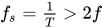


The signal whose Fourier transform is shown in the figure is also bandlimited. Suppose is a signal whose Fourier transform is the magnitude of which is shown in the figure. The highest frequency component in is As a result, the Nyquist rate is


Hub AI
Bandlimiting AI simulator
(@Bandlimiting_simulator)
Bandlimiting
Bandlimiting is the process of reducing a signal’s energy outside a specific frequency range, keeping only the desired part of the signal’s spectrum. This technique is crucial in signal processing and communications to ensure signals stay clear and effective. For example, it helps prevent interference between radio frequency signals, like those used in radio or TV broadcasts, and reduces aliasing distortion (a type of error) when converting signals to digital form for digital signal processing.
A bandlimited signal is a signal that, in strict terms, has no energy outside a specific frequency range. In practical use, a signal is called bandlimited if the energy beyond this range is so small that it can be ignored for a particular purpose, like audio recording or radio transmission. These signals can be either random (unpredictable, also called stochastic) or non-random (predictable, known as deterministic).
In mathematical terms, a bandlimited signal relates to its Fourier series or Fourier transform representation. A generic signal needs an infinite range of frequencies in a continuous Fourier series to describe it fully, but if only a finite range is enough, the signal is considered bandlimited. This means its Fourier transform or spectral density—which show the signal’s frequency content—has “bounded support”, meaning it drops to zero outside a limited frequency range.
A bandlimited signal theoretically must extend in time from minus infinity to plus infinity with at least occasional non-zero patches, which is not the case in practical situations (see lower down).
A bandlimited signal can be perfectly recreated from its samples if the sampling rate—how often the signal is measured—is more than twice the signal’s bandwidth (the range of frequencies it contains). This minimum rate is called the Nyquist rate, a key idea in the Nyquist–Shannon sampling theorem, which ensures no information is lost during sampling.
In reality, most signals aren’t perfectly bandlimited, and signals we care about—like audio or radio waves—often have unwanted energy outside the desired frequency range. To handle this, digital signal processing tools that sample or change sample rates use bandlimiting filters to reduce aliasing (a distortion where high frequencies disguise themselves as lower ones). These filters must be designed carefully, as they alter the signal’s frequency domain magnitude and phase (its strength and timing across frequencies) and its time domain properties (how it changes over time).
An example of a simple deterministic bandlimited signal is a sinusoid of the form If this signal is sampled at a rate so that we have the samples for all integers , we can recover completely from these samples. Similarly, sums of sinusoids with different frequencies and phases are also bandlimited to the highest of their frequencies.
The signal whose Fourier transform is shown in the figure is also bandlimited. Suppose is a signal whose Fourier transform is the magnitude of which is shown in the figure. The highest frequency component in is As a result, the Nyquist rate is