
Recent from talks
Fourier series
Knowledge base stats:
Talk channels stats:
Members stats:
Fourier series
A Fourier series (/ˈfʊrieɪ, -iər/) is a series expansion of a periodic function into a sum of trigonometric functions. The Fourier series is an example of a trigonometric series. By expressing a function as a sum of sines and cosines, many problems involving the function become easier to analyze because trigonometric functions are well understood. For example, Fourier series were first used by Joseph Fourier to find solutions to the heat equation. This application is possible because the derivatives of trigonometric functions fall into simple patterns. Fourier series cannot be used to approximate arbitrary functions, because most functions have infinitely many terms in their Fourier series, and the series do not always converge. Well-behaved functions, for example smooth functions, have Fourier series that converge to the original function. The coefficients of the Fourier series are determined by integrals of the function multiplied by trigonometric functions, described in Fourier series § Definition.
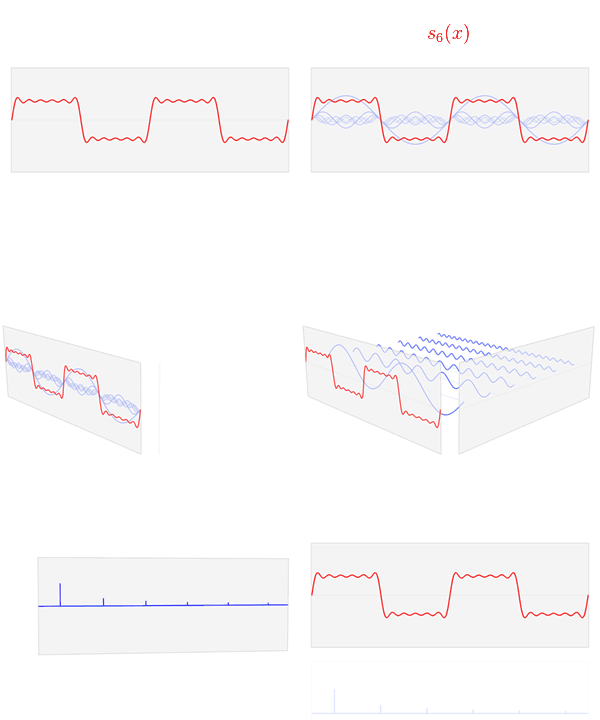
The study of the convergence of Fourier series focus on the behaviors of the partial sums, which means studying the behavior of the sum as more and more terms from the series are summed. The figures below illustrate some partial Fourier series results for the components of a square wave.
Fourier series are closely related to the Fourier transform, a more general tool that can even find the frequency information for functions that are not periodic. Periodic functions can be identified with functions on a circle; for this reason Fourier series are the subject of Fourier analysis on the circle group, denoted by or . The Fourier transform is also part of Fourier analysis, but is defined for functions on .


Since Fourier's time, many different approaches to defining and understanding the concept of Fourier series have been discovered, all of which are consistent with one another, but each of which emphasizes different aspects of the topic. Some of the more powerful and elegant approaches are based on mathematical ideas and tools that were not available in Fourier's time. Fourier originally defined the Fourier series for real-valued functions of real arguments, and used the sine and cosine functions in the decomposition. Many other Fourier-related transforms have since been defined, extending his initial idea to many applications and birthing an area of mathematics called Fourier analysis.
The Fourier series is named in honor of Jean-Baptiste Joseph Fourier (1768–1830), who made important contributions to the study of trigonometric series, after preliminary investigations by Leonhard Euler, Jean le Rond d'Alembert, and Daniel Bernoulli. Fourier introduced the series for the purpose of solving the heat equation in a metal plate, publishing his initial results in his 1807 Mémoire sur la propagation de la chaleur dans les corps solides (Treatise on the propagation of heat in solid bodies), and publishing his Théorie analytique de la chaleur (Analytical theory of heat) in 1822. The Mémoire introduced Fourier analysis, specifically Fourier series. Through Fourier's research the fact was established that an arbitrary (at first, continuous and later generalized to any piecewise-smooth) function can be represented by a trigonometric series. The first announcement of this great discovery was made by Fourier in 1807, before the French Academy. Early ideas of decomposing a periodic function into the sum of simple oscillating functions date back to the 3rd century BC, when ancient astronomers proposed an empiric model of planetary motions, based on deferents and epicycles.
Independently of Fourier, astronomer Friedrich Wilhelm Bessel introduced Fourier series to solve Kepler's equation. His work was published in 1819, unaware of Fourier's work which remained unpublished until 1822.
The heat equation is a partial differential equation. Prior to Fourier's work, no solution to the heat equation was known in the general case, although particular solutions were known if the heat source behaved in a simple way, in particular, if the heat source was a sine or cosine wave. These simple solutions are now sometimes called eigensolutions. Fourier's idea was to model a complicated heat source as a superposition (or linear combination) of simple sine and cosine waves, and to write the solution as a superposition of the corresponding eigensolutions. This superposition or linear combination is called the Fourier series.
From a modern point of view, Fourier's results are somewhat informal, due to the lack of a precise notion of function and integral in the early nineteenth century. Later, Peter Gustav Lejeune Dirichlet and Bernhard Riemann expressed Fourier's results with greater precision and formality.
Hub AI
Fourier series AI simulator
(@Fourier series_simulator)
Fourier series
A Fourier series (/ˈfʊrieɪ, -iər/) is a series expansion of a periodic function into a sum of trigonometric functions. The Fourier series is an example of a trigonometric series. By expressing a function as a sum of sines and cosines, many problems involving the function become easier to analyze because trigonometric functions are well understood. For example, Fourier series were first used by Joseph Fourier to find solutions to the heat equation. This application is possible because the derivatives of trigonometric functions fall into simple patterns. Fourier series cannot be used to approximate arbitrary functions, because most functions have infinitely many terms in their Fourier series, and the series do not always converge. Well-behaved functions, for example smooth functions, have Fourier series that converge to the original function. The coefficients of the Fourier series are determined by integrals of the function multiplied by trigonometric functions, described in Fourier series § Definition.
The study of the convergence of Fourier series focus on the behaviors of the partial sums, which means studying the behavior of the sum as more and more terms from the series are summed. The figures below illustrate some partial Fourier series results for the components of a square wave.
Fourier series are closely related to the Fourier transform, a more general tool that can even find the frequency information for functions that are not periodic. Periodic functions can be identified with functions on a circle; for this reason Fourier series are the subject of Fourier analysis on the circle group, denoted by or . The Fourier transform is also part of Fourier analysis, but is defined for functions on .
Since Fourier's time, many different approaches to defining and understanding the concept of Fourier series have been discovered, all of which are consistent with one another, but each of which emphasizes different aspects of the topic. Some of the more powerful and elegant approaches are based on mathematical ideas and tools that were not available in Fourier's time. Fourier originally defined the Fourier series for real-valued functions of real arguments, and used the sine and cosine functions in the decomposition. Many other Fourier-related transforms have since been defined, extending his initial idea to many applications and birthing an area of mathematics called Fourier analysis.
The Fourier series is named in honor of Jean-Baptiste Joseph Fourier (1768–1830), who made important contributions to the study of trigonometric series, after preliminary investigations by Leonhard Euler, Jean le Rond d'Alembert, and Daniel Bernoulli. Fourier introduced the series for the purpose of solving the heat equation in a metal plate, publishing his initial results in his 1807 Mémoire sur la propagation de la chaleur dans les corps solides (Treatise on the propagation of heat in solid bodies), and publishing his Théorie analytique de la chaleur (Analytical theory of heat) in 1822. The Mémoire introduced Fourier analysis, specifically Fourier series. Through Fourier's research the fact was established that an arbitrary (at first, continuous and later generalized to any piecewise-smooth) function can be represented by a trigonometric series. The first announcement of this great discovery was made by Fourier in 1807, before the French Academy. Early ideas of decomposing a periodic function into the sum of simple oscillating functions date back to the 3rd century BC, when ancient astronomers proposed an empiric model of planetary motions, based on deferents and epicycles.
Independently of Fourier, astronomer Friedrich Wilhelm Bessel introduced Fourier series to solve Kepler's equation. His work was published in 1819, unaware of Fourier's work which remained unpublished until 1822.
The heat equation is a partial differential equation. Prior to Fourier's work, no solution to the heat equation was known in the general case, although particular solutions were known if the heat source behaved in a simple way, in particular, if the heat source was a sine or cosine wave. These simple solutions are now sometimes called eigensolutions. Fourier's idea was to model a complicated heat source as a superposition (or linear combination) of simple sine and cosine waves, and to write the solution as a superposition of the corresponding eigensolutions. This superposition or linear combination is called the Fourier series.
From a modern point of view, Fourier's results are somewhat informal, due to the lack of a precise notion of function and integral in the early nineteenth century. Later, Peter Gustav Lejeune Dirichlet and Bernhard Riemann expressed Fourier's results with greater precision and formality.
Recent media