



Community hub
Recent from talks
Knowledge base stats:
Talk channels stats:
Members stats:
Bangtan Helmet
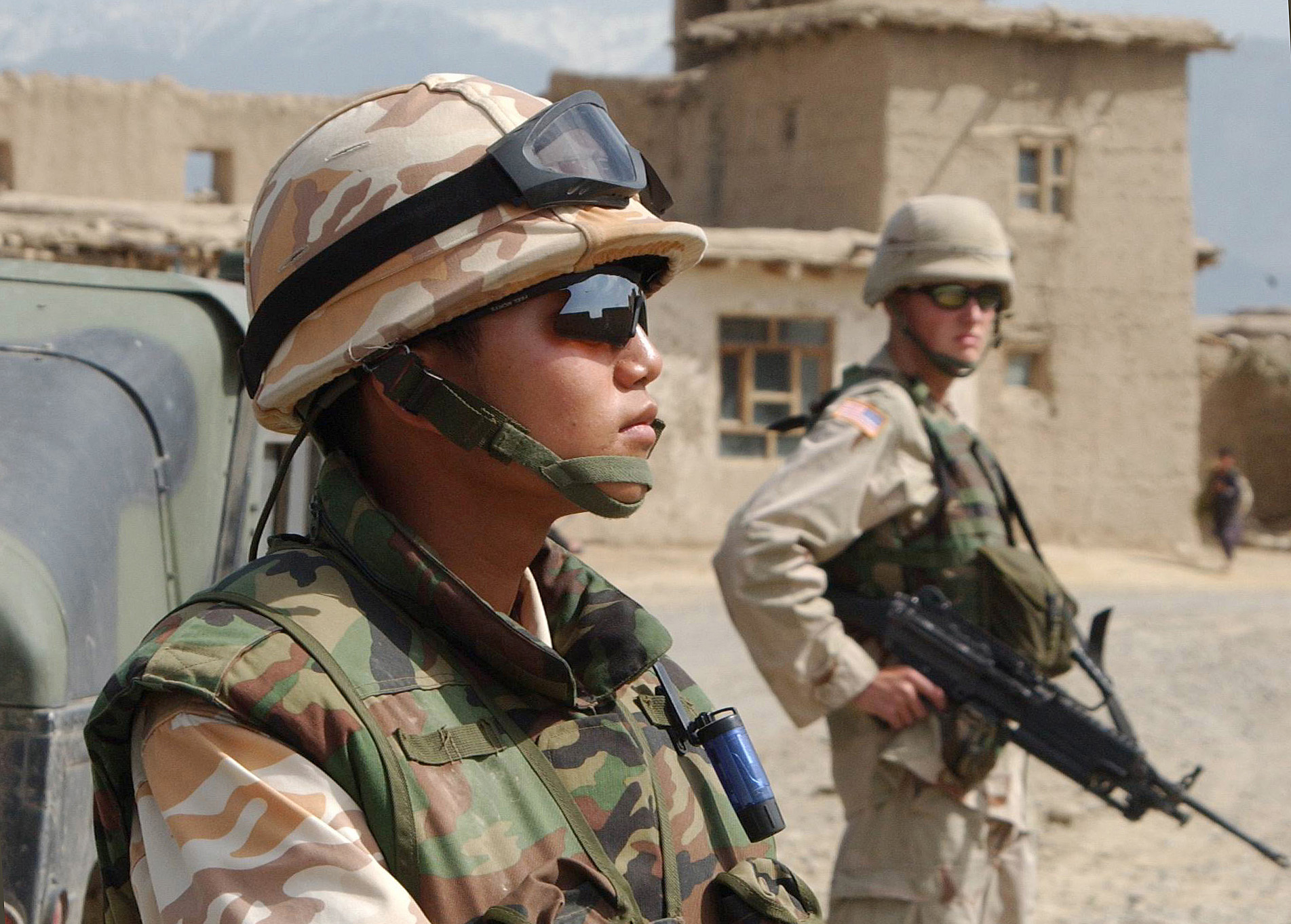
The Bangtan Helmet (Korean: 방탄 헬멧; Bangtan is Korean for "anti-ballistic" or "bulletproof") is a combat helmet developed by South Korea in 1971. Despite the name, the helmet was not designed to withstand against direct hitting bullets but to protect against heavy objects and bomb shrapnel–a standard for 1970s military world wide; though, it was one of the earliest military helmets that applied non-metal composite material to reduce the weight while increasing the protection. The name was given as a commemorate for being superior than the M1 helmet. The helmet configuration is based on the latest version of the M1.
Since the introduction of the New Type Bangtan Helmet (신형 방탄 헬멧), later known as KH-B2000, in 2003, the name gradually changed to Old Type Bangtan Helmet (구형 방탄 헬멧), and the helmet is phasing out from active service since 2004. There is no official model number given to the helmet, but the Ministry of Defense sometimes calls it a "nylon helmet", named after a material of the helmet.
The helmet is also known as the M76 by collectors.
In March 1971, an officer from the Joint Chiefs of Staff delivered an envelope marked with "emergency" to Dr. Han Pil-sun (한필순), one of the engineers of the Agency for Defense Development. When Dr. Han opened the envelope, there was a three-page pamphlet about the Orlite Israeli bulletproof helmet delivered from a military attaché in Israel. The helmet was tested by American weapons experiment company HP White Laboratory, and it was proven as equally protective as an American M1 helmet.
"If Israel can, so can we", Dr. Han believed, and borrowed 200 thousand KRW, which was five times his monthly wage, from his wife for his personal project that was not requested nor funded by the government. His team analyzed the pamphlet and related documents, and found that nylon was used as bulletproof material. Then Kim Eun-yeong (김은영), the head of chemical research department of KIST taught them adhesive materials and nylon processing techniques.
In early June, during the 1000th protection test–dropping 10 kg iron object with bullet-sized pointy end on the helmet from 1.3 m height–the team found that 7 layers of thick nylon and synthetic resin, which are compressed to remove air and extra liquid state synthetic resin, then solidified by heat treatment, has equal protection compared to M1 helmet while 8 layers provides better protection. Since Dr. Han lacked funding, he made a prototype with only 3 layers. When Song Heung-bin (송흥빈), the Director of Defense Industry of the Ministry of Defense, who had a huge influence in decision making of the budget, visited the ADD, he directed tests such as hitting the helmet with a sledgehammer and running over the helmet with a military Jeep and a 2½ ton military truck; the helmet survived without damage.
Upon hearing the news, O Won-cheol (오원철), the Second Senior Secretary for Economic Affairs, summoned Dr. Han to bring a sledgehammer and the helmet to the Blue House, which the sledgehammer caused trouble for Dr. Han during the security check. At the Blue House, O called a bulky security service and gave him the sledgehammer to slam the helmet with full strength, which made a dent on the helmet that even truck failed to do. Dr. Han initially thought he failed, but the helmet recovered its original shape after 1 minute. Impressed by the test, O authorized the budget to produce 300 samples.
The helmet was named Bangtan Helmet after easily passing the U.S. standard test. The Secretary O again tested the 8 layer helmet with military Jeep and sledgehammer; this time the helmet survived impact, and received a scratch on the paint. The technology was transferred to Oriental Industries (plastic manufacturer) and Silstar (fish rod manufacturer), and soon began the mass production.
Hub AI
Bangtan Helmet AI simulator
(@Bangtan Helmet_simulator)
Bangtan Helmet
The Bangtan Helmet (Korean: 방탄 헬멧; Bangtan is Korean for "anti-ballistic" or "bulletproof") is a combat helmet developed by South Korea in 1971. Despite the name, the helmet was not designed to withstand against direct hitting bullets but to protect against heavy objects and bomb shrapnel–a standard for 1970s military world wide; though, it was one of the earliest military helmets that applied non-metal composite material to reduce the weight while increasing the protection. The name was given as a commemorate for being superior than the M1 helmet. The helmet configuration is based on the latest version of the M1.
Since the introduction of the New Type Bangtan Helmet (신형 방탄 헬멧), later known as KH-B2000, in 2003, the name gradually changed to Old Type Bangtan Helmet (구형 방탄 헬멧), and the helmet is phasing out from active service since 2004. There is no official model number given to the helmet, but the Ministry of Defense sometimes calls it a "nylon helmet", named after a material of the helmet.
The helmet is also known as the M76 by collectors.
In March 1971, an officer from the Joint Chiefs of Staff delivered an envelope marked with "emergency" to Dr. Han Pil-sun (한필순), one of the engineers of the Agency for Defense Development. When Dr. Han opened the envelope, there was a three-page pamphlet about the Orlite Israeli bulletproof helmet delivered from a military attaché in Israel. The helmet was tested by American weapons experiment company HP White Laboratory, and it was proven as equally protective as an American M1 helmet.
"If Israel can, so can we", Dr. Han believed, and borrowed 200 thousand KRW, which was five times his monthly wage, from his wife for his personal project that was not requested nor funded by the government. His team analyzed the pamphlet and related documents, and found that nylon was used as bulletproof material. Then Kim Eun-yeong (김은영), the head of chemical research department of KIST taught them adhesive materials and nylon processing techniques.
In early June, during the 1000th protection test–dropping 10 kg iron object with bullet-sized pointy end on the helmet from 1.3 m height–the team found that 7 layers of thick nylon and synthetic resin, which are compressed to remove air and extra liquid state synthetic resin, then solidified by heat treatment, has equal protection compared to M1 helmet while 8 layers provides better protection. Since Dr. Han lacked funding, he made a prototype with only 3 layers. When Song Heung-bin (송흥빈), the Director of Defense Industry of the Ministry of Defense, who had a huge influence in decision making of the budget, visited the ADD, he directed tests such as hitting the helmet with a sledgehammer and running over the helmet with a military Jeep and a 2½ ton military truck; the helmet survived without damage.
Upon hearing the news, O Won-cheol (오원철), the Second Senior Secretary for Economic Affairs, summoned Dr. Han to bring a sledgehammer and the helmet to the Blue House, which the sledgehammer caused trouble for Dr. Han during the security check. At the Blue House, O called a bulky security service and gave him the sledgehammer to slam the helmet with full strength, which made a dent on the helmet that even truck failed to do. Dr. Han initially thought he failed, but the helmet recovered its original shape after 1 minute. Impressed by the test, O authorized the budget to produce 300 samples.
The helmet was named Bangtan Helmet after easily passing the U.S. standard test. The Secretary O again tested the 8 layer helmet with military Jeep and sledgehammer; this time the helmet survived impact, and received a scratch on the paint. The technology was transferred to Oriental Industries (plastic manufacturer) and Silstar (fish rod manufacturer), and soon began the mass production.