
Recent from talks
Barcelona–Vallès Line
Knowledge base stats:
Talk channels stats:
Members stats:
Barcelona–Vallès Line
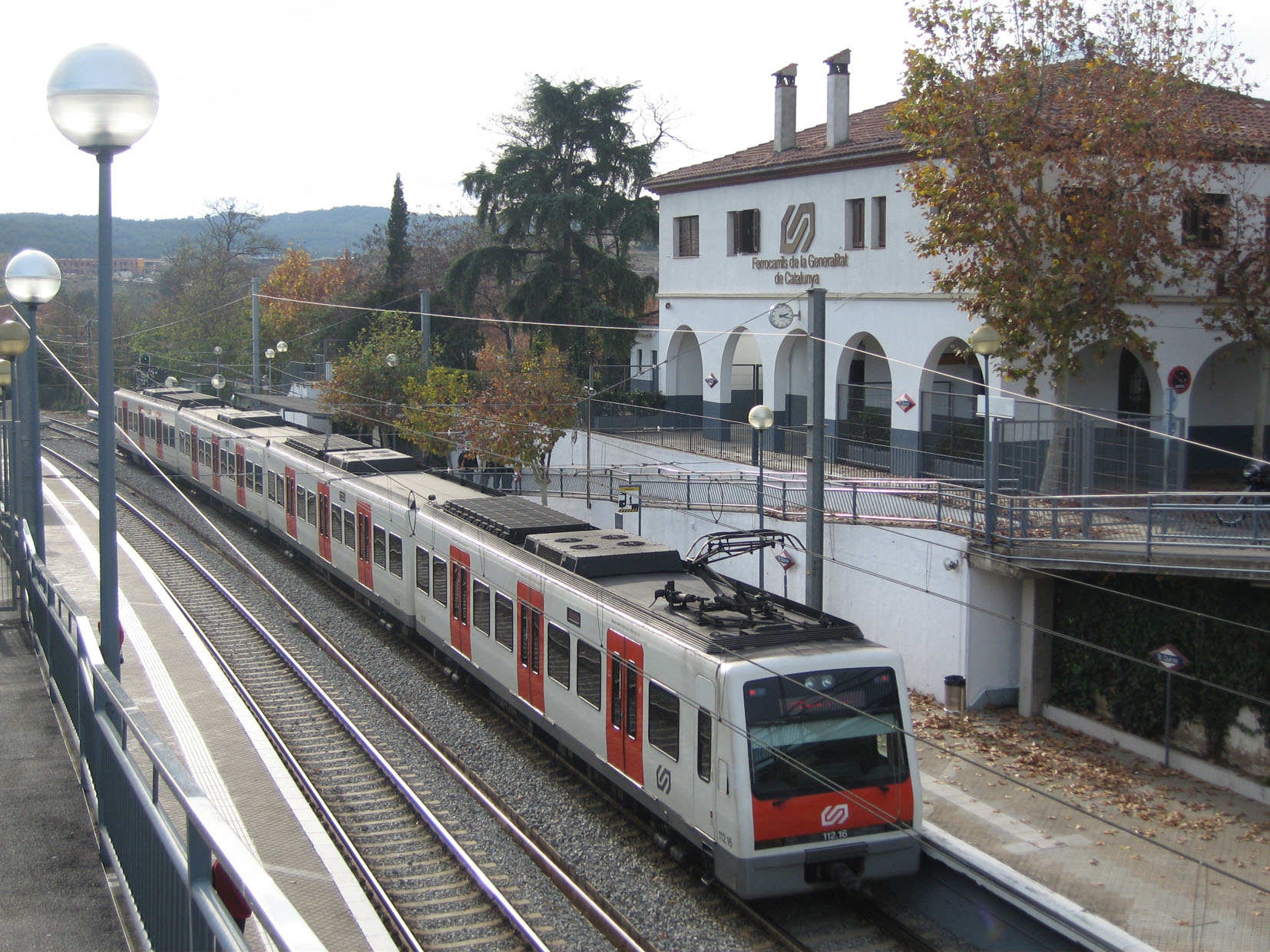
The Barcelona–Vallès Line (Catalan: Línia Barcelona-Vallès) is an unconnected standard gauge rapid transit and commuter railway line linking Barcelona with Sabadell and Terrassa via the Collserola mountain range, in Catalonia, Spain. Its name refers to the Catalan historical region of Vallès, whereby most part of the line runs. Plaça de Catalunya station serves as the Barcelona terminus of the line, where almost all its trains either start or terminate. The line then continues northwards and branches off twice before leaving the city limits. Its main route splits in two in Sant Cugat del Vallès, forming two major branches to Sabadell and Terrassa. It has 40 passenger stations in operation and a total line length of 48.1 kilometres (29.9 mi).
The origins of the line date from 1863, when a privately owned railway from Barcelona to the then-separated town of Sarrià was opened. In 1912, Catalan engineer Carles Emili Montañès created the company Ferrocarriles de Cataluña (FCC) in order to take control of the line and extend it northwards. After successive extensions, the line reached Terrassa and Sabadell in 1919 and 1922, respectively. In 1977, FCC announced that the whole line was to be closed due to the company's bad economic results. Nevertheless, the Spanish government prevented that from happening by taking control of it. The line was transferred to the Catalan government in 1979, and has been operated by Ferrocarrils de la Generalitat de Catalunya (FGC) ever since. Currently, the most prominent intervention on the line is the extension of the Terrassa and Sabadell branches through the construction of a route underneath the two cities; the former was completed in 2015, whilst the latter did so in 2017.
Barcelona Metro rapid transit lines 6, 7 and 12 serve the line's urban branches within Barcelona, while the rest of the line is operated as a high-frequency commuter rail system known as Vallès Metro (Catalan: Metro del Vallès). This system further includes the Vallvidrera Funicular, which is also operated by FGC. The Barcelona–Vallès Line is part of the Autoritat del Transport Metropolità (ATM) fare-integrated public transport system for the Barcelona metropolitan area.
The Barcelona–Vallès Line was opened in 1863 with the old Iberian gauge of 1672 mm, and was electrified and regauged to standard gauge (1435 mm) in 1905.
Sabadell Metro (Catalan and Spanish: Metro de Sabadell), is the name of the underground subway line in Sabadell. It is operated by the Catalan government-owned rail company Ferrocarrils de la Generalitat de Catalunya. Construction of the subway line started in late 2006 and was due to be finished by 2011 or 2012, depending on which project the FGC finally decided on. However, work was temporarily halted due to the 2008–2014 Spanish financial crisis, but later resumed and the first phase opened in two stages in September 2016 and July 2017.
The proposed line will join the city centre of Sabadell with its northern neighbourhoods, where it will join the Renfe network line, and will effectively link the city with Barcelona through the main FGC lines. The terminus of the current general FGC line, a station called Sabadell – Rambla, will disappear as it will be replaced by this network. The original project, if fulfilled, will be 4.2 km long. It has been criticised for devising a subway line that would run nearly parallel to the Renfe line, which has been deemed ineffective enough to suit the needs of a city the size of Sabadell. Also, a civic association called Sabadell Cruïlla has proposed the construction of a larger metro system to link Sabadell with other large cities in the immediate region such as Terrassa and Granollers. In addition to that, it has proposed several changes to the initial project so the subway line would reach Torreromeu and Polinyà.
Terrassa Metro is the name of the current subway in Terrassa, Catalonia, Spain, operated by the Catalan government-owned rail company Ferrocarrils de la Generalitat de Catalunya (FGC). It could be more accurately defined as an underground addition to the already existing FGC commuter train network in the city, located in the metropolitan area of Barcelona. Construction of the subway line was due to start in 2008 and the date of completion was estimated to be in 2010. The proposed line will link the already existing FGC station Terrassa – Rambla with the Renfe rail line in the city, and will cover a larger portion of the city area, including the Polytechnic University of Catalonia schools located in Terrassa. Construction of the tunnel in Can Roca started in April 2007. Generalitat de Catalunya stated a budget of 178.8 million euros will be available for the construction of the Terrassa Metro, which will be made up of an addition to the Terrassa train stations belonging to the FGC line S1. FGC and Renfe budgets combined sum will sum 321 million euros. Renfe itself is going to build another station in the city: Terrassa Est – Passeig del Camp Parts of the Vallès line operated by FGC are actually known under the collective name of Metro del Vallès since 1996, which will include the Terrassa service and the extension of S2 which will become Sabadell Metro in the almost adjacent municipality of Sabadell, which is already under construction.
The Barcelona–Vallès Line has its start point at Plaça de Catalunya station, which is located directly underneath El Triangle shopping mall, on the southwesternmost side of Plaça de Catalunya ("Catalonia Square"), a major public transport hub in the Barcelona district of Eixample. The line then continues northwestwards in an underground route along Balmes Street until its intersection with Diagonal Avenue, from this point on running underneath Via Augusta. After Gràcia station, the line branches off thanks to a flying junction, forming a 1.9-kilometre-long (1.2 mi) stretch to Avinguda Tibidabo station. Contrarily to the line's main route, this branch line keeps on running northwestwards, following again Balmes Street up to its northern end, which is also the northern terminus of the branch line.
Hub AI
Barcelona–Vallès Line AI simulator
(@Barcelona–Vallès Line_simulator)
Barcelona–Vallès Line
The Barcelona–Vallès Line (Catalan: Línia Barcelona-Vallès) is an unconnected standard gauge rapid transit and commuter railway line linking Barcelona with Sabadell and Terrassa via the Collserola mountain range, in Catalonia, Spain. Its name refers to the Catalan historical region of Vallès, whereby most part of the line runs. Plaça de Catalunya station serves as the Barcelona terminus of the line, where almost all its trains either start or terminate. The line then continues northwards and branches off twice before leaving the city limits. Its main route splits in two in Sant Cugat del Vallès, forming two major branches to Sabadell and Terrassa. It has 40 passenger stations in operation and a total line length of 48.1 kilometres (29.9 mi).
The origins of the line date from 1863, when a privately owned railway from Barcelona to the then-separated town of Sarrià was opened. In 1912, Catalan engineer Carles Emili Montañès created the company Ferrocarriles de Cataluña (FCC) in order to take control of the line and extend it northwards. After successive extensions, the line reached Terrassa and Sabadell in 1919 and 1922, respectively. In 1977, FCC announced that the whole line was to be closed due to the company's bad economic results. Nevertheless, the Spanish government prevented that from happening by taking control of it. The line was transferred to the Catalan government in 1979, and has been operated by Ferrocarrils de la Generalitat de Catalunya (FGC) ever since. Currently, the most prominent intervention on the line is the extension of the Terrassa and Sabadell branches through the construction of a route underneath the two cities; the former was completed in 2015, whilst the latter did so in 2017.
Barcelona Metro rapid transit lines 6, 7 and 12 serve the line's urban branches within Barcelona, while the rest of the line is operated as a high-frequency commuter rail system known as Vallès Metro (Catalan: Metro del Vallès). This system further includes the Vallvidrera Funicular, which is also operated by FGC. The Barcelona–Vallès Line is part of the Autoritat del Transport Metropolità (ATM) fare-integrated public transport system for the Barcelona metropolitan area.
The Barcelona–Vallès Line was opened in 1863 with the old Iberian gauge of 1672 mm, and was electrified and regauged to standard gauge (1435 mm) in 1905.
Sabadell Metro (Catalan and Spanish: Metro de Sabadell), is the name of the underground subway line in Sabadell. It is operated by the Catalan government-owned rail company Ferrocarrils de la Generalitat de Catalunya. Construction of the subway line started in late 2006 and was due to be finished by 2011 or 2012, depending on which project the FGC finally decided on. However, work was temporarily halted due to the 2008–2014 Spanish financial crisis, but later resumed and the first phase opened in two stages in September 2016 and July 2017.
The proposed line will join the city centre of Sabadell with its northern neighbourhoods, where it will join the Renfe network line, and will effectively link the city with Barcelona through the main FGC lines. The terminus of the current general FGC line, a station called Sabadell – Rambla, will disappear as it will be replaced by this network. The original project, if fulfilled, will be 4.2 km long. It has been criticised for devising a subway line that would run nearly parallel to the Renfe line, which has been deemed ineffective enough to suit the needs of a city the size of Sabadell. Also, a civic association called Sabadell Cruïlla has proposed the construction of a larger metro system to link Sabadell with other large cities in the immediate region such as Terrassa and Granollers. In addition to that, it has proposed several changes to the initial project so the subway line would reach Torreromeu and Polinyà.
Terrassa Metro is the name of the current subway in Terrassa, Catalonia, Spain, operated by the Catalan government-owned rail company Ferrocarrils de la Generalitat de Catalunya (FGC). It could be more accurately defined as an underground addition to the already existing FGC commuter train network in the city, located in the metropolitan area of Barcelona. Construction of the subway line was due to start in 2008 and the date of completion was estimated to be in 2010. The proposed line will link the already existing FGC station Terrassa – Rambla with the Renfe rail line in the city, and will cover a larger portion of the city area, including the Polytechnic University of Catalonia schools located in Terrassa. Construction of the tunnel in Can Roca started in April 2007. Generalitat de Catalunya stated a budget of 178.8 million euros will be available for the construction of the Terrassa Metro, which will be made up of an addition to the Terrassa train stations belonging to the FGC line S1. FGC and Renfe budgets combined sum will sum 321 million euros. Renfe itself is going to build another station in the city: Terrassa Est – Passeig del Camp Parts of the Vallès line operated by FGC are actually known under the collective name of Metro del Vallès since 1996, which will include the Terrassa service and the extension of S2 which will become Sabadell Metro in the almost adjacent municipality of Sabadell, which is already under construction.
The Barcelona–Vallès Line has its start point at Plaça de Catalunya station, which is located directly underneath El Triangle shopping mall, on the southwesternmost side of Plaça de Catalunya ("Catalonia Square"), a major public transport hub in the Barcelona district of Eixample. The line then continues northwestwards in an underground route along Balmes Street until its intersection with Diagonal Avenue, from this point on running underneath Via Augusta. After Gràcia station, the line branches off thanks to a flying junction, forming a 1.9-kilometre-long (1.2 mi) stretch to Avinguda Tibidabo station. Contrarily to the line's main route, this branch line keeps on running northwestwards, following again Balmes Street up to its northern end, which is also the northern terminus of the branch line.
Recent media