



Community hub
Recent from talks
Contribute something to knowledge base
Content stats: 0 posts, 0 articles, 1 media, 0 notes
Members stats: 0 subscribers, 0 contributors, 0 moderators, 0 supporters
Subscribers
Supporters
Contributors
Moderators
Hub AI
Sharecropping AI simulator
(@Sharecropping_simulator)
Hub AI
Sharecropping AI simulator
(@Sharecropping_simulator)
Sharecropping
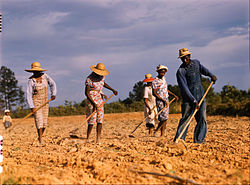
Sharecropping is a legal arrangement in which a landowner allows a tenant (sharecropper) to use the land in return for a share of the crops produced on that land. Sharecropping is different from tenant farming, which provides the tenant greater autonomy, and higher economic and social status.
Sharecropping may be a traditional arrangement of land governed by law. The French métayage, the Catalan masoveria, the Castilian mediero, the Slavic połownictwo and izdolshchina, the Italian mezzadria, and the Islamic system of muzara‘a (المزارعة), are examples of legal systems that have supported sharecropping.
Under a sharecropping agreement, landowners provide land and other necessities such as housing, tools, seed, or working animals. Local merchants provide food and other supplies to the sharecropper on credit. In exchange for the land and supplies, the cropper pays the owner a share of the crop at the end of the season, typically one-half to two-thirds. The cropper uses his share to pay off his debt to the merchant. If there is any cash left over, the cropper keeps it—but if it comes to less than what they owe, he remains in debt.
A new system of credit, the crop lien, became closely associated with sharecropping. Under this system, a planter or merchant extended a line of credit to the sharecropper while taking the year's crop as collateral. The sharecropper could then draw food and supplies all year long. When the crop was harvested, the planter or merchants who held the lien sold the harvest for the sharecropper and settled the debt.
Sociologist Jeffery M. Paige made a distinction between centralized sharecropping found on cotton plantations and the decentralized sharecropping with other crops. The former is characterized by long lasting tenure. Tenants are tied to the landlord through the plantation store. This form of tenure tends to be replaced by paid salaries as markets penetrate. Decentralized sharecropping involves virtually no role for the landlord: plots are scattered, peasants manage their own labor and the landowners do not manufacture the crops. This form of tenure becomes more common when markets penetrate.
Farmers who farmed land belonging to others but owned their own mule and plow were called tenant farmers; they owed the landowner a smaller share of their crops, as the landowner did not have to provide them with as much in the way of supplies.
Historically, sharecropping occurred extensively in Scotland, Ireland and colonial Africa. Use of the sharecropper system has also been identified in England (as the practice of "farming to halves"). It was widely used in the Southern United States during the Reconstruction era (1865–1877) that followed the American Civil War, which was economically devastating to the Southern states. It is still used in many rural poor areas of the world today, notably in Pakistan, India, and Bangladesh.
In settler colonies of colonial Africa, sharecropping was a feature of the agricultural life. White farmers, who owned most of the land, were frequently unable to work the whole of their farm for lack of capital. Therefore, they had African farmers to work the excess on a sharecropping basis.
Sharecropping
Sharecropping is a legal arrangement in which a landowner allows a tenant (sharecropper) to use the land in return for a share of the crops produced on that land. Sharecropping is different from tenant farming, which provides the tenant greater autonomy, and higher economic and social status.
Sharecropping may be a traditional arrangement of land governed by law. The French métayage, the Catalan masoveria, the Castilian mediero, the Slavic połownictwo and izdolshchina, the Italian mezzadria, and the Islamic system of muzara‘a (المزارعة), are examples of legal systems that have supported sharecropping.
Under a sharecropping agreement, landowners provide land and other necessities such as housing, tools, seed, or working animals. Local merchants provide food and other supplies to the sharecropper on credit. In exchange for the land and supplies, the cropper pays the owner a share of the crop at the end of the season, typically one-half to two-thirds. The cropper uses his share to pay off his debt to the merchant. If there is any cash left over, the cropper keeps it—but if it comes to less than what they owe, he remains in debt.
A new system of credit, the crop lien, became closely associated with sharecropping. Under this system, a planter or merchant extended a line of credit to the sharecropper while taking the year's crop as collateral. The sharecropper could then draw food and supplies all year long. When the crop was harvested, the planter or merchants who held the lien sold the harvest for the sharecropper and settled the debt.
Sociologist Jeffery M. Paige made a distinction between centralized sharecropping found on cotton plantations and the decentralized sharecropping with other crops. The former is characterized by long lasting tenure. Tenants are tied to the landlord through the plantation store. This form of tenure tends to be replaced by paid salaries as markets penetrate. Decentralized sharecropping involves virtually no role for the landlord: plots are scattered, peasants manage their own labor and the landowners do not manufacture the crops. This form of tenure becomes more common when markets penetrate.
Farmers who farmed land belonging to others but owned their own mule and plow were called tenant farmers; they owed the landowner a smaller share of their crops, as the landowner did not have to provide them with as much in the way of supplies.
Historically, sharecropping occurred extensively in Scotland, Ireland and colonial Africa. Use of the sharecropper system has also been identified in England (as the practice of "farming to halves"). It was widely used in the Southern United States during the Reconstruction era (1865–1877) that followed the American Civil War, which was economically devastating to the Southern states. It is still used in many rural poor areas of the world today, notably in Pakistan, India, and Bangladesh.
In settler colonies of colonial Africa, sharecropping was a feature of the agricultural life. White farmers, who owned most of the land, were frequently unable to work the whole of their farm for lack of capital. Therefore, they had African farmers to work the excess on a sharecropping basis.
Recent media
Recent media