Recent from talks
Nothing was collected or created yet.
Barney Kessel
View on Wikipedia
Key Information
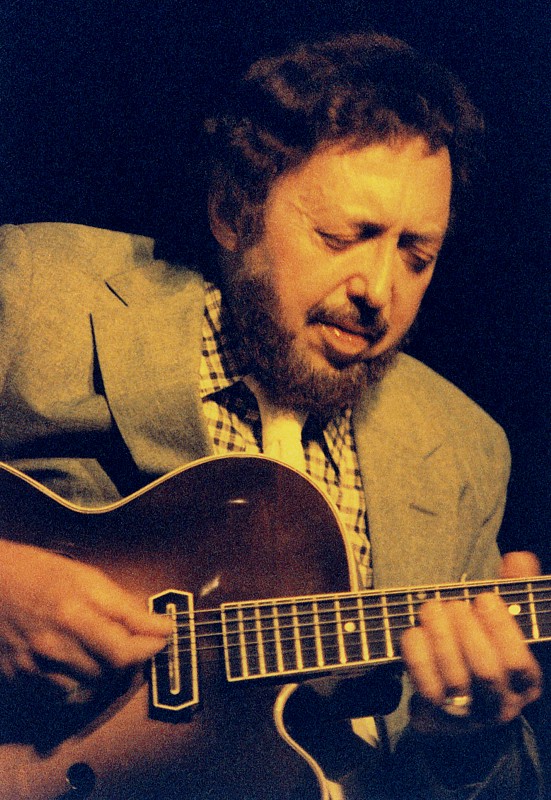
Barney Kessel (October 17, 1923 – May 6, 2004) was an American jazz guitarist. Known in particular for his knowledge of chords and inversions and chord-based melodies, he was a member of many prominent jazz groups as well as a "first call" guitarist for studio, film, and television recording sessions. Kessel was a member of the group of session musicians informally known as the Wrecking Crew.
Early life
[edit]
Kessel was born in Muskogee, Oklahoma in 1923 to a Jewish family.[2] Kessel's father was an immigrant from Hungary who owned and operated a shoe shop.[3] A self-taught guitarist, his only formal musical study was three months of guitar lessons at the age of 12.[4][5]
Career
[edit]He began his career as a teenager, touring with local swing bands. When he was 16, he started playing with the Oklahoma A&M band, Hal Price & the Varsitonians. The band members nicknamed him "Fruitcake" because he practiced in excess of 16 hours per day. Kessel gained recognition due in part to his youth, and in part to being the only white musician playing in all-African-American bands at black clubs.[6]
In the early 1940s, he moved to Los Angeles, where for one year he was a member of the Chico Marx big band.[7] Noticed by Norman Granz, he appeared in the 1944 film Jammin' the Blues, which featured Lester Young.[7][8][5] Soon after, he played in the bands of Charlie Barnet and Artie Shaw.[8] During the day, he worked as a studio musician and at night played bop-oriented jazz in clubs.[7][5] In 1947, he recorded with Charlie Parker.[7] He worked in Jazz at the Philharmonic and for one year in the early 1950s he was a member of the Oscar Peterson trio.[7][8] After leaving the trio, he recorded several solo albums for Contemporary.[8] He recorded a series of albums with Ray Brown and Shelly Manne as The Poll Winners because the three of them often won polls conducted by Metronome and DownBeat magazines.[8] He was the guitarist on the album Julie Is Her Name (1955) by Julie London, which includes the standard "Cry Me a River", selling a million copies and demonstrated Kessel's chordal approach to guitar.[9]
During the 1960s, Kessel worked for Columbia Pictures and was a member of a band of session musicians known as The Wrecking Crew. At one point, after a two and a half hour session to record a one-chord song, "The Beat Goes On," Kessel is reported to have stood up and proclaimed, "Never have so many played so little for so much."[10] He recorded with pop acts such as The Monkees and The Beach Boys and with jazz musicians Sonny Rollins and Art Tatum.[7] Kessel played the iconic opening notes of the acclaimed Beach Boys' Pet Sounds album, on the track "Wouldn't It Be Nice." He played a 12-string hybrid mando-guitar, plugged directly into the recording console, at Brian Wilson's request.[11] Kessel eventually left studio work to concentrate on his jazz career both onstage and on records. Along with solo work, he formed the ensemble Great Guitars with Charlie Byrd and Herb Ellis.[7]
Kessel was rated the No. 1 guitarist in Esquire, DownBeat, and Playboy magazine polls between 1947 and 1960.[12]
From 1957 to 1958, Kay Musical Instrument Company manufactured the Kay Barney Kessel signature series guitars (models "Pro", "Artist" and "Jazz Special").
From 1961 to 1974, Gibson Guitars manufactured the Barney Kessel artist signature guitars in Standard and Custom models.[13]
Artistry and equipment
[edit]Jazz music educator Wolf Marshall said the style that Barney Kessel employed in his music was "the natural outgrowth of the electric guitar tone fostered by Charlie Christian and embraced by virtually every exponent of the post-Christian school". Kessel's signature "warm, clean timbre" was created with hollow-body arch-top electric guitars with the neck pickup activated, played through a tube combo amp. The guitar stylings of Barney Kessel were rooted in 1930s and 1940s jazz, and were influenced by the swing and bebop styles of that time. Kessel was also influenced by post-bop modal jazz, hard bop, and free jazz. Specifically, he named Charlie Parker, Pat Martino, Oscar Peterson, Lester Young and Django Reinhardt as influences on his playing style. Additionally, Kessel's music had a strong blues influence "in both chord- and single-note form". Kessel was known for his chord stylings and single-note solos. Throughout his career, Kessel primarily played a sunburst Gibson ES-350P that was built in either 1947 or 1948, which the guitarist modified extensively. He replaced the original pickup with a "Charlie Christian" bar pickup, replaced the original volume and tone knobs with those taken off of a record player, omitted the pickguard, and installed dot inlays to replace the original fingerboard. Throughout his career, Kessel used various models of combo amplifiers made by Fender, Gibson and Univox. He used a heavy-gauge rounded pick and used medium-gauge Darco-wound polished guitar strings.[14]
Personal life
[edit]Kessel was married four times. His first marriage was to Gail Genovia Farmer during the 1950s and 1960s, with whom he had two sons, Dan and David Kessel.[15] He was later married to singer and vocal contractor Betty Jane (BJ) Baker for 16 years, a union that ended in divorce in 1980.[16] Following a ten-year marriage to Joanne “Jo” Kessel, he married his fourth wife, Phyllis Kessel, who remained with him for the final 12 years of his life.[17]
His sons, Dan and David Kessel, became accomplished record producers and session musicians in their own right, working with prominent figures such as Phil Spector, John Lennon, and Leonard Cohen.[18]
Legacy and influence
[edit]Kessel is regarded as a pivotal figure in the evolution of jazz guitar, noted for his sophisticated chordal vocabulary and seamless integration of bebop language into the instrument's repertoire. His work with the "Poll Winners" trio and the Wrecking Crew solidified his reputation as one of the most versatile guitarists in American music history.[19]
- In 1999, he was inducted into the Oklahoma Jazz Hall of Fame, recognizing his contributions to the genre.
- He consistently topped the DownBeat, Metronome, and Playboy jazz polls throughout the 1950s.[17]
- His signature Gibson and Kay guitar models remain highly sought after by jazz guitarists and collectors for their unique tonal characteristics.[20]
Death
[edit]Kessel was in poor health after suffering a stroke in 1992, which effectively ended his career. 12 years later, he died from a brain tumor at his home in San Diego, California on May 6, 2004 at the age of 80.[21][22]
Discography
[edit]As leader
[edit]- Barney Kessel (Contemporary, 1954)
- To Swing or Not to Swing (Contemporary, 1955)
- Kessel Plays Standards (Contemporary, 1956)
- Easy Like (Contemporary, 1956)
- Music to Listen to Barney Kessel By (Contemporary, 1957)
- The Poll Winners with Shelly Manne, Ray Brown (Contemporary, 1957)
- The Poll Winners Ride Again! with Shelly Manne, Ray Brown (Contemporary, 1958)
- Modern Jazz Performances from Bizet's Opera Carmen (Contemporary, 1959)
- Some Like It Hot (Contemporary, 1959)
- Poll Winners Three! with Shelly Manne, Ray Brown (Contemporary, 1960)
- Exploring the Scene! with Shelly Manne, Ray Brown (Contemporary, 1960)
- Bossa Nova Plus Big Band (Reprise, 1961)
- El Tigre with Harold Land (Charlie Parker, 1962)
- Let's Cook! (Contemporary, 1962)
- Breakfast At Tiffany's (Reprise, 1962)
- Barney Kessel's Swingin' Party (Contemporary, 1963)
- Contemporary Latin Rhythms (Reprise, 1963)
- On Fire (Emerald, 1965)
- Kessel's Kit (RCA Victor, 1969)
- Reflections in Rome (RCA Victor, 1969)
- Hair Is Beautiful (Atlantic, 1969)
- Feeling Free (Contemporary, 1969)
- What's New... Barney Kessel? (Mercury, 1969)
- Guitarra (RCA Camden, 1970)
- Swinging Easy! (Black Lion, 1971)
- I Remember Django with Stephane Grappelli (Black Lion, 1971)
- Limehouse Blues with Stephane Grappelli (Freedom, 1972)
- Summertime in Montreux (Black Lion, 1973)
- Easy Moments with Carlo Pes (Gemelli, 1973)
- Two Way Conversation with Red Mitchell (Sonet, 1974)
- Barney (& Friends) Plays Kessel (Concord Jazz, 1975)
- Just Friends (Sonet, 1975)
- Blue Soul (Black Lion, 1975)
- Great Guitars with Charlie Byrd and Herb Ellis (Concord Jazz, 1975)
- The Poll Winners: Straight Ahead with Ray Brown, Shelly Manne (Contemporary, 1975)
- Poor Butterfly with Herb Ellis (Concord Jazz, 1977)
- Soaring (Concord Jazz, 1977)
- Live at Sometime (Trio, 1977)
- A Tribute to the Great Hollywood Stars with Junko Mine (Trio, 1977)
- By Myself (Victor, 1977)
- Great Guitars at the Winery with Charlie Byrd and Herb Ellis (Concord Jazz, 1980)
- Jellybeans with Bob Maize and Jimmie Smith (Concord Jazz, 1981)
- Solo (Concord Jazz, 1983)
- Great Guitars at Charlie's Georgetown (Concord Jazz, 1983)
- Spontaneous Combustion with Monty Alexander (Contemporary, 1987)
- Red Hot and Blues (Contemporary, 1988)
- Autumn Leaves (Black Lion, 1989)
- Great Guitars Live with Charlie Byrd and Herb Ellis (Concord 2001)
- Live at the Jazz Mill 1954 (Modern Harmonic, 2016)
- Live at the Jazz Mill 1954 Vol. 2 (Modern Harmonic, 2018)
As sideman
[edit]With The Beach Boys
- The Beach Boys Today! (Capitol Records, 1965)
- Pet Sounds (Capitol Records, 1966)
With Benny Carter
- Alone Together (Norgran, 1955)
- Cosmopolite (Norgran, 1956)
- Jazz Giant (Contemporary, 1958)
- Aspects (United Artists, 1959)
With The Coasters
- Riot in Cell Block Number 9 (Spark Records, 1954)
- One Kiss Led to Another (Atco, 1956)
- Down in Mexico (Atco, 1956)
- Young Blood (Atco, 1957)
- Searchin' (Atco, 1957)
With Sam Cooke
- Night Beat (RCA Victor, 1963)
- Ain't That Good News (RCA, 1964)
With Buddy DeFranco
- Generalissimo (Verve, 1959)
- Live Date (Verve, 1959)
- Bravura (Verve, 1959)
- Wailers (Verve, 1960)
With Harry Edison
- Sweets (Clef, 1956)
- Gee Baby, Ain't I Good to You (Verve, 1957)
With Billie Holiday
- Billie Holiday Sings (Clef, 1952)
- Billie Holiday (Clef, 1953)
- Billie Holiday (Clef, 1954)
- Billie Holiday at JATP (Clef, 1954)
- Music for Torching (Clef, 1956)
- Velvet Mood (Clef, 1956)
- Lady Sings the Blues (Clef, 1956)
- Body and Soul (Verve, 1957)
- Songs for Distingué Lovers (Verve, 1957)
- All or Nothing at All (Verve, 1958)
With Peggy Lee
- Things Are Swingin' (Capitol, 1958)
- I Like Men! (Capitol, 1959)
- Jump for Joy (Capitol, 1959)
- Then Was Then – Now Is Now! (Capitol, 1965)
With Dean Martin
- Dream with Dean (Reprise, 1964)
With Anita O'Day
- This Is Anita (Verve, 1956)
- Pick Yourself Up with Anita O'Day (Verve, 1957)
- Anita Sings the Winners (Verve, 1958)
- Anita O'Day Swings Cole Porter with Billy May (Verve, 1959)
- Trav'lin' Light (Verve, 1961)
With Oscar Peterson
- The Oscar Peterson Quartet (Verve, 1955)
- Romance: The Vocal Styling of Oscar Peterson (Verve, 1956)
With Lou Rawls
- Too Much! (Capitol, 1967)
With Shorty Rogers
- Martians Come Back! (Atlantic, 1956)
- Way Up There (Atlantic, 1957)
- Chances Are It Swings (RCA Victor, 1958)
- The Wizard of Oz and Other Harold Arlen Songs (RCA Victor, 1959)
With The Ronettes
- Presenting the Fabulous Ronettes (Philles, 1964)
With Pete Rugolo
- Out on a Limb (EmArcy, 1956)
- An Adventure in Sound: Reeds in Hi-Fi (Mercury, 1958)
- An Adventure in Sound: Brass in Hi-Fi (Mercury, 1958)
With Sonny & Cher
- Look at Us (Atco Records, 1965)
- In Case You're in Love (Atlantic Records, 1967)
With others
- Georgie Auld, In the Land of Hi-Fi with Georgie Auld and His Orchestra (EmArcy, 1955)
- Frankie Avalon, ...And Now About Mr. Avalon (Chancellor, 1961)
- Louis Bellson, Skin Deep (Norgran, 1953)
- Chet Baker, Albert's House (Beverly Hills, 1969)
- Johnny Burnette, Roses Are Red (Liberty, 1962)
- Cher, All I Really Want to Do (EMI Records, 1965)
- Roy Clark, Stringing Along with the Blues (Capitol, 1966)
- Buddy Collette, Man of Many Parts (Contemporary, 1956)
- Sonny Criss, Go Man (Imperial, 1956)
- Bobby Day, Rockin' With Robbin (Class, 1959)
- Sylvia Telles, Sylvia Telles U.S.A. (Philips, 1961)
- Dion DiMucci, Born to Be with You (Collectables, 1975)
- Roy Eldridge, Dale's Wail (Clef, 1953)
- Ella Fitzgerald, Ella Fitzgerald Sings the Cole Porter Songbook (Verve, 1956)
- Sam Fletcher, Sam Fletcher Sings "I Believe In You" (Vee-Jay, 1964)
- The Four Freshmen, The Four Freshmen and Five Guitars (Capitol, 1959)
- The Four Freshmen, More Four Freshmen and 5 Trombones (Capitol, 1964)
- Wardell Gray, Dexter Gordon, Sonny Criss, Jazz Concert West Coast (Savoy, 1956)
- Hampton Hawes, Four! (Contemporary, 1958)
- Woody Herman, Songs for Hip Lovers (Verve, 1957)
- Milt Jackson, Ballads & Blues (Atlantic, 1956)
- Gene Krupa and Buddy Rich, The Drum Battle (Verve, 1960)
- Julie London, Julie Is Her Name (Liberty, 1955)
- Oliver Nelson, Soulful Brass (Impulse!, 1968)
- Art Pepper and Zoot Sims, Art 'n' Zoot (Pablo, 1995)
- Jane Powell, Can't We Be Friends? (Verve, 1956)
- The Righteous Brothers, Back to Back (Philles, 1965)
- Sonny Rollins, Sonny Rollins and the Contemporary Leaders (Contemporary, 1958)
- Chan Romero, Hippy Hippy Shake (Del-Fi 45, 1959)
- Evie Sands, Any Way That You Want Me (Rev-Ola, 1970)
- Mel Tormé, Back in Town (Verve, 1959)
- Mel Tormé, That's All (Columbia, 1965)
- Mel Tormé, A Day in the Life of Bonnie and Clyde (Liberty, 1968)
- Ike & Tina Turner, River Deep – Mountain High (A&M, 1966)
- Joe Williams, With Love (Temponic, 1972)
Bibliography
[edit]- Kessel, Barney; Almeida, Laurindo; Heitmeyer, Howard; Hendrickson, Al; Pitman, Bill; Bain, Bob; Marshall, Jack; Roberts, Howard (1961). West Coast Guitar: Eight Original Solos for Guitar. New York: Leeds Music Corporation. ASIN B0080YPG16. OCLC 79391800.
- Kessel, Barney (1992). The Jazz Guitar Artistry of Barney Kessel: Guitar Solo. Ashley Mark Publishing. ISBN 978-0793516438.
- Kessel, Barney (1997). The Jazz Guitar Artistry of Barney Kessel, Vol. 2. Ashley Mark Publishing. ISBN 978-0793587056.
- Kessel, Barney (2000). The Jazz Guitar Artistry of Barney Kessel, Vol. 3. Ashley Mark Publishing. ISBN 978-0634023231.
- Summerfield, Maurice J.; Kessel, Barney (2008). Barney Kessel: A Jazz Legend. Ashley Mark Publishing. ISBN 978-1872639697.
- Marshall, Wolf; Kessel, Barney (2009). Barney Kessel: A Step-by-Step Breakdown of His Guitar Styles and Techniques. Hal Leonard Corporation. ISBN 978-1423430476.
References
[edit]- ^ This is bebop guitar Jazzweekly.com Retrieved 11 August 2025
- ^ "About Barney Kessel". exhibits.library.umkc.edu. Retrieved March 22, 2023.
- ^ Bernstein, Adam (May 10, 2004). "Barney Kessel, 80". Washington Post. ISSN 0190-8286. Retrieved February 27, 2022.
- ^ Leonard Feather (1999). The biographical encyclopedia of jazz. Oxford University Press. p. 383. ISBN 978-0-19-507418-5.
- ^ a b c Yanow, Scott (April 1, 2013). The Great Jazz Guitarists. Backbeat Books. p. 108.
- ^ Oliver, Myrna (May 9, 2004). "Barney Kessel, 80, innovative jazz guitarist". The Boston Globe.
- ^ a b c d e f g Yanow, Scott (2013). The Great Jazz Guitarists. San Francisco: Backbeat. pp. 108–109. ISBN 978-1-61713-023-6.
- ^ a b c d e Yanow, Scott. "Barney Kessel". AllMusic. Retrieved September 24, 2019.
- ^ Larkin, Colin, ed. (1993). The Guinness Who's Who of Fifties Music. Guinness. p. 210. ISBN 0-85112-732-0.
- ^ Hartman, Kent (2012). The Wrecking Crew (1st ed.). New York: St. Martin's Press. p. 163. ISBN 9780312619749.
- ^ Kubernik, Harvey. "Brian Wilson: 50 Years Of Pet Sounds". vintagerock.com. Retrieved May 4, 2023.
- ^ "Barney Kessel". June 12, 2004. Retrieved July 16, 2008.
- ^ "Gibson and Barney Kessel". Premierguitar.com. July 11, 2007. Retrieved July 29, 2021.
- ^ Marshall, Wolf (2012). Jazz Guitar Icons. Hal-Leonard. p. 63.
- ^ "About Barney Kessel". University of Missouri-Kansas City. Retrieved December 28, 2025.
- ^ Oliver, Myrna (May 9, 2004). "Barney Kessel, 80; Key Guitarist of the Wrecking Crew". Los Angeles Times. Retrieved December 28, 2025.
- ^ a b Bernstein, Adam (May 10, 2004). "Barney Kessel, 80, Jazz Guitarist". The Washington Post. Retrieved December 28, 2025.
- ^ Brown, Mick (2008). Tearing Down the Wall of Sound: The Rise and Fall of Phil Spector. Vintage Books. p. 214. ISBN 978-1400076611.
- ^ Yanow, Scott. "Barney Kessel Biography". AllMusic. Retrieved December 28, 2025.
- ^ "Gibson Barney Kessel". Vintage Guitar Magazine. Retrieved December 28, 2025.
- ^ Keepnews, Peter (May 8, 2004). "Barney Kessel, 80, a Guitarist With Legends of Jazz, Dies". The New York Times.
- ^ Yanow, Scott (April 1, 2024). The Great Jazz Guitarists. Backbeat Books.
External links
[edit]- Barney Kessel at AllMusic
- Barney Kessel discography at Discogs
- Barney Kessel at IMDb
- "Barney Kessel Jazz Scene USA (1962)" on YouTube
- "Barney Kessel". Archived from the original on December 10, 2007. Retrieved October 17, 2006.
- "Barney Kessel". Find a Grave. Retrieved August 10, 2010.
- Barney Kessel Interview at NAMM Oral History Collection (1999)
- Barney Kessel Signature Phrases & Analysis
Barney Kessel
View on GrokipediaEarly Life
Childhood and Family Background
Barney Kessel was born on October 17, 1923, in Muskogee, Oklahoma, to a Jewish family; his father was a Hungarian immigrant who owned a shoe shop in the local community.[1][4][5] The Kessel family lived in a working-class household during the Great Depression, residing in Muskogee's African American business and entertainment district, which exposed young Barney to a vibrant cultural milieu.[6] His mother played a supportive role in fostering his budding interests, particularly by encouraging commitment to new pursuits rather than casual dabbling.[7] Non-musical childhood activities included working as a ticket taker at local venues and delivering newspapers on a paper route, which provided both pocket money and early glimpses into the world beyond home.[6][8] Kessel received a basic education in Muskogee but left school at age 14 to focus on professional opportunities. In 1942, at age 19, he relocated to Los Angeles, marking a significant shift from rural Oklahoma life to the bustling urban environment of California, where he began adjusting to new surroundings.[1] This transition marked a significant shift from his Oklahoma roots to the West Coast jazz scene.Musical Beginnings and Influences
Barney Kessel acquired his first guitar at the age of 12 in Muskogee, Oklahoma, purchasing it for a dollar with savings from his paper route.[9] His only formal training consisted of three months of guitar lessons at age 12.[4] Largely self-taught thereafter, he honed his skills by listening to radio broadcasts and records, imitating the styles he heard without sustained formal lessons.[10] Kessel's formative influences included pioneering jazz guitarists such as Django Reinhardt, whose virtuosic gypsy jazz inspired his technical approach,[11] Les Paul, known for innovative electric guitar techniques,[12] and Charlie Christian, whose blend of blues and swing profoundly shaped Kessel's early sound.[13] These artists fueled Kessel's growing fascination with swing rhythms and the complexities of bebop, bridging traditional jazz forms with modern improvisation.[14] By his early teens, Kessel was performing in local Oklahoma bands, leaving school at age 14 to dedicate himself fully to music, with his family's encouragement supporting this transition from childhood pursuits.[15] At 16, he jammed with Charlie Christian for three days during a visit to Oklahoma City, further solidifying his commitment to jazz.[13] Soon after moving to Los Angeles as a teenager, Kessel immersed himself in the Central Avenue jazz scene, sitting in at clubs that served as vital incubators for West Coast jazz talent.[13]Career
Early Professional Work
Kessel began his professional career as a teenager in Oklahoma, leaving school at age 14 to play with local bands such as Ellis Ezell's group in 1937, where he quickly gained recognition for his guitar skills. By age 16 in 1939, he was performing one-nighters with the University of Oklahoma dance band and Hal Price & the Varsitonians, marking his transition from amateur to paid engagements. These early experiences honed his abilities amid the swing era's vibrant scene, influenced briefly by figures like Django Reinhardt and Charlie Christian.[16][17][4] In the early 1940s, Kessel relocated to Los Angeles, initially supporting himself as a dishwasher while seeking opportunities in the city's thriving jazz district on Central Avenue. He soon secured steady work through the local musicians' union, performing on radio broadcasts and in clubs, which exposed him to West Coast jazz circles. His breakthrough came in 1943 when he joined Chico Marx's big band for a year, achieving his first national airplay through live performances. This period solidified his reputation as a versatile session player amid the wartime swing boom.[18][17][8] Kessel's recording debut occurred in 1944, featuring on tracks like "Skyliner" with jazz ensembles that showcased his emerging bop-inflected style. That same year, he made his mark in Hollywood by appearing as the only white musician in the influential short film Jammin' the Blues, directed by Gjon Mili, alongside Lester Young, Illinois Jacquet, and Harry Edison—his hands reportedly stained with berry juice for close-ups to blend visually. These sessions highlighted his adaptability in integrated settings during a segregated era. By 1945, he collaborated with Artie Shaw's orchestra on recordings such as "Jumpin' on the Merry-Go-Round," followed by stints with Charlie Barnet through 1947. In late 1946, Kessel joined Benny Goodman's band, contributing to live and recorded performances that bridged swing and postwar jazz. Postwar, he resumed prolific session work in Los Angeles, balancing club dates with studio commitments that laid the foundation for his enduring career.[19][20][13][8]Major Collaborations and Groups
Kessel's tenure with the Oscar Peterson Trio from 1951 to 1953 marked a significant chapter in his career, during which he contributed guitar to numerous studio recordings on the Clef and Mercury labels, including sessions captured in Los Angeles on November 25, 1951, featuring tracks like "Turtle Neck" and "It's Easy to Remember."[21] The trio, completed by pianist Oscar Peterson and bassist Ray Brown, toured Europe in 1952 as part of Jazz at the Philharmonic, performing at prestigious venues such as the Salle Pleyel in Paris and earning acclaim for their swinging interpretations of standards.[15] These live and studio efforts showcased Kessel's chordal sophistication and melodic interplay, solidifying his reputation within the bop-oriented jazz scene.[22] Earlier, in 1947, Kessel participated in seminal recording sessions with alto saxophonist Charlie Parker for the Dial label, providing rhythmic and harmonic support on tracks such as "Relaxin' at Camarillo" and "Little Willie Leaps," which highlighted Parker's innovative bebop phrasing against Kessel's clean, supportive guitar lines.[1] This collaboration bridged Kessel's West Coast roots with the East Coast avant-garde, influencing his approach to improvisation in high-profile ensembles. Throughout the 1950s, Kessel forged enduring partnerships with drummer Shelly Manne and pianist André Previn, most notably on the 1956 Contemporary Records album Music to Listen to Barney Kessel By, where the trio explored standards like "Cheerful Little Earful" and "Makin' Whoopee" with a cool, West Coast sensibility that emphasized space and subtlety.[23] These sessions extended to joint ventures like the 1959 adaptation of Bizet's Carmen, blending classical motifs with jazz improvisation, and reflected Kessel's versatility in small-group settings.[24] By the 1960s, Kessel's studio prowess led him to join the Wrecking Crew, an elite collective of Los Angeles session musicians, where he contributed guitar to pop and rock recordings, including pioneering the use of the 12-string guitar on the Crystals' 1963 hit "Then He Kissed Me" for Phil Spector.[25] As a Wrecking Crew member, Kessel played on numerous film scores during the 1950s and 1960s, including Elvis Presley vehicles such as Girls! Girls! Girls! (1962), featuring his work on "Return to Sender," and Orson Welles' Touch of Evil (1958), where his subtle chord voicings enhanced the noir atmosphere.[8] [26] In the mid-1950s, Kessel formed his own quartet, often featuring pianists like Hampton Hawes or André Previn alongside bassists Red Mitchell and drummers like Shelly Manne, which allowed him to lead explorations of the Great American Songbook on albums such as The Poll Winners (1957) with Manne and Ray Brown.[27] This ensemble facilitated international performances, including European tours with Jazz at the Philharmonic and early visits to Japan in the late 1950s and early 1960s, where Kessel's fluid style resonated with emerging jazz audiences, paving the way for his later global acclaim.[28]Later Career and Session Work
In the 1970s, Barney Kessel shifted his focus toward jazz performance and recording while continuing extensive session work in Los Angeles studios, primarily from the 1960s but extending into the decade with artists like the Beach Boys on albums such as Pet Sounds (1966) and related sessions, where his guitar work helped define the era's pop-jazz fusion.[29] His work with Elvis Presley, primarily from the 1950s and 1960s, remained a highlight of his session legacy, but he maintained a busy studio schedule into the 1970s with diverse genres.[20] A significant development was Kessel's formation of the Great Guitars ensemble in 1973 alongside Herb Ellis and Charlie Byrd, leading to international tours and multiple live albums on Concord Jazz. The group performed extensively in the United States and Europe, including a notable 1976 European tour that produced recordings capturing their swinging, chord-rich interplay.[30][20] Kessel also presented his seminar "The Effective Guitarist" worldwide during this period, emphasizing practical techniques for aspiring players in locations across Europe and beyond.[31] Throughout the 1980s, Kessel balanced ongoing session contributions with jazz leadership, releasing albums like Solo in 1983 and Spontaneous Combustion in 1987 with pianist Monty Alexander. He toured internationally, including performances in Japan and Europe, where his sophisticated harmonic approach resonated with global audiences. Red Hot and Blues, recorded in 1988, showcased his blues-inflected style on tracks like "Blues for Bird," marking a late-career highlight on Contemporary Records.[20][32] By the 1990s, health issues prompted semi-retirement, with Kessel limiting performances after a 1992 stroke that affected his playing ability. He resided in San Diego, California, focusing on teaching and occasional appearances, including tributes like the 1997 JVC Jazz Festival concert in New York honoring his contributions. Final recordings from this era included select tracks before his full withdrawal from active performance.[20][33]Artistry
Playing Style and Technique
Barney Kessel was renowned for his mastery of the chord-melody style, in which he seamlessly blended intricate single-note lines with complex harmonic voicings, allowing him to accompany melodies while simultaneously improvising rich counterpoints. This approach, often executed with a fluid integration of block chords and melodic embellishments, showcased his deep understanding of jazz harmony and enabled solo performances that evoked the fullness of an ensemble. His versatility in this technique earned him the enduring nickname "Mr. Guitar," reflecting his ability to navigate diverse musical contexts from intimate ballads to upbeat standards with equal finesse.[34][12][35] Kessel's adaptation of bebop to the electric guitar marked a significant evolution, incorporating rapid phrasing, chromatic runs, and octave playing that drew heavily from the influence of Charlie Christian, whom he idolized and emulated in his early development. By expanding on Christian's horn-like single-note lines and blues-inflected ideas, Kessel infused bebop's angular rhythms and substitutions into guitar solos, making the instrument more agile and expressive within fast-paced improvisations. This technique was particularly evident in his work with groups like the Oscar Peterson Trio, where his precise articulation and dynamic phrasing bridged swing-era roots with modern jazz complexities.[36][12][37] As a studio innovator, Kessel was among the first to experiment with overdubbing and multi-tracking on guitar recordings, layering multiple parts to create orchestral textures from a single instrument, a method he explored extensively in his solo albums during the 1950s and beyond. His style evolved from the swinging, groove-oriented phrasing of his swing-era beginnings. In trio settings, like his acclaimed Poll Winners recordings with Ray Brown and Shelly Manne, critics praised his clean, luminous tone and improvisational fluency, noting the crisp intensity of his up-tempo lines and the melting lyricism of his ballads, which maintained rhythmic pocket and harmonic sophistication throughout.[38][13][39]Signature Equipment
Barney Kessel relied primarily on Gibson ES-350 archtop guitars from the late 1940s onward, favoring their warm, resonant tone for jazz applications. He owned two such instruments—likely 1946 or 1947 Premier models—which he customized extensively for session reliability, including relocating the volume and tone controls closer together and installing "chicken head" knobs for quick adjustments during live and studio work.[40] Kessel replaced the stock P-90 pickups on his ES-350s with single-coil Gibson ES-150 "Charlie Christian" pickups, praising the latter's unique alloy magnet for its irreplaceable warmth and clarity. He paired these with flatwound strings to promote smooth sustain and reduced finger noise, essential for his intricate chord-melody work. One ES-350 featured a modified 20-fret ebony fretboard to resist sweat buildup and prolong string life during long sessions, while the other included a 22-fret neck extension for expanded range.[40] In orchestral and big-band rhythm roles, such as sessions with Barbra Streisand and Elvis Presley, Kessel employed 1930s Gibson L-5 archtops for their acoustic projection and stability. Although Gibson introduced signature Barney Kessel models (Regular and Custom) from 1961 to 1972, he rarely used them due to a strained relationship with the company and continued favoring his personalized ES-350s. This gear evolution supported his chordal style by providing versatile, feedback-resistant tone without effects pedals.[40][41]Personal Life
Family and Relationships
Kessel's first marriage, which took place in the late 1940s or early 1950s, resulted in the birth of his two sons, Dan and David, both of whom later pursued careers as record producers.[1][13] The demands of his early touring schedule created challenges in family life, as he noted in a 1970s interview that after being away for extended periods, the "normal complexities" of fatherhood prompted him to prioritize time at home with his young children over continued road work.[42] His second marriage was to singer and vocal contractor Betty Jane "B.J." Baker in 1961; the union lasted until their divorce in 1980, during which time Baker helped raise Kessel's sons from his first marriage.[1][43] Kessel maintained a friendly relationship with Baker after their separation, including bonds with her children from a previous marriage, Tim and Mickey Rooney Jr.[1] Kessel's third marriage was to Joanne "Jo" Kessel, an Oklahoma schoolteacher, which lasted approximately ten years in the 1980s.[13] His fourth and final marriage was to Phyllis Van Doren, a lifestyle magazine editor and jazz enthusiast, in 1992; they settled in San Diego, California, where she provided care during his later health struggles and accompanied him on personal travels until his death in 2004.[1][44][13] This home life in San Diego offered Kessel a stable base amid his ongoing musical commitments, allowing him to balance occasional performances with family support.[13][8]Health Challenges
In the early 1990s, Barney Kessel faced a significant health setback when he suffered a massive stroke in May 1992, which resulted in partial paralysis on his right side and initial loss of speech, severely limiting his physical abilities.[45][46] The stroke left his mouth slightly drooped and his right side permanently affected, though his memory remained intact.[45][20] Kessel underwent extensive rehabilitation, including years of intensive speech therapy and physical exercises, supported by his wife, Phyllis, who helped him regain limited speech and some writing capability.[45][47] Through persistent efforts, he achieved a degree of communication, though it was not as clear or fluid as before, allowing him to express himself in a more private capacity.[45] In the years following the stroke, Kessel became increasingly dependent on caregivers, including paid aides, local volunteers from the guitar community, and support from international fans, as he required assistance for daily activities over the subsequent 12 years.[45] This dependency marked a profound shift to a more secluded life in San Diego, where he resided with Phyllis, focusing on limited teaching and occasional travel with aid rather than public engagements.[45][48] The health challenges took a heavy emotional toll on his family, particularly Phyllis, who described the period of caregiving from 1992 until his death as "some of the most difficult times of my life," while balancing her own health issues and professional responsibilities.[45] Despite these struggles, the couple's bond provided a foundation for Kessel's adjusted routine in their San Diego home.[45]Death and Legacy
Final Years and Death
Following his debilitating stroke in 1992, Barney Kessel resided at his home in San Diego, California, with his wife, Phyllis, where he received care amid his long-term health decline. Unable to perform, he made only limited public appearances, such as speaking at a 1997 tribute concert during the JVC Jazz Festival in New York and a 2002 benefit concert in his honor at Birdland.[20] Kessel died on May 6, 2004, at the age of 80, from complications of a malignant brain tumor first diagnosed in November 2001.[46][48] Funeral services were held privately, with burial taking place later that month at Woodlawn Cemetery in Canandaigua, New York. Kessel's wife, Phyllis, confirmed the cause of death to the press and, on behalf of the family—which included two sons from a previous marriage, three stepchildren, and five grandchildren—requested donations to jazz education programs in lieu of flowers.[20] Upon his passing, the jazz community issued immediate tributes in major publications, with The New York Times describing him as "a celebrated jazz soloist and a ubiquitous but anonymous studio musician" whose work spanned decades, and The Los Angeles Times hailing him as "one of the most influential jazz guitarists of the 20th century."[46][48]Influence and Recognition
Barney Kessel's pioneering adoption of the electric guitar in jazz, building on Charlie Christian's innovations, played a pivotal role in establishing it as a lead instrument in the genre, transitioning from rhythm accompaniment to melodic and harmonic forefront. His chord-based melodies and improvisational fluency influenced a lineage of jazz guitarists, including John McLaughlin, Pat Metheny, John Scofield, and later figures like Charlie Hunter, who drew from his versatile, swinging style in trio and ensemble settings.[49][50] During his lifetime, Kessel received widespread acclaim as a top guitarist, topping polls in Down Beat (1956–1959), Esquire, and Playboy magazines from 1947 to 1960, reflecting his dominance in jazz circles. He was inducted into the Oklahoma Jazz Hall of Fame in 1991 and the Oklahoma Music Hall of Fame in 1999, honoring his contributions to jazz and session work. Additionally, he earned a Lifetime Achievement Award from the San Diego Music Awards in 2000 and served as a U.S. State Department Cultural Ambassador.[6][48][51][3][13][52] Following his death in 2004, Kessel's legacy endured through posthumous tributes, including features in the documentary series The Guitar in Jazz (Episode 4, focusing on his and Herb Ellis's techniques) and centennial celebrations marking the 100th anniversary of his birth in 2023, with ongoing tributes such as 2024-2025 performances by protégés like Bruce Forman and Pat Bergeson. Archival reissues, such as the 2021 two-CD set The Contemporary Years: Selected Recordings 1953-57 compiling his early leader albums, renewed interest in his catalog. Academic recognition came via the University of Missouri-Kansas City's 2010s exhibit of his personal manuscripts and etudes, highlighting his pedagogical impact on guitar technique.[53][36][54][55]Discography
Albums as Leader
Kessel's tenure as a bandleader began prominently in the mid-1950s with releases on Contemporary Records, where he explored jazz standards through intimate trio and quartet configurations, emphasizing his clean tone, harmonic sophistication, and rhythmic drive. An early album in this capacity, To Swing or Not to Swing (1955), featured the guitarist at the helm of a quartet including pianist Claude Williamson, bassist Red Mitchell, and drummer Shelly Manne, delivering inventive takes on tunes like "Tenderly" and "Speak Low" that balanced lyrical introspection with bop-inflected improvisation. This recording, produced by Les Koenig, marked Kessel's emergence as a interpretive force on the electric guitar, prioritizing melodic flow over virtuosic flash.[56] Building on this foundation, Music to Listen to Barney Kessel By (1957) showcased Kessel in a more relaxed trio setting with bassist George Duvivier and drummer Shelly Manne, interpreting a mix of standards and originals such as "Makin' Whoopee" and "Blues for a Playboy." Recorded across sessions in 1956 and produced by Koenig, the album highlighted Kessel's ability to evoke a lounge-like swing while incorporating subtle chordal explorations, reflecting the cool jazz aesthetic prevalent in West Coast scenes. Its thematic focus on accessible yet sophisticated listening experiences underscored Kessel's versatility in blending entertainment with artistic depth.[57] A cornerstone of Kessel's leadership discography was the Poll Winners series (1957–1960), co-led with bassist Ray Brown and drummer Shelly Manne, which capitalized on their consecutive victories in DownBeat magazine's critics' polls for their respective instruments. The inaugural volume, The Poll Winners (1957), featured trio renditions of standards like "Jordu" and "Satin Doll," produced by Koenig and emphasizing seamless interplay and up-tempo swing that defined the group's chemistry. Follow-ups The Poll Winners Ride Again! (1958) and Poll Winners Three! (1960) expanded this format with adventurous arrangements of jazz staples and originals, such as "It Could Happen to You" and "My Funny Valentine," maintaining a focus on collective improvisation while allowing Kessel's single-note lines to shine; these albums, totaling over 30 tracks across the series, solidified the trio's reputation for polished, high-energy performances. The production emphasized live-like energy in studio settings, with minimal overdubs to capture their poll-winning synergy. In the late 1960s, amid shifting jazz landscapes, Kessel revisited his leadership role with Feeling Free (1969), a Contemporary release that introduced experimental elements through a quintet featuring vibraphonist Bobby Hutcherson, pianist Bill Mays, bassist Chuck Domanico, and drummer Elvin Jones. Produced by Koenig, the album incorporated bossa nova rhythms and covers of contemporary hits like "This Guy's in Love with You," alongside originals such as "Moving Up," marking a departure from strict standards toward fusion-tinged grooves while retaining Kessel's signature warmth.[58] This work reflected his adaptive phase, blending post-bop structures with broader influences to appeal to evolving audiences.[59] Kessel's output as leader extended well into the 1970s and beyond, encompassing over 20 albums across labels like Black Lion, Sonet, and Concord, often in trio formats that revisited standards with fresh perspectives or delved into experimental territories. Notable later efforts include Summertime in Montreux (1973), a live trio recording capturing his swinging interpretations during a European tour, and explorations in the 1980s that highlighted his enduring command of the guitar in collaborative yet leader-driven contexts.[60] These releases underscored thematic evolutions from traditional standards to more improvisational and genre-blending phases, with production notes often prioritizing acoustic intimacy or live vitality to preserve his improvisational spark.Key Sideman Appearances
Barney Kessel's career as a sideman spanned decades, encompassing over 300 recording credits where he provided guitar work across jazz, pop, and studio sessions.[61] His contributions ranged from intricate solos and rhythmic foundations to occasional arrangement suggestions, showcasing his versatility in supporting lead artists while elevating ensemble dynamics.[16] In the late 1940s, Kessel made pivotal appearances in the bebop scene, notably on Charlie Parker's 1947 Dial Records session for tracks including "Cool Blues," where he delivered supportive guitar lines alongside Miles Davis on trumpet and Dodo Marmarosa on piano.[62] This recording highlighted Kessel's early ability to integrate chordal complexity into high-speed bebop rhythms, complementing Parker's alto saxophone innovations.[63] During the 1950s and early 1960s, Kessel joined forces with pianist Oscar Peterson, contributing guitar to various albums in the 1950s during his time with the Oscar Peterson Trio, where his melodic fills and chord voicings added warmth to the group's swinging propulsion alongside Ray Brown on bass and other drummers.[16] His role in these sessions emphasized rhythmic precision and subtle solo interjections, bridging swing-era roots with modern jazz sensibilities.[16] By the 1960s, Kessel became a core member of the Wrecking Crew, the elite Los Angeles session collective that backed numerous pop hits, including his work on the Beach Boys' Pet Sounds album (1966), where he provided rhythm guitar and occasional solos, blending jazz harmonic depth with rock's commercial polish and influencing hits through the 1980s.[13] Kessel's sideman efforts also permeated film and television soundtracks, with contributions to over 200 productions that underscored his adaptability in orchestral settings.[6] Notable examples include guitar parts on scores for four Elvis Presley films, such as Girls! Girls! Girls! (1962), where he provided rhythmic drive and solo flourishes to enhance the King's rockabilly energy.[8] These sessions often featured Kessel in rhythm sections or delivering targeted solos, while his arrangement insights occasionally shaped transitional cues in Hollywood's golden era output.[13]Bibliography
- Kessel, Barney (1967). The Guitar. Windsor Music Company. ISBN 978-0-910468-02-2.[64]
