



Community hub
Recent from talks
Contribute something to knowledge base
Content stats: 0 posts, 0 articles, 0 media, 0 notes
Members stats: 0 subscribers, 0 contributors, 0 moderators, 0 supporters
Subscribers
Supporters
Contributors
Moderators
Hub AI
Barrelled space AI simulator
(@Barrelled space_simulator)
Hub AI
Barrelled space AI simulator
(@Barrelled space_simulator)
Barrelled space
In functional analysis and related areas of mathematics, a barrelled space (also written barreled space) is a topological vector space (TVS) for which every barrelled set in the space is a neighbourhood for the zero vector. A barrelled set or a barrel in a topological vector space is a set that is convex, balanced, absorbing, and closed. Barrelled spaces are studied because a form of the Banach–Steinhaus theorem still holds for them. Barrelled spaces were introduced by Bourbaki (1950).
A convex and balanced subset of a real or complex vector space is called a disk and it is said to be disked, absolutely convex, or convex balanced.
A barrel or a barrelled set in a topological vector space (TVS) is a subset that is a closed absorbing disk; that is, a barrel is a convex, balanced, closed, and absorbing subset.
Every barrel must contain the origin. If and if is any subset of then is a convex, balanced, and absorbing set of if and only if this is all true of in for every -dimensional vector subspace thus if then the requirement that a barrel be a closed subset of is the only defining property that does not depend solely on (or lower)-dimensional vector subspaces of


If is any TVS then every closed convex and balanced neighborhood of the origin is necessarily a barrel in (because every neighborhood of the origin is necessarily an absorbing subset). In fact, every locally convex topological vector space has a neighborhood basis at its origin consisting entirely of barrels. However, in general, there might exist barrels that are not neighborhoods of the origin; "barrelled spaces" are exactly those TVSs in which every barrel is necessarily a neighborhood of the origin. Every finite dimensional topological vector space is a barrelled space so examples of barrels that are not neighborhoods of the origin can only be found in infinite dimensional spaces.
The closure of any convex, balanced, and absorbing subset is a barrel. This is because the closure of any convex (respectively, any balanced, any absorbing) subset has this same property.
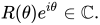
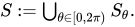
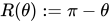
A family of examples: Suppose that is equal to (if considered as a complex vector space) or equal to (if considered as a real vector space). Regardless of whether is a real or complex vector space, every barrel in is necessarily a neighborhood of the origin (so is an example of a barrelled space). Let be any function and for every angle let denote the closed line segment from the origin to the point Let Then is always an absorbing subset of (a real vector space) but it is an absorbing subset of (a complex vector space) if and only if it is a neighborhood of the origin. Moreover, is a balanced subset of if and only if for every (if this is the case then and are completely determined by 's values on ) but is a balanced subset of if and only it is an open or closed ball centered at the origin (of radius ). In particular, barrels in are exactly those closed balls centered at the origin with radius in If then is a closed subset that is absorbing in but not absorbing in and that is neither convex, balanced, nor a neighborhood of the origin in By an appropriate choice of the function it is also possible to have be a balanced and absorbing subset of that is neither closed nor convex. To have be a balanced, absorbing, and closed subset of that is neither convex nor a neighborhood of the origin, define on as follows: for let (alternatively, it can be any positive function on that is continuously differentiable, which guarantees that and that is closed, and that also satisfies which prevents from being a neighborhood of the origin) and then extend to by defining which guarantees that is balanced in


![{\displaystyle R:[0,2\pi )\to (0,\infty ]}](https://wikimedia.org/api/rest_v1/media/math/render/svg/e45b0db59ec2241ebe7b14d47aa5de8ffa461eb8)





![{\displaystyle (0,\infty ].}](https://wikimedia.org/api/rest_v1/media/math/render/svg/853a49556870b53448d42fda7b8086ac5e35f603)








Denote by the space of continuous linear maps from into


Barrelled space
In functional analysis and related areas of mathematics, a barrelled space (also written barreled space) is a topological vector space (TVS) for which every barrelled set in the space is a neighbourhood for the zero vector. A barrelled set or a barrel in a topological vector space is a set that is convex, balanced, absorbing, and closed. Barrelled spaces are studied because a form of the Banach–Steinhaus theorem still holds for them. Barrelled spaces were introduced by Bourbaki (1950).
A convex and balanced subset of a real or complex vector space is called a disk and it is said to be disked, absolutely convex, or convex balanced.
A barrel or a barrelled set in a topological vector space (TVS) is a subset that is a closed absorbing disk; that is, a barrel is a convex, balanced, closed, and absorbing subset.
Every barrel must contain the origin. If and if is any subset of then is a convex, balanced, and absorbing set of if and only if this is all true of in for every -dimensional vector subspace thus if then the requirement that a barrel be a closed subset of is the only defining property that does not depend solely on (or lower)-dimensional vector subspaces of
If is any TVS then every closed convex and balanced neighborhood of the origin is necessarily a barrel in (because every neighborhood of the origin is necessarily an absorbing subset). In fact, every locally convex topological vector space has a neighborhood basis at its origin consisting entirely of barrels. However, in general, there might exist barrels that are not neighborhoods of the origin; "barrelled spaces" are exactly those TVSs in which every barrel is necessarily a neighborhood of the origin. Every finite dimensional topological vector space is a barrelled space so examples of barrels that are not neighborhoods of the origin can only be found in infinite dimensional spaces.
The closure of any convex, balanced, and absorbing subset is a barrel. This is because the closure of any convex (respectively, any balanced, any absorbing) subset has this same property.
A family of examples: Suppose that is equal to (if considered as a complex vector space) or equal to (if considered as a real vector space). Regardless of whether is a real or complex vector space, every barrel in is necessarily a neighborhood of the origin (so is an example of a barrelled space). Let be any function and for every angle let denote the closed line segment from the origin to the point Let Then is always an absorbing subset of (a real vector space) but it is an absorbing subset of (a complex vector space) if and only if it is a neighborhood of the origin. Moreover, is a balanced subset of if and only if for every (if this is the case then and are completely determined by 's values on ) but is a balanced subset of if and only it is an open or closed ball centered at the origin (of radius ). In particular, barrels in are exactly those closed balls centered at the origin with radius in If then is a closed subset that is absorbing in but not absorbing in and that is neither convex, balanced, nor a neighborhood of the origin in By an appropriate choice of the function it is also possible to have be a balanced and absorbing subset of that is neither closed nor convex. To have be a balanced, absorbing, and closed subset of that is neither convex nor a neighborhood of the origin, define on as follows: for let (alternatively, it can be any positive function on that is continuously differentiable, which guarantees that and that is closed, and that also satisfies which prevents from being a neighborhood of the origin) and then extend to by defining which guarantees that is balanced in
Denote by the space of continuous linear maps from into