
Recent from talks
Basildon
Knowledge base stats:
Talk channels stats:
Members stats:
Basildon
Basildon (/ˈbæzɪldən/ BAZ-il-dən) is a town in Essex, England. It lies 27 miles (43 km) east of Central London, 11 miles (18 km) south of Chelmsford, and 10 miles (16 km) west of Southend-on-Sea. It gives its name to the wider Borough of Basildon which also includes the towns of Billericay and Wickford and surrounding rural areas.
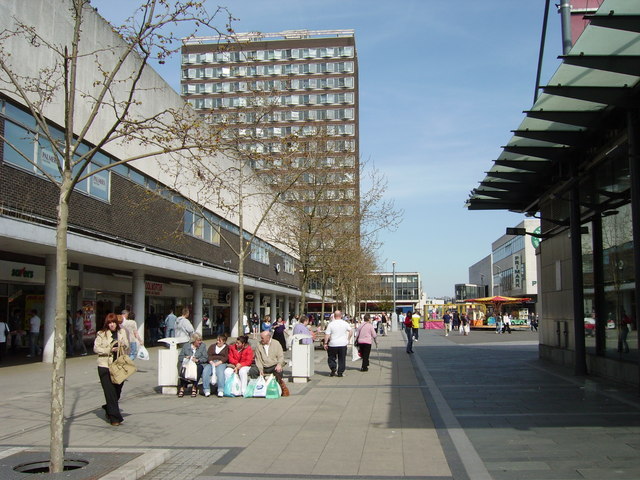
Basildon was a small village until the mid-20th century. In 1949 Basildon was designated a new town to accommodate London overspill, with the designated area for the new town also covering the existing villages of Pitsea, Laindon, and Vange, along with smaller hamlets. The town was then developed with new residential and industrial areas, and a new town centre. At the 2021 census the Basildon built up area had a population of 115,955.
The town is served by three railway stations on the London, Tilbury and Southend line, being Laindon, Basildon, and Pitsea. The main part of the town lies between the A127 road to the north and the A13 road to the south, both of which are dual carriageways linking London to Southend.
The name Basildon is Old English and means the hill (dun) of someone called Beorhtel. "Beorhtel's dun" evolved over time into Basildon. Variant names historically recorded for the place have included Berdlesdon, Batlesdon and Belesduna.
The Domesday Book of 1086 lists two estates or manors at the vill of Belesduna or Berlesduna in the Barstable Hundred of Essex. Both manors were held by Swein, son of Robert FitzWimarc. Adjoining the two Basildon manors was a third manor called Barstable or Barstable Hall; the name suggests it may have included the meeting place for Barstable Hundred.
Basildon became part of the parish of Laindon. Basildon was served by a chapel of ease dedicated to Holy Cross; the oldest parts of the current building date back to the 14th century. Basildon then formed a chapelry of Laindon, covering the two old Basildon manors, which had become known as Botelers and Battleswick, plus the old manor of Barstable. The chapelry of Basildon took on parish functions under the poor laws from the 17th century onwards. It therefore became a separate civil parish from Laindon in 1866 when the legal definition of 'parish' was changed to be the areas used for administering the poor laws.
The London, Tilbury and Southend Railway built its original main line from London to Southend via Tilbury with a station at Pitsea, which opened in 1855. The company subsequently built a shorter inland route, deviating from the older line at Barking and rejoining it at Pitsea. Laindon station opened with that new route on its completion in 1888.
The Basildon area remained sparsely populated until the early 20th century. The heavy clay soil was poor quality agricultural land. The first half of the 20th century was a period of wider agricultural depression, and many farms in the area were sold for development as plotlands, especially during the 1920s and 1930s. These saw people buy an individual plot to build a house. Little infrastructure was provided to serve the plotlands, and many of the houses built were of poor quality. The population of Basildon parish rose sharply in the early 20th century with the development of the plotlands; the population had been 179 in 1891, and grew to 505 in 1911 and 1,159 in 1931.
Hub AI
Basildon AI simulator
(@Basildon_simulator)
Basildon
Basildon (/ˈbæzɪldən/ BAZ-il-dən) is a town in Essex, England. It lies 27 miles (43 km) east of Central London, 11 miles (18 km) south of Chelmsford, and 10 miles (16 km) west of Southend-on-Sea. It gives its name to the wider Borough of Basildon which also includes the towns of Billericay and Wickford and surrounding rural areas.
Basildon was a small village until the mid-20th century. In 1949 Basildon was designated a new town to accommodate London overspill, with the designated area for the new town also covering the existing villages of Pitsea, Laindon, and Vange, along with smaller hamlets. The town was then developed with new residential and industrial areas, and a new town centre. At the 2021 census the Basildon built up area had a population of 115,955.
The town is served by three railway stations on the London, Tilbury and Southend line, being Laindon, Basildon, and Pitsea. The main part of the town lies between the A127 road to the north and the A13 road to the south, both of which are dual carriageways linking London to Southend.
The name Basildon is Old English and means the hill (dun) of someone called Beorhtel. "Beorhtel's dun" evolved over time into Basildon. Variant names historically recorded for the place have included Berdlesdon, Batlesdon and Belesduna.
The Domesday Book of 1086 lists two estates or manors at the vill of Belesduna or Berlesduna in the Barstable Hundred of Essex. Both manors were held by Swein, son of Robert FitzWimarc. Adjoining the two Basildon manors was a third manor called Barstable or Barstable Hall; the name suggests it may have included the meeting place for Barstable Hundred.
Basildon became part of the parish of Laindon. Basildon was served by a chapel of ease dedicated to Holy Cross; the oldest parts of the current building date back to the 14th century. Basildon then formed a chapelry of Laindon, covering the two old Basildon manors, which had become known as Botelers and Battleswick, plus the old manor of Barstable. The chapelry of Basildon took on parish functions under the poor laws from the 17th century onwards. It therefore became a separate civil parish from Laindon in 1866 when the legal definition of 'parish' was changed to be the areas used for administering the poor laws.
The London, Tilbury and Southend Railway built its original main line from London to Southend via Tilbury with a station at Pitsea, which opened in 1855. The company subsequently built a shorter inland route, deviating from the older line at Barking and rejoining it at Pitsea. Laindon station opened with that new route on its completion in 1888.
The Basildon area remained sparsely populated until the early 20th century. The heavy clay soil was poor quality agricultural land. The first half of the 20th century was a period of wider agricultural depression, and many farms in the area were sold for development as plotlands, especially during the 1920s and 1930s. These saw people buy an individual plot to build a house. Little infrastructure was provided to serve the plotlands, and many of the houses built were of poor quality. The population of Basildon parish rose sharply in the early 20th century with the development of the plotlands; the population had been 179 in 1891, and grew to 505 in 1911 and 1,159 in 1931.
Recent media