
Recent from talks
Battle for Hill 140
Knowledge base stats:
Talk channels stats:
Members stats:
Battle for Hill 140
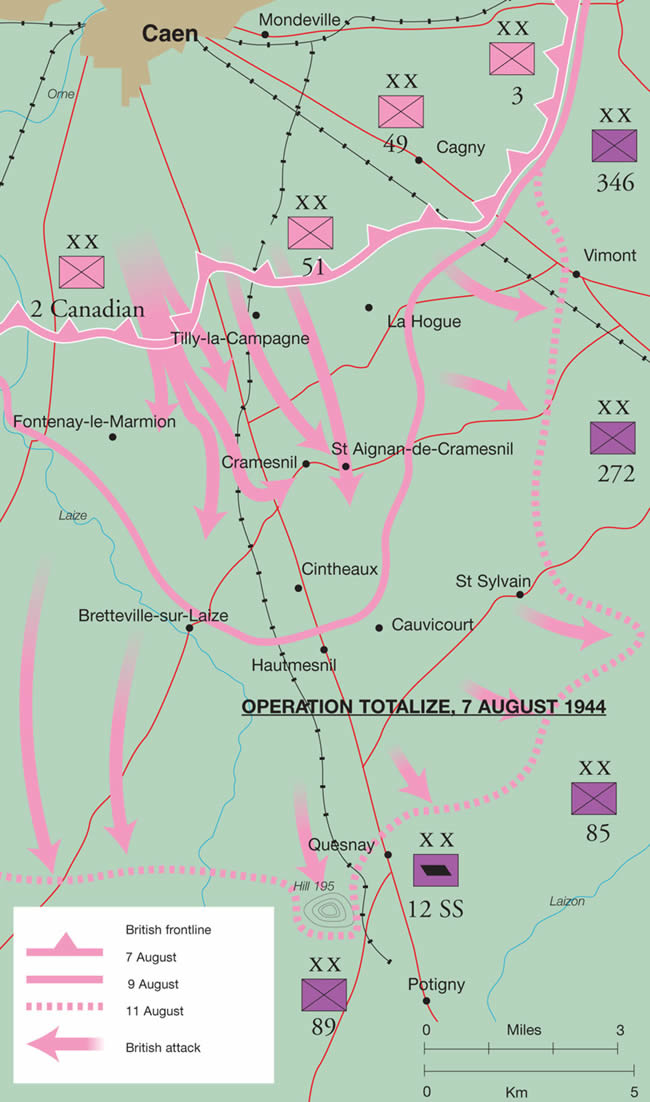
The Battle for Hill 140 was fought on 9 August 1944 as part of Operation Totalize between a battle group from the 4th Canadian Division and German troops, mainly from the 12th SS Panzer Division "Hitlerjugend". It occurred several miles east of the village of Estrées-la-Campagne, when, during a night attack, the Canadian troops strayed east from the axis of advance, occupying the wrong area on a forward slope. The consequence of the mistake was the destruction of the Canadian combat group by a German counterattack that lasted several hours. It was an unprecedented case during the Normandy campaign and probably the entire World War II, for such a large force to lose track of the terrain, lose its way and consequently be completely wrecked.
The attack of the II Canadian Corps south of Caen, codenamed "Totalize", began on the night of August 7–8. The plan, prepared by the corps commander, Maj. Gen. Guy Simonds, envisaged that Allied units would penetrate German defensive lines to a depth of 20 km and swiftly seize the hills directly north of the town of Falaise. In reality, the advance progressed at a very slow pace, with the two armored divisions expected to play a major role – 4th Canadian Division (4th AD) and Polish 1st Armoured Division (1st AD) – making only small gains throughout August 8, suffering heavy casualties in men and equipment. The Canadians advanced just over 2 km, reaching Cintheaux, while the Poles were halted at their starting positions near Cramesnil.
In the evening of August 8, Simonds ordered his armored divisions to resume the attack the next day. The 1st AD (commanded by Brigadier General Stanisław Maczek) was tasked with capturing the village of Cauvicourt and the Hill 140, located 5 km to the south, from which the crossings on the Laison river could be controlled. Meanwhile, acting to the right of the Poles, the 4th AD (commanded by Major General George Kitching) was to advance along the Caen–Falaise road (Route Nationale 158) and capture another key terrain feature – Hill 195. According to the corps commander's order issued in the evening, both divisions were to set out during the night and launch the attack at dawn.
Kitching entrusted the capture of Hill 195 to the 4th Canadian Armoured Brigade. In order to accomplish this task, its commander, Brigadier Eric Booth, reorganized his forces into two tactical groups, named after the commanding officers, known as Halpenny Force and Worthington Force. The former was to capture the village of Bretteville-le-Rabet, while the latter, moving along the Caen–Falaise road, was to strike at Hill 195 located 6 km further south, seize and hold it until reinforcements arrived.
The Worthington Force consisted of the 28th Armoured Regiment "British Columbia" (commanded by Lieutenant Colonel Donald "Don" Worthington), whose core comprised three squadrons of Sherman tanks, as well as three infantry companies from the "Algonquin" Regiment on M2 half-track armored cars (commanded by Lieutenant Colonel A.J. Hay). At 31 years old, Worthington was the youngest regimental commander in the 4th AD, but he enjoyed the trust of Kitching, who considered him one of his best officers. The forces entrusted to him were rested but inexperienced. They did not participate in the fighting on August 8; the attack on Hill 195 was to be their baptism of fire.
The opponent of the armored divisions of the II Canadian Corps was the 12th SS Panzer Division "Hitlerjugend", which had been fighting in Normandy for over two months (commanded by SS-Brigadeführer Kurt Meyer), supported by elements of the shattered 89th Infantry Division from the first phase of Operation Totalize. Meyer divided his forces into four kampfgruppen. Defending the area of Hill 195, the target of Worthington's attack, was Kampfgruppe Olboeter (reinforced III Battalion of the 26th SS Panzergrenadier Regiment). To its right, in the Quesnay forest, was Kampfgruppe Wünsche (remnants of the 12th SS Panzer Regiment, reinforced by Tiger tanks from the 102nd SS Heavy Tank Battalion). Engaged in combat against the Poles near Cramesnil was Kampfgruppe Waldmüller (reinforced I Battalion of the 25th SS Panzergrenadier Regiment). Facing the risk of being outflanked, Meyer ordered Waldmüller to withdraw to the area of Hill 140 on the night of August 8–9. Further east, near Rouvres, was Kampfgruppe Krause (reinforced I Battalion of the 26th SS Panzergrenadier Regiment).
Although the 12th SS Panzer Division lost over 20 of its approximately 50 operational tanks on August 8, and the combat strength of the 89th Infantry Division, which bore the brunt of the Allied attack, was reduced by over half, Meyer largely managed to conduct a coordinated retreat and restore defensive lines based on the Quesnay forest. Additionally, reinforcements were hastening to his aid in the form of the 85th Infantry Division. Nevertheless, the intelligence of the II Canadian Corps downplayed the enemy's combat capability and overestimated the losses inflicted upon them. As a result, Worthington expected to encounter only "a few minor German formations" on his path.
Booth issued the order to attack around midnight. His intention was for Worthington's group to set out as quickly as possible and, utilizing the element of surprise, seize Hill 195 with the break of dawn. Around 1:30 A.M., Worthington gathered his officers and conducted a short briefing during which he outlined the objective and the method of attack:
Hub AI
Battle for Hill 140 AI simulator
(@Battle for Hill 140_simulator)
Battle for Hill 140
The Battle for Hill 140 was fought on 9 August 1944 as part of Operation Totalize between a battle group from the 4th Canadian Division and German troops, mainly from the 12th SS Panzer Division "Hitlerjugend". It occurred several miles east of the village of Estrées-la-Campagne, when, during a night attack, the Canadian troops strayed east from the axis of advance, occupying the wrong area on a forward slope. The consequence of the mistake was the destruction of the Canadian combat group by a German counterattack that lasted several hours. It was an unprecedented case during the Normandy campaign and probably the entire World War II, for such a large force to lose track of the terrain, lose its way and consequently be completely wrecked.
The attack of the II Canadian Corps south of Caen, codenamed "Totalize", began on the night of August 7–8. The plan, prepared by the corps commander, Maj. Gen. Guy Simonds, envisaged that Allied units would penetrate German defensive lines to a depth of 20 km and swiftly seize the hills directly north of the town of Falaise. In reality, the advance progressed at a very slow pace, with the two armored divisions expected to play a major role – 4th Canadian Division (4th AD) and Polish 1st Armoured Division (1st AD) – making only small gains throughout August 8, suffering heavy casualties in men and equipment. The Canadians advanced just over 2 km, reaching Cintheaux, while the Poles were halted at their starting positions near Cramesnil.
In the evening of August 8, Simonds ordered his armored divisions to resume the attack the next day. The 1st AD (commanded by Brigadier General Stanisław Maczek) was tasked with capturing the village of Cauvicourt and the Hill 140, located 5 km to the south, from which the crossings on the Laison river could be controlled. Meanwhile, acting to the right of the Poles, the 4th AD (commanded by Major General George Kitching) was to advance along the Caen–Falaise road (Route Nationale 158) and capture another key terrain feature – Hill 195. According to the corps commander's order issued in the evening, both divisions were to set out during the night and launch the attack at dawn.
Kitching entrusted the capture of Hill 195 to the 4th Canadian Armoured Brigade. In order to accomplish this task, its commander, Brigadier Eric Booth, reorganized his forces into two tactical groups, named after the commanding officers, known as Halpenny Force and Worthington Force. The former was to capture the village of Bretteville-le-Rabet, while the latter, moving along the Caen–Falaise road, was to strike at Hill 195 located 6 km further south, seize and hold it until reinforcements arrived.
The Worthington Force consisted of the 28th Armoured Regiment "British Columbia" (commanded by Lieutenant Colonel Donald "Don" Worthington), whose core comprised three squadrons of Sherman tanks, as well as three infantry companies from the "Algonquin" Regiment on M2 half-track armored cars (commanded by Lieutenant Colonel A.J. Hay). At 31 years old, Worthington was the youngest regimental commander in the 4th AD, but he enjoyed the trust of Kitching, who considered him one of his best officers. The forces entrusted to him were rested but inexperienced. They did not participate in the fighting on August 8; the attack on Hill 195 was to be their baptism of fire.
The opponent of the armored divisions of the II Canadian Corps was the 12th SS Panzer Division "Hitlerjugend", which had been fighting in Normandy for over two months (commanded by SS-Brigadeführer Kurt Meyer), supported by elements of the shattered 89th Infantry Division from the first phase of Operation Totalize. Meyer divided his forces into four kampfgruppen. Defending the area of Hill 195, the target of Worthington's attack, was Kampfgruppe Olboeter (reinforced III Battalion of the 26th SS Panzergrenadier Regiment). To its right, in the Quesnay forest, was Kampfgruppe Wünsche (remnants of the 12th SS Panzer Regiment, reinforced by Tiger tanks from the 102nd SS Heavy Tank Battalion). Engaged in combat against the Poles near Cramesnil was Kampfgruppe Waldmüller (reinforced I Battalion of the 25th SS Panzergrenadier Regiment). Facing the risk of being outflanked, Meyer ordered Waldmüller to withdraw to the area of Hill 140 on the night of August 8–9. Further east, near Rouvres, was Kampfgruppe Krause (reinforced I Battalion of the 26th SS Panzergrenadier Regiment).
Although the 12th SS Panzer Division lost over 20 of its approximately 50 operational tanks on August 8, and the combat strength of the 89th Infantry Division, which bore the brunt of the Allied attack, was reduced by over half, Meyer largely managed to conduct a coordinated retreat and restore defensive lines based on the Quesnay forest. Additionally, reinforcements were hastening to his aid in the form of the 85th Infantry Division. Nevertheless, the intelligence of the II Canadian Corps downplayed the enemy's combat capability and overestimated the losses inflicted upon them. As a result, Worthington expected to encounter only "a few minor German formations" on his path.
Booth issued the order to attack around midnight. His intention was for Worthington's group to set out as quickly as possible and, utilizing the element of surprise, seize Hill 195 with the break of dawn. Around 1:30 A.M., Worthington gathered his officers and conducted a short briefing during which he outlined the objective and the method of attack:
Recent media