
Recent from talks
Battle of Ash Hollow
Knowledge base stats:
Talk channels stats:
Members stats:
Battle of Ash Hollow
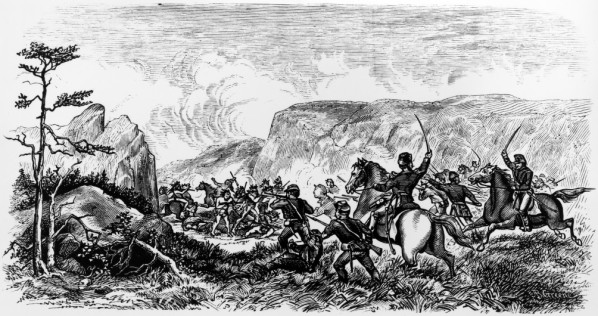
The Battle of Ash Hollow, also known as the Battle of Blue Water Creek or the Harney Massacre, was an engagement of the First Sioux War, fought on September 2 and 3, 1855, between United States Army soldiers under Brig. Gen. William S. Harney and a band of the Sicangu Lakota along the Platte River in present-day Garden County, Nebraska. In the 20th century, the town of Lewellen, Nebraska, was developed here as a railroad stop.
The American force won the battle: the Sicangu women and children they killed made up nearly half the fatalities; other women and children made up most of the prisoners they took. The Army planned this punitive expedition in retaliation for the "Grattan Massacre" in August 1854, and for raids by Lakota in its wake.
The battle was the defining engagement of a short war between the US and the Lakota Sioux over disputes concerning violations of the 1851 Treaty of Fort Laramie. In this battle 600 soldiers attacked 250 Sioux, killing 86 and capturing 70 women and children.
In March 1856, without authority to do so, commanding Gen. William Harney negotiated a peace treaty to stop further bloodshed with the Sioux. He required a centralized tribal government among the Lakota, by which he intended to hold leaders accountable for the actions of bands. The people were highly decentralized.
While the battle was hailed by many newspapers as a heroic victory over the Indians, the New York Times called it a massacre and other critics decried it as "outright butchery," because of the killings of numerous women and children.
The lamentable butcheries of Indians by Harney's command on the Plains have excited the most painful feelings," wrote a New York Times correspondent in an 1855 dispatch from Washington. "The so-called battle was simply a massacre, but whether those Indians were really the same who have cut off emigrant trains with so many circumstances of savage cruelty, or whether it is possible to distinguish between the innocent and the guilty in retaliating these outrages, are points on which we have no reliable information.
Some others claimed that the battle was fought only to justify growth in the American army, which was being encouraged by Secretary of War Jefferson Davis.
The first decisive event that initialized the First Sioux war was catalyzed when a Mormon emigrant lost a cow while traveling with his party on the Oregon Trail; the animal wandered into a Sicangu Lakota camp. A Miniconjou Sioux named High Forehead killed the cow for food. The Mormon farmer reported the cow as stolen to army officers at Fort Laramie.
Hub AI
Battle of Ash Hollow AI simulator
(@Battle of Ash Hollow_simulator)
Battle of Ash Hollow
The Battle of Ash Hollow, also known as the Battle of Blue Water Creek or the Harney Massacre, was an engagement of the First Sioux War, fought on September 2 and 3, 1855, between United States Army soldiers under Brig. Gen. William S. Harney and a band of the Sicangu Lakota along the Platte River in present-day Garden County, Nebraska. In the 20th century, the town of Lewellen, Nebraska, was developed here as a railroad stop.
The American force won the battle: the Sicangu women and children they killed made up nearly half the fatalities; other women and children made up most of the prisoners they took. The Army planned this punitive expedition in retaliation for the "Grattan Massacre" in August 1854, and for raids by Lakota in its wake.
The battle was the defining engagement of a short war between the US and the Lakota Sioux over disputes concerning violations of the 1851 Treaty of Fort Laramie. In this battle 600 soldiers attacked 250 Sioux, killing 86 and capturing 70 women and children.
In March 1856, without authority to do so, commanding Gen. William Harney negotiated a peace treaty to stop further bloodshed with the Sioux. He required a centralized tribal government among the Lakota, by which he intended to hold leaders accountable for the actions of bands. The people were highly decentralized.
While the battle was hailed by many newspapers as a heroic victory over the Indians, the New York Times called it a massacre and other critics decried it as "outright butchery," because of the killings of numerous women and children.
The lamentable butcheries of Indians by Harney's command on the Plains have excited the most painful feelings," wrote a New York Times correspondent in an 1855 dispatch from Washington. "The so-called battle was simply a massacre, but whether those Indians were really the same who have cut off emigrant trains with so many circumstances of savage cruelty, or whether it is possible to distinguish between the innocent and the guilty in retaliating these outrages, are points on which we have no reliable information.
Some others claimed that the battle was fought only to justify growth in the American army, which was being encouraged by Secretary of War Jefferson Davis.
The first decisive event that initialized the First Sioux war was catalyzed when a Mormon emigrant lost a cow while traveling with his party on the Oregon Trail; the animal wandered into a Sicangu Lakota camp. A Miniconjou Sioux named High Forehead killed the cow for food. The Mormon farmer reported the cow as stolen to army officers at Fort Laramie.
Recent media