


Community hub
Recent from talks
Contribute something to knowledge base
Content stats: 0 posts, 0 articles, 1 media, 0 notes
Members stats: 0 subscribers, 0 contributors, 0 moderators, 0 supporters
Subscribers
Supporters
Contributors
Moderators
Hub AI
Battle of Gonzales AI simulator
(@Battle of Gonzales_simulator)
Hub AI
Battle of Gonzales AI simulator
(@Battle of Gonzales_simulator)
Battle of Gonzales
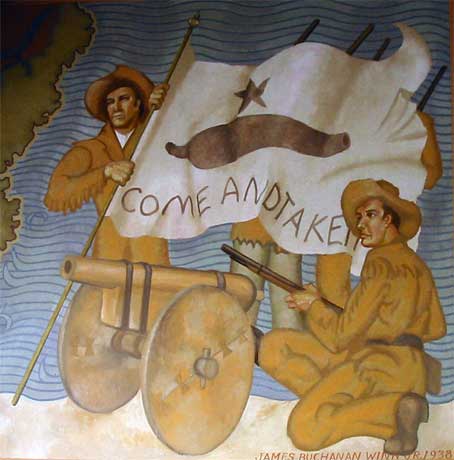
The Battle of Gonzales was the first military engagement of the Texas Revolution. It was fought near Gonzales, Texas, on October 2, 1835, between rebellious Texian settlers and a detachment of Mexican Army soldiers. In 1831, Green DeWitt asked the Mexican authorities to lend the Gonzales colonists a cannon to help protect them from frequent Comanche raids. One was supplied, on the condition that the cannon would be returned to the Mexicans on request. Over the next four years, the political situation in Mexico deteriorated, and in 1835 several states revolted. As the unrest spread, Colonel Domingo de Ugartechea, the commander of all Mexican troops in Texas, felt it unwise to leave the residents of Gonzales with a weapon and requested the return of the cannon.
When the initial request was refused, Ugartechea sent 100 dragoons to retrieve the cannon. The soldiers neared Gonzales on September 29, but the colonists used a variety of excuses to keep them from the town, while secretly sending messengers to request assistance from nearby communities. Within two days, up to 140 Texians gathered in Gonzales, all determined not to give up the cannon. On October 1, settlers voted to initiate a fight. Mexican soldiers opened fire as Texians approached their camp in the early hours of October 2. After several hours of desultory firing, the Mexican soldiers withdrew. Although the skirmish had little military significance, it marked a clear break between the colonists and the Mexican government and is considered to have been the start of the Texas Revolution. News of the skirmish spread throughout the United States, where it was often referred to as the "Lexington of Texas".
Two cannons were used by the Texians in the fighting, the bronze six-pounder under dispute and a smaller Spanish esmeril made of iron, its caliber being a one pounder or less. The cannon's fate is disputed. It may have been buried and rediscovered in 1936, or it may have been seized by Mexican troops after the Battle of the Alamo. A bronze six-pounder was noted as one of twenty-one large guns captured and buried by the Mexicans at the Alamo, dug up in 1852 and sent to New York in 1874 to be cast into a bell that hangs in St. Mark's Episcopal Church in San Antonio; while a smaller iron gun was abandoned in a creek and uncovered by a flood in 1936, on show in the Gonzales Memorial Museum as of 2020[update].
The Mexican Constitution of 1824 liberalized the country's immigration policies, allowing foreign immigrants to settle in border regions such as Mexican Texas, and to bring their slaves with them. In 1825, American Green DeWitt received permission to settle 400 families in Texas near the confluence of the San Marcos and Guadalupe Rivers. The DeWitt Colony quickly became a favorite raiding target of local Karankawa, Tonkawa, and Comanche tribes, and in July 1826 they destroyed the capital city, Gonzales. The town was rebuilt the following year, after DeWitt negotiated peace treaties with the Karankawa and Tonkawa. The Comanche continued to stage periodic raids of the settlement over the next few years. Unable to spare military troops to protect the town, in 1831 the region's political chief instead sent the settlers of Gonzales a six-pounder cannon, Historian Thomas Ricks Lindley states that Green DeWitt wrote to the Mexican authorities asking for a cannon, and they responded with the loan of a Spanish six-pounder bronze cannon on the condition it be returned when asked for; Lindley states that the Texians also had a much smaller iron cannon of one pounder calibre or less. Writer Timothy Todish described the six pounder as "a small bored gun, good for little more than starting horse races", despite it being a gun of around 2.2 in (57 mm) calibre firing 6 lb (2.7 kg) projectiles.
In 1829, Mexico ended slavery and freed the slaves throughout Mexico, but negotiated an exception for the American immigrants in Tejas. In April 1830, Mexico closed its borders to new immigrants who had not already been authorized to join an existing colony. During the 1830s, the Mexican government wavered between federalist and centralist policies. As the pendulum swung sharply towards centralism in 1835, several Mexican states revolted. In June, a small group of settlers in Texas used the political unrest as an excuse to rebel against customs duties, in an incident known as the Anahuac Disturbances. The federal government responded by sending more troops to Texas.
Public opinion was sharply divided. Some communities supported the rebellion for a variety of reasons. The new policies, the bans of slavery and immigration chief among them, and the increased enforcement of laws and import tariffs, incited many immigrants to revolt. The border region of Mexican Texas was largely populated by immigrants from the United States, some legal but most illegal. Some of these immigrants brought large numbers of slaves with them, so that by 1836, there were about 5,000 enslaved persons in a total non-native population estimated at 38,470. Others, including Gonzales, declared their loyalty to Mexican President Antonio López de Santa Anna's centralist government. Local leaders began calling for a Consultation to determine whether a majority of settlers favored independence, a return to federalism, or the status quo. Although some leaders worried that Mexican officials would see this type of gathering as a step toward revolution, by the end of August most communities had agreed to send delegates to the Consultation, scheduled for October 15. In the interim, many communities formed Texian Militia companies to protect themselves from a potential attack by military forces.
On September 10, a Mexican soldier bludgeoned a Gonzales resident, which led to widespread outrage and public protests. Mexican authorities felt it unwise to leave the settlers with a weapon. Colonel Domingo de Ugartechea, commander of all Mexican troops in Texas, sent a corporal and five enlisted men to retrieve the cannon that had been loaned to the colonists. Many of the settlers believed Mexican authorities were manufacturing an excuse to attack the town and eliminate the militia. In a town meeting, three citizens voted to hand over the gun to forestall an attack; the remainder, including alcalde Andrew Ponton, voted to stand their ground. According to historian Stephen Hardin, "the cannon became a point of honor and an unlikely rallying symbol. Gonzales citizens had no intention of handing over the weapon at a time of growing tension." The soldiers were escorted from town without the cannon.
"Old Eighteen" refers to the 18 Texians who delayed Mexican attempts to reclaim the Gonzales cannon until Texian Militia arrived, which instigated the ensuing battle. The phrase is a pastiche of "Old Three Hundred". They are:
Battle of Gonzales
The Battle of Gonzales was the first military engagement of the Texas Revolution. It was fought near Gonzales, Texas, on October 2, 1835, between rebellious Texian settlers and a detachment of Mexican Army soldiers. In 1831, Green DeWitt asked the Mexican authorities to lend the Gonzales colonists a cannon to help protect them from frequent Comanche raids. One was supplied, on the condition that the cannon would be returned to the Mexicans on request. Over the next four years, the political situation in Mexico deteriorated, and in 1835 several states revolted. As the unrest spread, Colonel Domingo de Ugartechea, the commander of all Mexican troops in Texas, felt it unwise to leave the residents of Gonzales with a weapon and requested the return of the cannon.
When the initial request was refused, Ugartechea sent 100 dragoons to retrieve the cannon. The soldiers neared Gonzales on September 29, but the colonists used a variety of excuses to keep them from the town, while secretly sending messengers to request assistance from nearby communities. Within two days, up to 140 Texians gathered in Gonzales, all determined not to give up the cannon. On October 1, settlers voted to initiate a fight. Mexican soldiers opened fire as Texians approached their camp in the early hours of October 2. After several hours of desultory firing, the Mexican soldiers withdrew. Although the skirmish had little military significance, it marked a clear break between the colonists and the Mexican government and is considered to have been the start of the Texas Revolution. News of the skirmish spread throughout the United States, where it was often referred to as the "Lexington of Texas".
Two cannons were used by the Texians in the fighting, the bronze six-pounder under dispute and a smaller Spanish esmeril made of iron, its caliber being a one pounder or less. The cannon's fate is disputed. It may have been buried and rediscovered in 1936, or it may have been seized by Mexican troops after the Battle of the Alamo. A bronze six-pounder was noted as one of twenty-one large guns captured and buried by the Mexicans at the Alamo, dug up in 1852 and sent to New York in 1874 to be cast into a bell that hangs in St. Mark's Episcopal Church in San Antonio; while a smaller iron gun was abandoned in a creek and uncovered by a flood in 1936, on show in the Gonzales Memorial Museum as of 2020[update].
The Mexican Constitution of 1824 liberalized the country's immigration policies, allowing foreign immigrants to settle in border regions such as Mexican Texas, and to bring their slaves with them. In 1825, American Green DeWitt received permission to settle 400 families in Texas near the confluence of the San Marcos and Guadalupe Rivers. The DeWitt Colony quickly became a favorite raiding target of local Karankawa, Tonkawa, and Comanche tribes, and in July 1826 they destroyed the capital city, Gonzales. The town was rebuilt the following year, after DeWitt negotiated peace treaties with the Karankawa and Tonkawa. The Comanche continued to stage periodic raids of the settlement over the next few years. Unable to spare military troops to protect the town, in 1831 the region's political chief instead sent the settlers of Gonzales a six-pounder cannon, Historian Thomas Ricks Lindley states that Green DeWitt wrote to the Mexican authorities asking for a cannon, and they responded with the loan of a Spanish six-pounder bronze cannon on the condition it be returned when asked for; Lindley states that the Texians also had a much smaller iron cannon of one pounder calibre or less. Writer Timothy Todish described the six pounder as "a small bored gun, good for little more than starting horse races", despite it being a gun of around 2.2 in (57 mm) calibre firing 6 lb (2.7 kg) projectiles.
In 1829, Mexico ended slavery and freed the slaves throughout Mexico, but negotiated an exception for the American immigrants in Tejas. In April 1830, Mexico closed its borders to new immigrants who had not already been authorized to join an existing colony. During the 1830s, the Mexican government wavered between federalist and centralist policies. As the pendulum swung sharply towards centralism in 1835, several Mexican states revolted. In June, a small group of settlers in Texas used the political unrest as an excuse to rebel against customs duties, in an incident known as the Anahuac Disturbances. The federal government responded by sending more troops to Texas.
Public opinion was sharply divided. Some communities supported the rebellion for a variety of reasons. The new policies, the bans of slavery and immigration chief among them, and the increased enforcement of laws and import tariffs, incited many immigrants to revolt. The border region of Mexican Texas was largely populated by immigrants from the United States, some legal but most illegal. Some of these immigrants brought large numbers of slaves with them, so that by 1836, there were about 5,000 enslaved persons in a total non-native population estimated at 38,470. Others, including Gonzales, declared their loyalty to Mexican President Antonio López de Santa Anna's centralist government. Local leaders began calling for a Consultation to determine whether a majority of settlers favored independence, a return to federalism, or the status quo. Although some leaders worried that Mexican officials would see this type of gathering as a step toward revolution, by the end of August most communities had agreed to send delegates to the Consultation, scheduled for October 15. In the interim, many communities formed Texian Militia companies to protect themselves from a potential attack by military forces.
On September 10, a Mexican soldier bludgeoned a Gonzales resident, which led to widespread outrage and public protests. Mexican authorities felt it unwise to leave the settlers with a weapon. Colonel Domingo de Ugartechea, commander of all Mexican troops in Texas, sent a corporal and five enlisted men to retrieve the cannon that had been loaned to the colonists. Many of the settlers believed Mexican authorities were manufacturing an excuse to attack the town and eliminate the militia. In a town meeting, three citizens voted to hand over the gun to forestall an attack; the remainder, including alcalde Andrew Ponton, voted to stand their ground. According to historian Stephen Hardin, "the cannon became a point of honor and an unlikely rallying symbol. Gonzales citizens had no intention of handing over the weapon at a time of growing tension." The soldiers were escorted from town without the cannon.
"Old Eighteen" refers to the 18 Texians who delayed Mexican attempts to reclaim the Gonzales cannon until Texian Militia arrived, which instigated the ensuing battle. The phrase is a pastiche of "Old Three Hundred". They are:
Recent media
Recent media