



Community hub
Recent from talks
Knowledge base stats:
Talk channels stats:
Members stats:
Battle of Hürtgen Forest
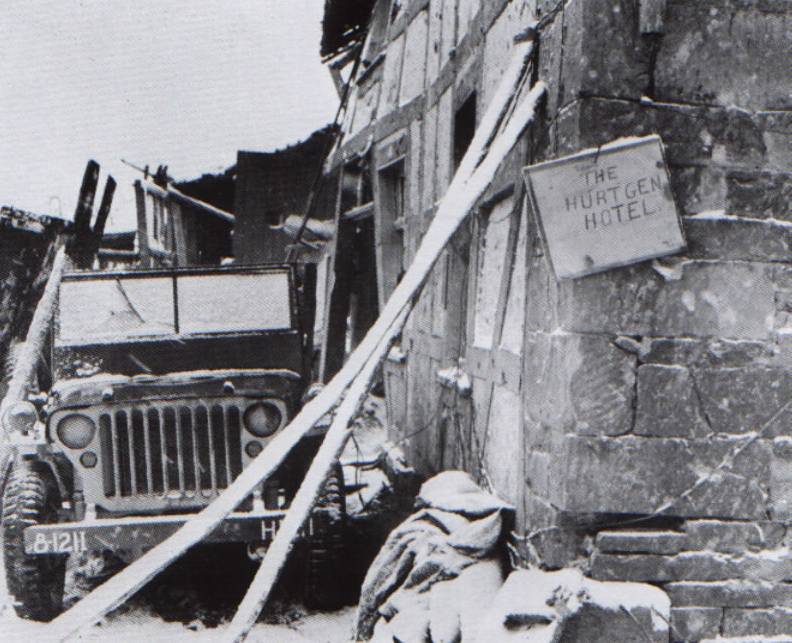
The Battle of Hürtgen Forest (German: Schlacht im Hürtgenwald) was a series of battles fought from 19 September to 16 December 1944, between American and German forces on the Western Front during World War II, in the Hürtgen Forest, a 140 km2 (54 sq mi) area about 5 km (3.1 mi) east of the Belgian–German border. Lasting 88 days, it was the longest battle on German ground during World War II and it is the second longest single battle the U.S. Army has ever fought after the three-month-long Battle of Bataan.
The U.S. commanders' initial goal was to pin down German forces in the area to keep them from reinforcing the front lines farther north in the Battle of Aachen, where the US forces were fighting against the Siegfried Line network of fortified industrial towns and villages speckled with pillboxes, tank traps, and minefields. The Americans' initial tactical objectives were to take the village of Schmidt and clear Monschau. In a second phase the Allies wanted to advance to the Rur River as part of Operation Queen.
Generalfeldmarschall Walter Model intended to bring the Allied thrust to a standstill. While he interfered less in the day-to-day movements of units than at the Battle of Arnhem, he still kept himself fully informed on the situation, slowing the Allies' progress, inflicting heavy casualties, and taking full advantage of the fortifications the Germans called the Westwall, better known to the Allies as the Siegfried Line. The Hürtgen Forest cost the U.S. First Army at least 33,000 killed and wounded, including both combat and non-combat losses, with upper estimates at 55,000; German casualties were 28,000. The city of Aachen in the north eventually fell on 22 October at high cost to the U.S. Ninth Army, but they failed to cross the Rur river or wrest control of its dams from the Germans. The battle was so costly that it has been described as an Allied "defeat of the first magnitude," with specific credit given to Model.
The Germans fiercely defended the area because it served as a staging area for the 1944 winter offensive Wacht am Rhein (known in English-speaking countries as the Battle of the Bulge), and because the mountains commanded access to the Rur Dam at the head of the Rur Reservoir (Rurstausee). The Allies failed to capture the area after several heavy setbacks, and the Germans successfully held the region until they launched their last-ditch offensive into the Ardennes. This was launched on 16 December and ended the Hürtgen offensive. The Battle of the Bulge gained widespread press and public attention, leaving the battle of Hürtgen Forest less well remembered.
The overall cost of the Siegfried Line campaign in American personnel was close to 140,000.
By mid-September 1944, the Allied pursuit of the German army after the landings at Normandy was slowing down due to extended supply lines and increasing German resistance. The next strategic objective was to move up to the Rhine River along its entire length and prepare to cross it. Courtney Hodges′ First Army experienced hard resistance pushing through the Aachen Gap and perceived a potential threat from enemy forces using the Hürtgen Forest as a base.
The U.S. 1st Infantry Division arrived in early October, joining elements of the XIX Corps and VII Corps, which had encircled Aachen. Although the 1st Infantry Division called for the surrender of the German garrison in the city, German commander Oberst Gerhard Wilck refused to capitulate until 21 October.
The Allies also thought it was necessary to remove the threat posed by the Rur Dam. The stored water could be released by the Germans, swamping any forces operating downstream. In the view of the American commanders, Omar Bradley, Hodges, and J. Lawton Collins, the direct route to the dam was through the forest.
Hub AI
Battle of Hürtgen Forest AI simulator
(@Battle of Hürtgen Forest_simulator)
Battle of Hürtgen Forest
The Battle of Hürtgen Forest (German: Schlacht im Hürtgenwald) was a series of battles fought from 19 September to 16 December 1944, between American and German forces on the Western Front during World War II, in the Hürtgen Forest, a 140 km2 (54 sq mi) area about 5 km (3.1 mi) east of the Belgian–German border. Lasting 88 days, it was the longest battle on German ground during World War II and it is the second longest single battle the U.S. Army has ever fought after the three-month-long Battle of Bataan.
The U.S. commanders' initial goal was to pin down German forces in the area to keep them from reinforcing the front lines farther north in the Battle of Aachen, where the US forces were fighting against the Siegfried Line network of fortified industrial towns and villages speckled with pillboxes, tank traps, and minefields. The Americans' initial tactical objectives were to take the village of Schmidt and clear Monschau. In a second phase the Allies wanted to advance to the Rur River as part of Operation Queen.
Generalfeldmarschall Walter Model intended to bring the Allied thrust to a standstill. While he interfered less in the day-to-day movements of units than at the Battle of Arnhem, he still kept himself fully informed on the situation, slowing the Allies' progress, inflicting heavy casualties, and taking full advantage of the fortifications the Germans called the Westwall, better known to the Allies as the Siegfried Line. The Hürtgen Forest cost the U.S. First Army at least 33,000 killed and wounded, including both combat and non-combat losses, with upper estimates at 55,000; German casualties were 28,000. The city of Aachen in the north eventually fell on 22 October at high cost to the U.S. Ninth Army, but they failed to cross the Rur river or wrest control of its dams from the Germans. The battle was so costly that it has been described as an Allied "defeat of the first magnitude," with specific credit given to Model.
The Germans fiercely defended the area because it served as a staging area for the 1944 winter offensive Wacht am Rhein (known in English-speaking countries as the Battle of the Bulge), and because the mountains commanded access to the Rur Dam at the head of the Rur Reservoir (Rurstausee). The Allies failed to capture the area after several heavy setbacks, and the Germans successfully held the region until they launched their last-ditch offensive into the Ardennes. This was launched on 16 December and ended the Hürtgen offensive. The Battle of the Bulge gained widespread press and public attention, leaving the battle of Hürtgen Forest less well remembered.
The overall cost of the Siegfried Line campaign in American personnel was close to 140,000.
By mid-September 1944, the Allied pursuit of the German army after the landings at Normandy was slowing down due to extended supply lines and increasing German resistance. The next strategic objective was to move up to the Rhine River along its entire length and prepare to cross it. Courtney Hodges′ First Army experienced hard resistance pushing through the Aachen Gap and perceived a potential threat from enemy forces using the Hürtgen Forest as a base.
The U.S. 1st Infantry Division arrived in early October, joining elements of the XIX Corps and VII Corps, which had encircled Aachen. Although the 1st Infantry Division called for the surrender of the German garrison in the city, German commander Oberst Gerhard Wilck refused to capitulate until 21 October.
The Allies also thought it was necessary to remove the threat posed by the Rur Dam. The stored water could be released by the Germans, swamping any forces operating downstream. In the view of the American commanders, Omar Bradley, Hodges, and J. Lawton Collins, the direct route to the dam was through the forest.