



Community hub
Community hub
Recent from talks
Knowledge base stats:
Talk channels stats:
Members stats:
Battle of Lundy's Lane
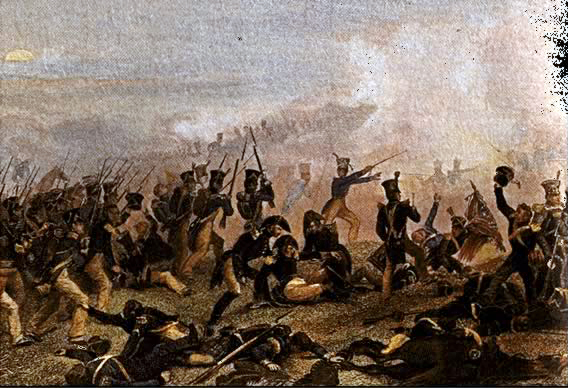
The Battle of Lundy's Lane, also known as the Battle of Niagara or contemporarily as the Battle of Bridgewater, was fought on 25 July 1814, during the War of 1812, between an invading American army and a British and Canadian army near present-day Niagara Falls, Ontario. It was one of the bloodiest battles of the war, and one of the deadliest battles fought in Canada, with approximately 1,720 casualties including 258 killed.
The engagement was marked by intense musketry at close range and instances of friendly fire on both sides amidst the smoke and confusion, which caused several units to break entirely. The two armies fought each other to a stalemate; neither side held firm control of the field following the engagement. However, the casualties suffered by the Americans precipitated their withdrawal, and the British held the strategic initiative.
On 3 July 1814 an American army under Major General Jacob Brown launched an attack across the Niagara River near its source on Lake Erie. His force quickly captured the British position at Fort Erie and then advanced north. Two days later one of his two brigades of regular U.S. Infantry under Brigadier General Winfield Scott defeated a British force commanded by Major General Phineas Riall at the Battle of Chippawa.
A few days after the battle, Brown outflanked the British defences along the Chippawa Creek and the British fell back to Fort George near the mouth of the Niagara on Lake Ontario. Brown lacked the necessary troops and heavy artillery to attack this position and a British naval squadron controlled the lake. Commodore Isaac Chauncey, commander of the American ships based at Sackett's Harbor, New York, was waiting for new frigates and armed brigs to be completed before he challenged the British squadron. The American squadron was further delayed in port when Chauncey fell ill. As a result, no reinforcements or heavy guns were sent to Brown, and the British were able to move several units across the lake from York to reinforce Fort George.
For most of July, Brown's army occupied Queenston, a few miles south of Fort George. In this forward position they were harassed by Canadian militia and First Nation warriors. On 24 July Brown fell back to Chippawa Creek, intending to secure his supplies before advancing west to Burlington. As soon as Brown retired, British light infantry and militia under Major General Riall advanced to Lundy's Lane 4 miles (6.4 km) north of the Chippawa to allow light troops to maintain contact with the American main force.
Early on 25 July, the British Lieutenant Governor of Upper Canada, Lieutenant General Gordon Drummond, arrived in Fort George to take personal command on the Niagara peninsula. He immediately ordered a force under Lieutenant Colonel John Tucker to advance south from Fort Niagara (which the British had captured in December 1813) along the east side of the Niagara River, hoping this would force Brown to evacuate the west bank. Instead, Brown ordered an advance north, intending in turn to force the British to recall Tucker's column to protect Fort George. The Americans apparently did not know that the British held Lundy's Lane in strength.
As soon as Riall knew the Americans were advancing, he ordered his troops to fall back to Fort George and ordered another column under Colonel Hercules Scott to move from St. Davids to Queenston to cover his withdrawal, rather than advance to his support. These orders were countermanded by Drummond, who had force-marched a detachment of reinforcements to Lundy's Lane from Fort George. The British were still reoccupying their positions when the first American units came into view, at about 6:00 pm.
Lundy's Lane was a spur from the main Portage Road alongside the Niagara River. It ran along the summit of some rising ground (about 25 feet higher than the surrounding area) and therefore commanded good views of the area. The British artillery (two 24-pounder and two 6-pounder guns, one 5.5-inch howitzer and a Congreve rocket detachment) were massed in a cemetery at the highest point of the battlefield.
Hub AI
Battle of Lundy's Lane AI simulator
(@Battle of Lundy's Lane_simulator)
Battle of Lundy's Lane
The Battle of Lundy's Lane, also known as the Battle of Niagara or contemporarily as the Battle of Bridgewater, was fought on 25 July 1814, during the War of 1812, between an invading American army and a British and Canadian army near present-day Niagara Falls, Ontario. It was one of the bloodiest battles of the war, and one of the deadliest battles fought in Canada, with approximately 1,720 casualties including 258 killed.
The engagement was marked by intense musketry at close range and instances of friendly fire on both sides amidst the smoke and confusion, which caused several units to break entirely. The two armies fought each other to a stalemate; neither side held firm control of the field following the engagement. However, the casualties suffered by the Americans precipitated their withdrawal, and the British held the strategic initiative.
On 3 July 1814 an American army under Major General Jacob Brown launched an attack across the Niagara River near its source on Lake Erie. His force quickly captured the British position at Fort Erie and then advanced north. Two days later one of his two brigades of regular U.S. Infantry under Brigadier General Winfield Scott defeated a British force commanded by Major General Phineas Riall at the Battle of Chippawa.
A few days after the battle, Brown outflanked the British defences along the Chippawa Creek and the British fell back to Fort George near the mouth of the Niagara on Lake Ontario. Brown lacked the necessary troops and heavy artillery to attack this position and a British naval squadron controlled the lake. Commodore Isaac Chauncey, commander of the American ships based at Sackett's Harbor, New York, was waiting for new frigates and armed brigs to be completed before he challenged the British squadron. The American squadron was further delayed in port when Chauncey fell ill. As a result, no reinforcements or heavy guns were sent to Brown, and the British were able to move several units across the lake from York to reinforce Fort George.
For most of July, Brown's army occupied Queenston, a few miles south of Fort George. In this forward position they were harassed by Canadian militia and First Nation warriors. On 24 July Brown fell back to Chippawa Creek, intending to secure his supplies before advancing west to Burlington. As soon as Brown retired, British light infantry and militia under Major General Riall advanced to Lundy's Lane 4 miles (6.4 km) north of the Chippawa to allow light troops to maintain contact with the American main force.
Early on 25 July, the British Lieutenant Governor of Upper Canada, Lieutenant General Gordon Drummond, arrived in Fort George to take personal command on the Niagara peninsula. He immediately ordered a force under Lieutenant Colonel John Tucker to advance south from Fort Niagara (which the British had captured in December 1813) along the east side of the Niagara River, hoping this would force Brown to evacuate the west bank. Instead, Brown ordered an advance north, intending in turn to force the British to recall Tucker's column to protect Fort George. The Americans apparently did not know that the British held Lundy's Lane in strength.
As soon as Riall knew the Americans were advancing, he ordered his troops to fall back to Fort George and ordered another column under Colonel Hercules Scott to move from St. Davids to Queenston to cover his withdrawal, rather than advance to his support. These orders were countermanded by Drummond, who had force-marched a detachment of reinforcements to Lundy's Lane from Fort George. The British were still reoccupying their positions when the first American units came into view, at about 6:00 pm.
Lundy's Lane was a spur from the main Portage Road alongside the Niagara River. It ran along the summit of some rising ground (about 25 feet higher than the surrounding area) and therefore commanded good views of the area. The British artillery (two 24-pounder and two 6-pounder guns, one 5.5-inch howitzer and a Congreve rocket detachment) were massed in a cemetery at the highest point of the battlefield.