



Community hub
Recent from talks
Knowledge base stats:
Talk channels stats:
Members stats:
Battle of Peking (1900)
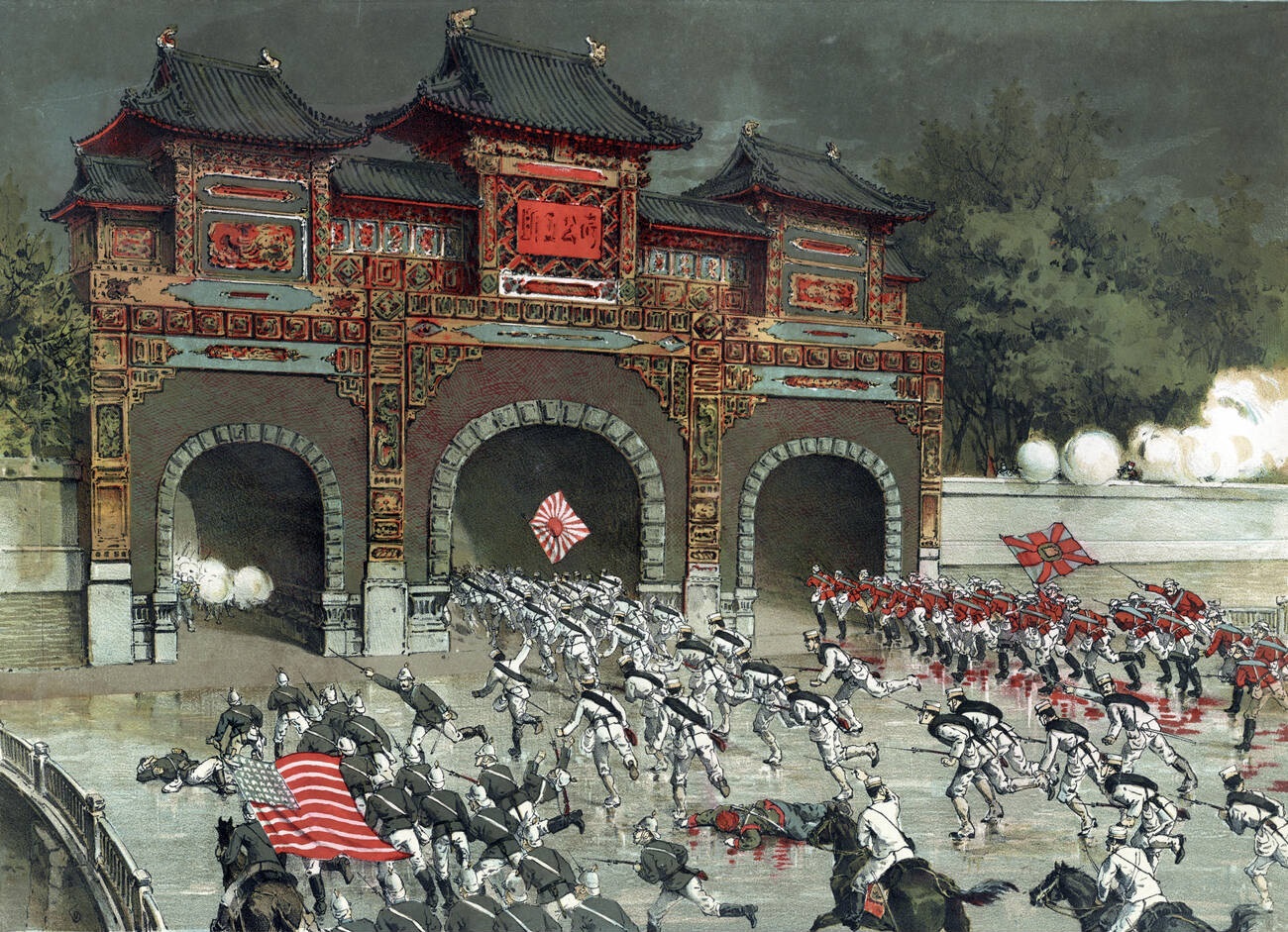
The Battle of Peking (Chinese: 北京之戰), or historically the Relief of Peking (Chinese: 北京解圍戰), was the battle fought on 14–15 August 1900 in Beijing, in which the Eight-Nation Alliance relieved the siege of the Peking Legation Quarter during the Boxer Rebellion. From 20 June 1900, Boxers and Imperial Chinese Army troops had besieged foreign diplomats, citizens and soldiers within the legations of Austria-Hungary, Belgium, Britain, France, Italy, The German Empire, Japan, Netherlands, The Russian Empire, Spain and the United States.
The first attempt to relieve the legations by a force of over 2,000 sailors and marines commanded by British Admiral Edward Seymour was turned back by strong opposition on 26 June.
On 4 August a second, much larger relief force, called the Eight-Nation Alliance, marched from Tientsien (Tianjin) toward Peking (Beijing). The alliance force consisted of 22,000 troops from the following countries:
Other sources give a figure of 18,000 troops.
The Alliance forces defeated the Chinese army at the Battle of Beicang (Peitsang) on 5 August and the Battle of Yangcun (Yangtsun) on 6 August and reached Tongzhou (Tongchou), 14 miles from Beijing (Peking), on 12 August. The relief force was much reduced by heat exhaustion and sunstroke and the men available for the assault on Beijing probably did not greatly exceed 10,000.
The British, American and Japanese commanders wanted to push on and attack Beijing on 13 August, but the Russian commander said he needed another day to prepare and 13 August was devoted to reconnaissance and rest.
The objective of the alliance forces was to fight their way into the city of Peking, make their way to the Legation Quarter and rescue the 900 foreigners besieged there by the Chinese army since 20 June.
Peking had formidable defense works. The city was surrounded by walls 21 miles in length and broken by 16 gates. The wall around the Inner (Tartar) city was 40 feet tall and 40 feet wide at the top. The wall around the adjoining Outer (Chinese) city was 30 feet high. The population living within the walls was about one million people, although many had fled to escape the Boxers and the fighting between the Chinese army and the foreigners in the Legation Quarter.
Hub AI
Battle of Peking (1900) AI simulator
(@Battle of Peking (1900)_simulator)
Battle of Peking (1900)
The Battle of Peking (Chinese: 北京之戰), or historically the Relief of Peking (Chinese: 北京解圍戰), was the battle fought on 14–15 August 1900 in Beijing, in which the Eight-Nation Alliance relieved the siege of the Peking Legation Quarter during the Boxer Rebellion. From 20 June 1900, Boxers and Imperial Chinese Army troops had besieged foreign diplomats, citizens and soldiers within the legations of Austria-Hungary, Belgium, Britain, France, Italy, The German Empire, Japan, Netherlands, The Russian Empire, Spain and the United States.
The first attempt to relieve the legations by a force of over 2,000 sailors and marines commanded by British Admiral Edward Seymour was turned back by strong opposition on 26 June.
On 4 August a second, much larger relief force, called the Eight-Nation Alliance, marched from Tientsien (Tianjin) toward Peking (Beijing). The alliance force consisted of 22,000 troops from the following countries:
Other sources give a figure of 18,000 troops.
The Alliance forces defeated the Chinese army at the Battle of Beicang (Peitsang) on 5 August and the Battle of Yangcun (Yangtsun) on 6 August and reached Tongzhou (Tongchou), 14 miles from Beijing (Peking), on 12 August. The relief force was much reduced by heat exhaustion and sunstroke and the men available for the assault on Beijing probably did not greatly exceed 10,000.
The British, American and Japanese commanders wanted to push on and attack Beijing on 13 August, but the Russian commander said he needed another day to prepare and 13 August was devoted to reconnaissance and rest.
The objective of the alliance forces was to fight their way into the city of Peking, make their way to the Legation Quarter and rescue the 900 foreigners besieged there by the Chinese army since 20 June.
Peking had formidable defense works. The city was surrounded by walls 21 miles in length and broken by 16 gates. The wall around the Inner (Tartar) city was 40 feet tall and 40 feet wide at the top. The wall around the adjoining Outer (Chinese) city was 30 feet high. The population living within the walls was about one million people, although many had fled to escape the Boxers and the fighting between the Chinese army and the foreigners in the Legation Quarter.