


Community hub
Recent from talks
Contribute something to knowledge base
Content stats: 0 posts, 0 articles, 1 media, 0 notes
Members stats: 0 subscribers, 0 contributors, 0 moderators, 0 supporters
Subscribers
Supporters
Contributors
Moderators
Hub AI
Battle of Selma AI simulator
(@Battle of Selma_simulator)
Hub AI
Battle of Selma AI simulator
(@Battle of Selma_simulator)
Battle of Selma
The Battle of Selma was fought on April 2, 1865 in Dallas County, Alabama during the American Civil War. It was part of the Union campaign through Alabama and Georgia, known as Wilson's Raid, in the final full month of the Civil War.
Brevet Major-General James H. Wilson, commanding three divisions of Union cavalry, about 13,500 men, led his men south from Gravelly Springs, Alabama, on March 22, 1865. Opposed by Confederate Lieutenant-General Nathan B. Forrest, Wilson skillfully continued his march and eventually defeated him in a running battle at Ebenezer Church, on April 1. Continuing towards Selma, Wilson split his command into three columns. Although Selma was well-defended, the Union columns broke through the defenses at separate points forcing the Confederates to surrender the city, although many of the officers and men, including Forrest and Lieutenant-General Richard Taylor, escaped.
On March 30, 1865, General Wilson detached Brigadier-General John T. Croxton's brigade to destroy all Confederate property at Tuscaloosa, Alabama. After capturing a Confederate courier who carried dispatches from Forrest describing the strength and disposition of his scattered forces, Wilson sent a brigade to destroy the bridge across the Cahaba River at Centreville. This effectively cut off Forrest from reinforcement. It also began a running fight that did not end until after the fall of Selma. Forrest had scattered his command through Mississippi, Alabama, and Tennessee, to refit his command following the Middle Tennessee Campaign, and Forrest spent several days in late March struggling to consolidate his force before Wilson's cavalry could advance south.
On the afternoon of April 1, following skirmishing in the morning, Wilson's advance guard ran into Forrest's line of battle at Ebenezer Church, where the Randolph Road intersected the main Selma road. Forrest had hoped to bring his entire force to bear on Wilson. However, because of delays caused by flooding, plus earlier contacts with the enemy, Forrest could only muster less than 2,000 men, many of whom were not veterans but poorly trained militia consisting of old men and young boys.
The outnumbered Confederates fought for over an hour, as Wilson deployed more Union cavalry and artillery on the field. Forrest himself was wounded by a saber-wielding Union captain, whom he killed with his revolver. Finally, a Union cavalry charge broke the Confederate militia, causing Forrest to be flanked on his right. He was forced to retreat under severe pressure. The battle failed to significantly delay or damage Wilson's force.
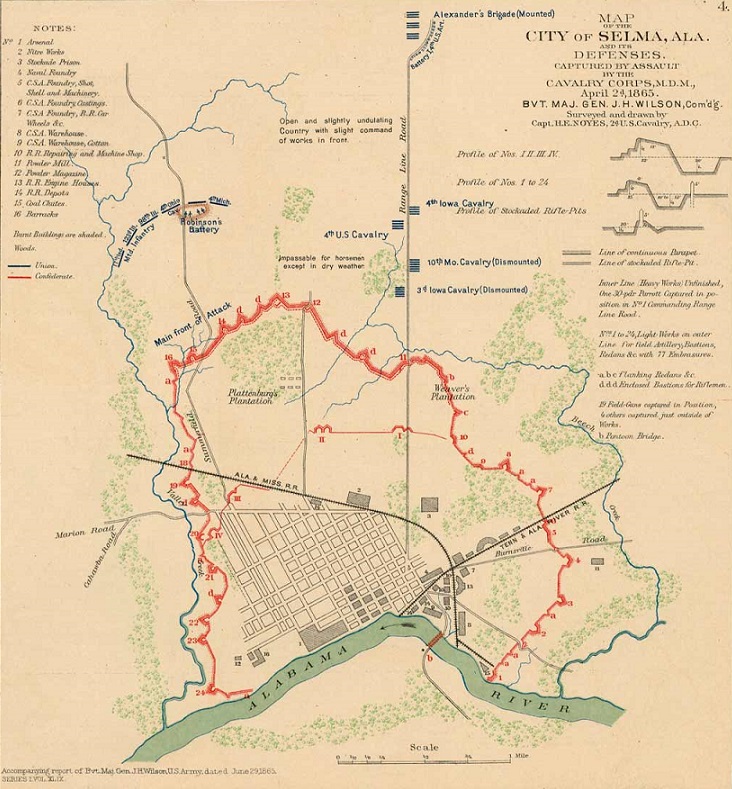
Early the next morning Forrest arrived at Selma, Alabama, a town of about 10,000 inhabitants, "horse and rider covered in blood." He advised Lieutenant-General Richard Taylor, departmental commander, to leave the city. Taylor did so after giving Forrest command of the defense. Selma was protected by three miles of fortifications, which ran in a semicircle around the city. They were anchored on the north and south by the Alabama River. The works had been built two years earlier and, while neglected since then, they were still formidable. The defenses were from 8 to 12 feet high, 15 feet thick at the base, and had a ditch 4 feet wide and 5 feet deep along the front. Before this was a picket fence of heavy posts planted in the ground, 5 feet high, and sharpened at the top. At prominent positions, earthen forts were built with artillery in position to cover the ground over which an assault would have to be made.
The Confederates defending Selma consisted of Armstrong, Roddey, and Crossland's brigades, Myrick's Artillery Battalion, Forrest's escort, and Alabama militia. Forrest's line of battle was so long that his 2,000 men were separated from each other from five to ten feet. There being from five to ten times as many Union troops, their line was close together. Just before the battle, it looked like they were all over the field to their front.
Wilson's force arrived at the Selma fortifications at 2 p.m. He placed Gen. Long's division across the Summerfield Road, with the Chicago Board of Trade Battery in support. Upton's Division was placed across the Range Line Road with Battery I, 4th U.S. Artillery in support. Wilson had 9,000 well-armed and well-trained troops available to make the assault. Wilson's plan was for Upton to send in a 300-man detachment after dark to cross the swamp on the Confederate right, enter the works, and begin a flanking movement toward the center moving along the line of fortifications. Then a single gun from Upton's artillery would fire the signal for an attack by the entire Federal corps. At 5 p.m., however, the ammunition train in Wilson's rear was attacked by advance elements of Forrest's scattered forces who were moving toward Selma. Long and Upton had both positioned significant numbers of the troops in their rear to guard against such an event. However, Long decided on his own to begin an assault against the Selma fortifications to neutralize the attack in his rear.
Battle of Selma
The Battle of Selma was fought on April 2, 1865 in Dallas County, Alabama during the American Civil War. It was part of the Union campaign through Alabama and Georgia, known as Wilson's Raid, in the final full month of the Civil War.
Brevet Major-General James H. Wilson, commanding three divisions of Union cavalry, about 13,500 men, led his men south from Gravelly Springs, Alabama, on March 22, 1865. Opposed by Confederate Lieutenant-General Nathan B. Forrest, Wilson skillfully continued his march and eventually defeated him in a running battle at Ebenezer Church, on April 1. Continuing towards Selma, Wilson split his command into three columns. Although Selma was well-defended, the Union columns broke through the defenses at separate points forcing the Confederates to surrender the city, although many of the officers and men, including Forrest and Lieutenant-General Richard Taylor, escaped.
On March 30, 1865, General Wilson detached Brigadier-General John T. Croxton's brigade to destroy all Confederate property at Tuscaloosa, Alabama. After capturing a Confederate courier who carried dispatches from Forrest describing the strength and disposition of his scattered forces, Wilson sent a brigade to destroy the bridge across the Cahaba River at Centreville. This effectively cut off Forrest from reinforcement. It also began a running fight that did not end until after the fall of Selma. Forrest had scattered his command through Mississippi, Alabama, and Tennessee, to refit his command following the Middle Tennessee Campaign, and Forrest spent several days in late March struggling to consolidate his force before Wilson's cavalry could advance south.
On the afternoon of April 1, following skirmishing in the morning, Wilson's advance guard ran into Forrest's line of battle at Ebenezer Church, where the Randolph Road intersected the main Selma road. Forrest had hoped to bring his entire force to bear on Wilson. However, because of delays caused by flooding, plus earlier contacts with the enemy, Forrest could only muster less than 2,000 men, many of whom were not veterans but poorly trained militia consisting of old men and young boys.
The outnumbered Confederates fought for over an hour, as Wilson deployed more Union cavalry and artillery on the field. Forrest himself was wounded by a saber-wielding Union captain, whom he killed with his revolver. Finally, a Union cavalry charge broke the Confederate militia, causing Forrest to be flanked on his right. He was forced to retreat under severe pressure. The battle failed to significantly delay or damage Wilson's force.
Early the next morning Forrest arrived at Selma, Alabama, a town of about 10,000 inhabitants, "horse and rider covered in blood." He advised Lieutenant-General Richard Taylor, departmental commander, to leave the city. Taylor did so after giving Forrest command of the defense. Selma was protected by three miles of fortifications, which ran in a semicircle around the city. They were anchored on the north and south by the Alabama River. The works had been built two years earlier and, while neglected since then, they were still formidable. The defenses were from 8 to 12 feet high, 15 feet thick at the base, and had a ditch 4 feet wide and 5 feet deep along the front. Before this was a picket fence of heavy posts planted in the ground, 5 feet high, and sharpened at the top. At prominent positions, earthen forts were built with artillery in position to cover the ground over which an assault would have to be made.
The Confederates defending Selma consisted of Armstrong, Roddey, and Crossland's brigades, Myrick's Artillery Battalion, Forrest's escort, and Alabama militia. Forrest's line of battle was so long that his 2,000 men were separated from each other from five to ten feet. There being from five to ten times as many Union troops, their line was close together. Just before the battle, it looked like they were all over the field to their front.
Wilson's force arrived at the Selma fortifications at 2 p.m. He placed Gen. Long's division across the Summerfield Road, with the Chicago Board of Trade Battery in support. Upton's Division was placed across the Range Line Road with Battery I, 4th U.S. Artillery in support. Wilson had 9,000 well-armed and well-trained troops available to make the assault. Wilson's plan was for Upton to send in a 300-man detachment after dark to cross the swamp on the Confederate right, enter the works, and begin a flanking movement toward the center moving along the line of fortifications. Then a single gun from Upton's artillery would fire the signal for an attack by the entire Federal corps. At 5 p.m., however, the ammunition train in Wilson's rear was attacked by advance elements of Forrest's scattered forces who were moving toward Selma. Long and Upton had both positioned significant numbers of the troops in their rear to guard against such an event. However, Long decided on his own to begin an assault against the Selma fortifications to neutralize the attack in his rear.
Recent media
Recent media