
Recent from talks
Battle of the Valerik River
Knowledge base stats:
Talk channels stats:
Members stats:
Battle of the Valerik River
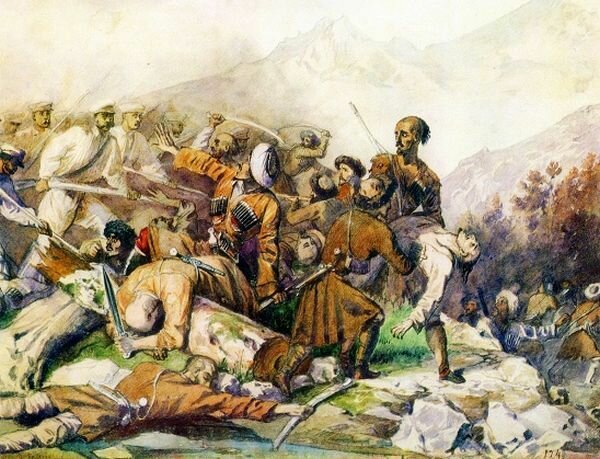
The Battle of the Valerik River on 11 July 1840 was fought as part of the Russian conquest of the Caucasus. It occurred about 30 km (19 miles) southwest of the fortress of Groznaya (now Grozny) between forces of the Imperial Russian Army and North Caucasian mountaineers led by the naib (viceroy) Ahberdila Muhammad. It remains famous because of the poem "Valerik" by Mikhail Lermontov, a participant.
An attempt to disarm the population of Chechnya in the spring of 1840 had caused unrest which grew into open rebellion against the Russian authorities. The Caucasus resistance leader, Imam Shamil, took this opportunity to appoint Ahberdila Muhammad as naib (governor) of Lesser Chechnya and call for a general uprising of the Karabulaks, Galashians, the Sunzha and Nadterechny Chechens, Nazrans and Ghalghaï. The Russian authorities felt compelled to organize a military expedition against the rebels. The Russian writer M. Lermontov also participated in the battle.
On 6 July the Galafeyev detachment set out from the Groznaya fortress and began destroying the fields and villages to the south and southwest of the fortress, as the inhabitants fled. The rebels did not resist directly, but engaged in constant harassing actions which afflicted the Russians and caused losses.
The detachment's line of march led toward the village of Achkhoy, the road to which passed through the Chekhinsky Forest and crossed the Valerik River. The rebels apparently anticipated the Russian movement and for three days fortified the banks of the Valerik with abatis and debris. On 11 July the Galafeyev detachment decamped from the village of Gekhi and moved toward the Valerik.
Lermontov, in a letter to Barbara Lopukhin and later in his poem "Valerik", evaluated the strength of the enemy at 6,000 to 7,000 fighters. Given that in the area of Lesser Chechnya under the leadership of Ahberdila Muhammad, there were 5,700 families, and that an unprecedented effort was being made on the part of the rebels; assuming about one fighter from each family, the number 6,000 does not seem too high.
Passing through the Chekhinsky Forest toward the Valerik, the Russian column stretched along a narrow forest road. The approaches to the river saw the first clash as the rebels fired on the column from the forest undergrowth. The Russian advance guard, however, quickly chased off the enemy and the column's battle order was restored.
Soon a Russian detachment reached the Valerik. The river at this point intersects the road the Russians were using almost perpendicularly, and in normal conditions is easily fordable. The bank on the Russian side is an open beach, but the opposite bank is steep and wooded. On both sides of the road the rebels had cut down trees to create a clear field of fire about the length of a musket shot.
Approaching the river to within canister range, the Russian gunners fired a volley into the thicket on the opposite shore, but no reaction was seen.
Hub AI
Battle of the Valerik River AI simulator
(@Battle of the Valerik River_simulator)
Battle of the Valerik River
The Battle of the Valerik River on 11 July 1840 was fought as part of the Russian conquest of the Caucasus. It occurred about 30 km (19 miles) southwest of the fortress of Groznaya (now Grozny) between forces of the Imperial Russian Army and North Caucasian mountaineers led by the naib (viceroy) Ahberdila Muhammad. It remains famous because of the poem "Valerik" by Mikhail Lermontov, a participant.
An attempt to disarm the population of Chechnya in the spring of 1840 had caused unrest which grew into open rebellion against the Russian authorities. The Caucasus resistance leader, Imam Shamil, took this opportunity to appoint Ahberdila Muhammad as naib (governor) of Lesser Chechnya and call for a general uprising of the Karabulaks, Galashians, the Sunzha and Nadterechny Chechens, Nazrans and Ghalghaï. The Russian authorities felt compelled to organize a military expedition against the rebels. The Russian writer M. Lermontov also participated in the battle.
On 6 July the Galafeyev detachment set out from the Groznaya fortress and began destroying the fields and villages to the south and southwest of the fortress, as the inhabitants fled. The rebels did not resist directly, but engaged in constant harassing actions which afflicted the Russians and caused losses.
The detachment's line of march led toward the village of Achkhoy, the road to which passed through the Chekhinsky Forest and crossed the Valerik River. The rebels apparently anticipated the Russian movement and for three days fortified the banks of the Valerik with abatis and debris. On 11 July the Galafeyev detachment decamped from the village of Gekhi and moved toward the Valerik.
Lermontov, in a letter to Barbara Lopukhin and later in his poem "Valerik", evaluated the strength of the enemy at 6,000 to 7,000 fighters. Given that in the area of Lesser Chechnya under the leadership of Ahberdila Muhammad, there were 5,700 families, and that an unprecedented effort was being made on the part of the rebels; assuming about one fighter from each family, the number 6,000 does not seem too high.
Passing through the Chekhinsky Forest toward the Valerik, the Russian column stretched along a narrow forest road. The approaches to the river saw the first clash as the rebels fired on the column from the forest undergrowth. The Russian advance guard, however, quickly chased off the enemy and the column's battle order was restored.
Soon a Russian detachment reached the Valerik. The river at this point intersects the road the Russians were using almost perpendicularly, and in normal conditions is easily fordable. The bank on the Russian side is an open beach, but the opposite bank is steep and wooded. On both sides of the road the rebels had cut down trees to create a clear field of fire about the length of a musket shot.
Approaching the river to within canister range, the Russian gunners fired a volley into the thicket on the opposite shore, but no reaction was seen.
Recent media