


Community hub
Recent from talks
Contribute something to knowledge base
Content stats: 0 posts, 0 articles, 1 media, 0 notes
Members stats: 0 subscribers, 0 contributors, 0 moderators, 0 supporters
Subscribers
Supporters
Contributors
Moderators
Batty Langley
Batty Langley (baptised 14 September 1696 – 3 March 1751) was an English garden designer, architect, and prolific writer who produced a number of engraved designs for "Gothick" structures, summerhouses and garden seats in the years before the mid-18th century.
An eccentric landscape designer, he gave four of his sons the names Hiram, Euclid, Vitruvius and Archimedes. He published extensively, and attempted to "improve" Gothic forms by giving them classical proportions.
Langley was baptised in Twickenham, Middlesex, the son of a jobbing gardener Daniel Langley and his wife Elizabeth. He bore the name of David Batty, one of his father's patrons. He started worked as a gardener, inheriting some of his father's clients in Twickenham, then a village of suburban villas within easy reach of London by a pleasant water journey on the Thames. An early client was Thomas Vernon of Twickenham Park.
He married Anne Smith in February 1719. They had four children, but she died in June 1726. He had ten further children with his second wife, Catherine.
Langley moved into surveying and landscape gardening. He published his first book, Practical Geometry, in 1726. Inspired by Switzer's Ichnographia Rustica of 1718, Langley advocated more irregular, informal gardens, with rococo "arti-natural" landscaping. His sinuous forms predated William Hogarth's line of beauty.
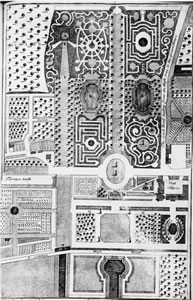
For the Palladian house built at Twickenham by James Johnston in 1710 (later Orleans House, demolished 1926), Langley, probably on his own endeavour, prepared and published a garden plan, which offered an encyclopaedia of the garden features that were swiftly becoming obsolete by the time the plan was published in Langley's A Sure Method of Improving Estates (1728): here are several mazes, a "wilderness" with many tortuous path-turnings, garden rooms or cabinets de verdure cut into dense woodland, formal stretches of garden canal and formally shaped basins of water, some with central fountains, and a central allée of trees leading to an exedra.
His New Principles of Gardening (1728) included designs for mazes, a feature he could never quite leave behind, with 28 plates engraved by his brother Thomas. He also published A Sure Method of Improving Estates (1728) and Pomona (1729).
He also undertook work at Castle Howard in North Yorkshire and Wrest Park in Bedfordshire.
Batty Langley
Batty Langley (baptised 14 September 1696 – 3 March 1751) was an English garden designer, architect, and prolific writer who produced a number of engraved designs for "Gothick" structures, summerhouses and garden seats in the years before the mid-18th century.
An eccentric landscape designer, he gave four of his sons the names Hiram, Euclid, Vitruvius and Archimedes. He published extensively, and attempted to "improve" Gothic forms by giving them classical proportions.
Langley was baptised in Twickenham, Middlesex, the son of a jobbing gardener Daniel Langley and his wife Elizabeth. He bore the name of David Batty, one of his father's patrons. He started worked as a gardener, inheriting some of his father's clients in Twickenham, then a village of suburban villas within easy reach of London by a pleasant water journey on the Thames. An early client was Thomas Vernon of Twickenham Park.
He married Anne Smith in February 1719. They had four children, but she died in June 1726. He had ten further children with his second wife, Catherine.
Langley moved into surveying and landscape gardening. He published his first book, Practical Geometry, in 1726. Inspired by Switzer's Ichnographia Rustica of 1718, Langley advocated more irregular, informal gardens, with rococo "arti-natural" landscaping. His sinuous forms predated William Hogarth's line of beauty.
For the Palladian house built at Twickenham by James Johnston in 1710 (later Orleans House, demolished 1926), Langley, probably on his own endeavour, prepared and published a garden plan, which offered an encyclopaedia of the garden features that were swiftly becoming obsolete by the time the plan was published in Langley's A Sure Method of Improving Estates (1728): here are several mazes, a "wilderness" with many tortuous path-turnings, garden rooms or cabinets de verdure cut into dense woodland, formal stretches of garden canal and formally shaped basins of water, some with central fountains, and a central allée of trees leading to an exedra.
His New Principles of Gardening (1728) included designs for mazes, a feature he could never quite leave behind, with 28 plates engraved by his brother Thomas. He also published A Sure Method of Improving Estates (1728) and Pomona (1729).
He also undertook work at Castle Howard in North Yorkshire and Wrest Park in Bedfordshire.
Recent media
Recent media