Hubbry Logo
search
logo

Bayes error rate

logo
Community Hub0 Subscribers
Read side by side
from Wikipedia

In statistical classification, Bayes error rate is the lowest possible error rate for any classifier of a random outcome (into, for example, one of two categories) and is analogous to the irreducible error.[1][2]

A number of approaches to the estimation of the Bayes error rate exist. One method seeks to obtain analytical bounds which are inherently dependent on distribution parameters, and hence difficult to estimate. Another approach focuses on class densities, while yet another method combines and compares various classifiers.[2]

The Bayes error rate finds important use in the study of patterns and machine learning techniques.[3]

Definition

[edit]

Mohri, Rostamizadeh and Talwalkar define it as

Given a distribution over , the Bayes error is defined as the infimum of the errors achieved by measurable functions :
A hypothesis h with R(h) = R* is called a Bayes hypothesis or Bayes classifier.

Error determination

[edit]

In terms of machine learning and pattern classification, the labels of a set of random observations can be divided into 2 or more classes. Each observation is called an instance and the class it belongs to is the label. The Bayes error rate of the data distribution is the probability an instance is misclassified by a classifier that knows the true class probabilities given the predictors.

For a multiclass classifier, the expected prediction error may be calculated as follows:[3]

where is the instance, the expectation value, is a class into which an instance is classified, is the conditional probability of label for instance , and is the 0–1 loss function:

,

where is the Kronecker delta.

When the learner knows the conditional probability, then one solution is:

This solution is known as the Bayes classifier.

The corresponding expected Prediction Error is called the Bayes error rate:

,

where the sum can be omitted in the last step due to considering the counter event. By the definition of the Bayes classifier, it maximizes and, therefore, minimizes the Bayes error BE.

The Bayes error is non-zero if the classification labels are not deterministic, i.e., there is a non-zero probability of a given instance belonging to more than one class.[4] In a regression context with squared error, the Bayes error is equal to the noise variance.[3]

Proof of Minimality

[edit]

Proof that the Bayes error rate is indeed the minimum possible and that the Bayes classifier is therefore optimal, may be found together on the Wikipedia page Bayes classifier.


Plug-in Rules for Binary Classifiers

[edit]

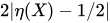
A plug-in rule uses an estimate of the posterior probability to form a classification rule. Given an estimate , the excess Bayes error rate of the associated classifier is bounded above by:

To see this, note that the excess Bayes error is equal to 0 where the classifiers agree, and equal to where they disagree. To form the bound, notice that is at least as far as when the classifiers disagree.
See also

[edit]

References

[edit]
Revisions and contributorsEdit on WikipediaRead on Wikipedia
from Grokipedia
The Bayes error rate is the lowest achievable error rate for any classifier in a given supervised classification problem, serving as a theoretical lower bound on the misclassification probability under the 0-1 loss function. It is defined as 1EX[max1jcP(Y=jX)]1 - \mathbb{E}_{\mathbf{X}} \left[ \max_{1 \leq j \leq c} P(Y = j \mid \mathbf{X}) \right], where the expectation is taken over the marginal distribution of the feature vector X\mathbf{X}, YY is the class label, and cc is the number of classes; this quantifies the irreducible error arising from inherent overlaps in the class-conditional distributions.[1] The rate is achieved exclusively by the Bayes optimal classifier, which assigns an input x\mathbf{x} to the class j^=argmaxjP(Y=jX=x)\hat{j} = \arg\max_j P(Y = j \mid \mathbf{X} = \mathbf{x}), equivalent to selecting the class with the highest posterior probability based on the true joint distribution fX,Yf_{\mathbf{X},Y}.[1] In machine learning, the Bayes error rate acts as a fundamental benchmark for evaluating classifier performance, indicating how close a practical model can approach optimal generalization without overfitting or underfitting.[2] It depends solely on the underlying data distribution and feature quality, rather than on algorithmic choices, making it zero only when class-conditional densities have no overlap and positive otherwise due to probabilistic ambiguity.[3] Since the true distribution is unknown in practice, estimating the Bayes error rate is challenging but crucial for assessing whether poor performance stems from inadequate features, limited data, or suboptimal algorithms; common estimation techniques include ensemble-based methods that average posterior probabilities from diverse classifiers or use information-theoretic measures like mutual information to approximate the bound.[3] Recent advances have explored training neural networks to approach the Bayes error rate, such as through specialized losses like the Bayes Optimal Learning Threshold (BOLT), which have demonstrated superior results on benchmarks including MNIST (99.29% accuracy) and CIFAR-10 (93.29% accuracy) by directly optimizing toward the posterior maximum rather than surrogate objectives like cross-entropy.[2] These developments highlight the rate's role in pushing the limits of achievable accuracy, particularly in high-dimensional settings where traditional estimators may fail.

Fundamentals

Definition

The Bayes error rate is defined as the lowest possible error rate achievable by any classifier in a given classification problem, representing the expected probability of misclassification under the optimal Bayes classifier when the true underlying probability distributions are fully known. This optimal classifier assigns each observation to the class that maximizes the posterior probability $ P(Y = c \mid X = x) $, where $ Y $ is the class label and $ X $ is the feature vector. Formally, the Bayes error rate $ R^* $ is given by
R=E[1maxcP(Y=cX)]=(1maxcP(Y=cx))dPX(x), R^* = \mathbb{E}\left[1 - \max_c P(Y = c \mid X)\right] = \int \left(1 - \max_c P(Y = c \mid x)\right) \, dP_X(x),
where the expectation is taken over the distribution of the features $ X $, and the maximum is over all possible class labels $ c $. This quantity captures the inherent uncertainty in the data due to overlapping class-conditional distributions, making it the irreducible minimum error even with perfect model specification. Intuitively, the Bayes error rate quantifies the fundamental limit imposed by probabilistic overlap in the classes; for instance, if class distributions are completely separable, $ R^* = 0 $, but any overlap introduces unavoidable misclassifications. The concept emerged within statistical decision theory during the mid-20th century, extending the foundational Bayes' theorem originally formulated by Thomas Bayes and published posthumously in 1763.[4]

Bayesian Decision Theory Context

Bayesian decision theory establishes a probabilistic framework for optimal decision-making under uncertainty, particularly in classification tasks where the goal is to assign an observation to one of several possible classes. This theory formalizes the minimization of expected risk, defined as the average loss incurred over the joint distribution of observations and true classes. For classification problems, the 0-1 loss function is commonly employed, assigning a loss of 1 for misclassification and 0 for correct assignment, thereby reducing the objective to minimizing the probability of error. At the core of Bayesian decision theory lies the posterior probability $ P(Y=c \mid X=x) $, which quantifies the probability that the true class label $ Y $ is $ c $ given the feature vector $ X = x $. These posteriors encapsulate all available information about the class membership and serve as the basis for rational decision-making, allowing the incorporation of both data-driven evidence and prior beliefs to update the probability of each class. The Bayes classifier rule operationalizes this by assigning the observation $ X = x $ to the class $ c^* = \arg\max_c P(Y=c \mid X=x) $, selecting the class with the maximum a posteriori probability to minimize the expected 0-1 loss. This rule derives directly from Bayes' theorem, which computes the posterior as
P(Y=cX=x)=p(xY=c)P(Y=c)p(x), P(Y=c \mid X=x) = \frac{p(x \mid Y=c) P(Y=c)}{p(x)},
where $ p(x \mid Y=c) $ denotes the class-conditional likelihood (the density of $ x $ given class $ c $), $ P(Y=c) $ is the prior probability of class $ c $, and $ p(x) = \sum_c p(x \mid Y=c) P(Y=c) $ is the marginal density of $ x $. This connection highlights the theory's reliance on priors to reflect domain knowledge or base rates, combined with likelihoods to weigh evidence from the observation. In contrast to frequentist approaches, which emphasize parameter estimation from data alone and treat probabilities as long-run frequencies without priors, Bayesian decision theory explicitly models uncertainty through subjective or objective priors, enabling a coherent update to posteriors that integrates all information sources. The Bayes error rate corresponds to the expected risk under this optimal rule, serving as a theoretical benchmark for classifier performance.

Computation

General Formula

The Bayes error rate $ R^* $ represents the minimum achievable error rate for classifying observations from a joint distribution $ P(X, Y) $, where $ X $ is the feature vector and $ Y $ is the class label taking values in $ {1, 2, \dots, K} $ for the multi-class setting. It is derived as the expected value of the conditional misclassification probability under the optimal Bayes classifier, which assigns $ x $ to $ \arg\max_c P(Y = c \mid X = x) $. This conditional error is $ 1 - \max_c P(Y = c \mid X = x) $, so $ R^* = E\left[1 - \max_c P(Y = c \mid X)\right] $. The expectation is taken with respect to the marginal distribution of $ X $, yielding the integral form $ R^* = \int_{\mathcal{X}} \left(1 - \max_c P(Y = c \mid x)\right) p(x) , dx $, where $ p(x) $ denotes the marginal density of $ X $ and $ \mathcal{X} $ is the feature space. This expression arises from integrating the pointwise error over all possible feature values, weighted by their density.[5] In the multi-class extension for $ K > 2 $, the formula captures the probability of not selecting the true class, as the Bayes classifier maximizes the posterior for each $ x $, leading to misclassification precisely when the true class does not have the highest posterior. The posterior probabilities $ P(Y = c \mid x) $ follow from Bayesian decision theory via Bayes' theorem applied to the known joint distribution. The derivation relies on the assumption that the full joint distribution $ P(X, Y) $ is known, enabling exact computation of class-conditional densities $ p(x \mid Y = c) $ and priors $ P(Y = c) $; additionally, observations are assumed to be independent and identically distributed from this distribution.[6] As an illustrative example, consider a setting where each class follows a Gaussian mixture model with known means, covariances, and mixing weights; the posteriors are then mixtures of Gaussian densities, and $ R^* $ is obtained by integrating $ 1 - \max_c P(Y = c \mid x) $ over the decision regions defined by posterior maxima, often requiring partitioning the space into Voronoi-like cells for evaluation.

Binary Classification Case

In the binary classification case, the Bayes error rate simplifies from the general multi-class form to a direct integral over the feature space. Specifically, it is given by
R=min(π0p0(x),π1p1(x))dx, R^* = \int \min\left( \pi_0 p_0(\mathbf{x}), \pi_1 p_1(\mathbf{x}) \right) d\mathbf{x},
where π0\pi_0 and π1=1π0\pi_1 = 1 - \pi_0 are the prior probabilities of the two classes, and p0(x)p_0(\mathbf{x}) and p1(x)p_1(\mathbf{x}) are the corresponding class-conditional probability density functions.[7] This expression represents the expected minimum conditional error probability, integrated over the marginal density of x\mathbf{x}. The optimal Bayes classifier assigns a feature vector x\mathbf{x} to class 1 if the posterior probability P(Y=1x)>0.5P(Y=1 \mid \mathbf{x}) > 0.5, and to class 0 otherwise; this decision boundary occurs where P(Y=1x)=0.5P(Y=1 \mid \mathbf{x}) = 0.5. Since the posterior incorporates the priors via Bayes' theorem, P(Y=1x)=π1p1(x)π0p0(x)+π1p1(x)P(Y=1 \mid \mathbf{x}) = \frac{\pi_1 p_1(\mathbf{x})}{\pi_0 p_0(\mathbf{x}) + \pi_1 p_1(\mathbf{x})}, unequal priors shift the boundary relative to the equal-prior case by altering the likelihood ratio threshold p1(x)p0(x)>π0π1\frac{p_1(\mathbf{x})}{p_0(\mathbf{x})} > \frac{\pi_0}{\pi_1}.[7] In contrast to multi-class settings, binary classification involves only a single decision boundary (or surface in higher dimensions), reducing the complexity of determining the regions where one class dominates. The Bayes error rate quantifies the inherent overlap between the two class-conditional distributions, weighted by the priors. In symmetric scenarios with equal priors (π0=π1=0.5\pi_0 = \pi_1 = 0.5), RR^* measures the degree of separability; minimal overlap yields low error, while substantial overlap increases it. For instance, when the class-conditional distributions are univariate Gaussians with equal variances σ2\sigma^2 but different means μ0<μ1\mu_0 < \mu_1, the decision boundary is at μ0+μ12\frac{\mu_0 + \mu_1}{2}, and the error admits a closed-form expression using the Gaussian Q-function (the complementary cumulative distribution function of the standard normal):
R=Q(μ1μ02σ), R^* = Q\left( \frac{\mu_1 - \mu_0}{2\sigma} \right),
which can equivalently be written in terms of the error function as R=12erfc(μ1μ022σ)R^* = \frac{1}{2} \operatorname{erfc}\left( \frac{\mu_1 - \mu_0}{2\sqrt{2}\sigma} \right). This highlights how the error decreases exponentially with increasing separation between means relative to the variance.

Theoretical Properties

Proof of Optimality

The proof of the optimality of the Bayes classifier begins by considering the general setup in statistical decision theory for classification problems. Let (X,Y)(X, Y) be a random pair where XRdX \in \mathbb{R}^d is the feature vector and YY takes values in a finite set Y={1,,K}\mathcal{Y} = \{1, \dots, K\} representing the classes, with known joint distribution PX,YP_{X,Y}. A classifier δ:RdY\delta: \mathbb{R}^d \to \mathcal{Y} is a measurable function that assigns a predicted class to each feature vector. Under the 0-1 loss function L(y,a)=1{ya}L(y, a) = 1_{\{y \neq a\}}, the risk (expected loss) of δ\delta is
R(δ)=E[L(Y,δ(X))]=P(Yδ(X)). R(\delta) = \mathbb{E}[L(Y, \delta(X))] = P(Y \neq \delta(X)).
The Bayes risk RR^* is defined as the infimum of R(δ)R(\delta) over all possible classifiers δ\delta. The conditional risk given X=xX = x for a fixed classifier δ\delta is
R(δx)=E[L(Y,δ(x))X=x]=yYP(Y=yX=x)1{yδ(x)}=1P(Y=δ(x)X=x). R(\delta \mid x) = \mathbb{E}[L(Y, \delta(x)) \mid X = x] = \sum_{y \in \mathcal{Y}} P(Y = y \mid X = x) \cdot 1_{\{y \neq \delta(x)\}} = 1 - P(Y = \delta(x) \mid X = x).
For any xx, the minimum possible conditional risk is achieved by choosing the action aYa \in \mathcal{Y} that maximizes the posterior probability P(Y=aX=x)P(Y = a \mid X = x), yielding
minaYR(δax)=1maxaYP(Y=aX=x)=minaYP(YaX=x), \min_{a \in \mathcal{Y}} R(\delta_a \mid x) = 1 - \max_{a \in \mathcal{Y}} P(Y = a \mid X = x) = \min_{a \in \mathcal{Y}} P(Y \neq a \mid X = x),
where δa(x)=a\delta_a(x) = a is the constant classifier assigning class aa. The Bayes classifier δ(x)\delta^*(x) is defined pointwise as δ(x)=argmaxaYP(Y=aX=x)\delta^*(x) = \arg\max_{a \in \mathcal{Y}} P(Y = a \mid X = x), so R(δx)=minaYR(δax)R(\delta^* \mid x) = \min_{a \in \mathcal{Y}} R(\delta_a \mid x). For any other classifier δ\delta, since δ(x)\delta(x) selects some aYa \in \mathcal{Y},
R(δx)minaYR(δax)=R(δx), R(\delta \mid x) \geq \min_{a \in \mathcal{Y}} R(\delta_a \mid x) = R(\delta^* \mid x),
with equality if and only if δ(x)=δ(x)\delta(x) = \delta^*(x) (or any maximizer if there are ties). Integrating over the marginal distribution of XX, the overall risk decomposes as
R(δ)=E[R(δX)]=RdR(δx)dPX(x)RdR(δx)dPX(x)=E[R(δX)]=R(δ). R(\delta) = \mathbb{E}[R(\delta \mid X)] = \int_{\mathbb{R}^d} R(\delta \mid x) \, dP_X(x) \geq \int_{\mathbb{R}^d} R(\delta^* \mid x) \, dP_X(x) = \mathbb{E}[R(\delta^* \mid X)] = R(\delta^*).
Thus, R(δ)R=R(δ)R(\delta) \geq R^* = R(\delta^*) for any classifier δ\delta, with equality if δ=δ\delta = \delta^* almost everywhere with respect to PXP_X. The Bayes error rate is therefore RR^*, the lowest achievable error rate under the known distribution PX,YP_{X,Y}. This proof assumes the joint distribution is fully known, allowing exact computation of the posteriors; in practice, with unknown distributions, the Bayes risk serves as a theoretical lower bound but may not be attainable. The result extends to randomized classifiers, which output a probability distribution γ(x)=(γ1(x),,γK(x))\gamma(x) = (\gamma_1(x), \dots, \gamma_K(x)) over Y\mathcal{Y} with kγk(x)=1\sum_k \gamma_k(x) = 1 and γk(x)0\gamma_k(x) \geq 0. The conditional risk becomes
R(γx)=k=1Kγk(x)R(δkx), R(\gamma \mid x) = \sum_{k=1}^K \gamma_k(x) \cdot R(\delta_k \mid x),
a convex combination of the deterministic conditional risks. Since the minimum over convex combinations is achieved at the extreme points (i.e., deterministic classifiers), the optimal randomized risk equals the optimal deterministic risk RR^*, and no improvement is possible beyond the Bayes classifier.

Bounds and Limitations

The Bayes error rate, while theoretically optimal, is constrained by several fundamental bounds that highlight its theoretical limits. A key lower bound is provided by Fano's inequality, which connects the error rate to the uncertainty in class labels given the features. For a classification problem with KK classes, the Bayes error rate RR^* satisfies
RH(YX)1logK, R^* \geq \frac{H(Y \mid X) - 1}{\log K},
where H(YX)H(Y \mid X) denotes the conditional entropy of the class labels YY given the features XX. This bound underscores that significant residual uncertainty in the features about the classes implies a non-zero irreducible error, even with perfect knowledge of the distributions. Complementing this, for binary classification, an upper bound on the Bayes error is given by the Hellman-Raviv inequality, which leverages the conditional entropy as well: RH(YX)/2R^* \leq H(Y \mid X)/2.[8] This result, derived in the context of equivocation and Chernoff measures, also relates to divergence metrics such as the Bhattacharyya coefficient, where for the binary case, Rp1(x)p2(x)dxR^* \leq \int \sqrt{p_1(x) p_2(x)} \, dx, with p1p_1 and p2p_2 as class-conditional densities; extensions to multiple classes use pairwise overlaps.[8] Despite these bounds, the Bayes error rate has inherent limitations in practical settings. It assumes complete knowledge of the underlying probability distributions, which is unattainable in real-world scenarios where distributions must be estimated from finite data, leading to approximations that exceed the true RR^*. Moreover, while RR^* captures the irreducible error due to inherent overlap in the distributions, it disregards the complexity of modeling the distributions themselves, such as computational costs or parametric assumptions that can inflate empirical errors. Asymptotically, the behavior of the Bayes error rate depends on feature dimensionality and class separability. With increasing dimensions, if added features reduce conditional entropy by enhancing separability (e.g., through higher signal-to-noise ratios in Gaussian models), RR^* decreases toward zero. However, in high dimensions without sufficient structure, distributions may appear more similar due to volume concentration effects, potentially elevating RR^* unless separability scales appropriately. The Bayes error rate also ties into broader theoretical constraints via the no-free-lunch theorem, which asserts that no classifier can outperform the Bayes optimal classifier on average when performance is aggregated across all possible distributions. This implies that while the Bayes error sets the per-distribution benchmark, empirical methods cannot universally beat it without distribution-specific adaptations, reinforcing the centrality of RR^* as an unattainable ideal.

Estimation Methods

Plug-in Classifiers

Plug-in classifiers provide a parametric approach to approximating the Bayes classifier by estimating the necessary components from training data. In this method, the class priors π^c\hat{\pi}_c are estimated as the empirical proportions of samples from each class cc, and the conditional densities p^(xc)\hat{p}(x \mid c) are estimated using parametric models, such as assuming a specific family like Gaussian distributions. The plug-in classifier is then formed by substituting these estimates into the Bayes decision rule: δ^(x)=argmaxcπ^cp^(xc)\hat{\delta}(x) = \arg\max_c \hat{\pi}_c \hat{p}(x \mid c).[9] The apparent error rate of the plug-in classifier, computed on the training data, serves as an estimate of its performance but tends to underestimate the true Bayes error due to overfitting, introducing optimism bias. This bias arises because the estimates π^c\hat{\pi}_c and p^(xc)\hat{p}(x \mid c) are fitted directly to the training samples, leading to lower reported errors than the expected error on unseen data. To mitigate this, techniques like cross-validation are often applied to obtain a more reliable estimate of the plug-in error relative to the irreducible Bayes error.[10] In the binary classification case with two classes, say c=0c = 0 and c=1c = 1, the plug-in approach simplifies under Gaussian assumptions with equal covariance matrices Σ\Sigma. Here, linear discriminant analysis (LDA) emerges as the plug-in classifier, where the decision boundary is a linear hyperplane derived from the log-ratio of the estimated posteriors. Specifically, the discriminant function for class cc is δc(x)=xTΣ1μc12μcTΣ1μc+logπc\delta_c(x) = x^T \Sigma^{-1} \mu_c - \frac{1}{2} \mu_c^T \Sigma^{-1} \mu_c + \log \pi_c, and classification assigns xx to the class maximizing this, yielding a linear boundary when covariances are shared across classes. Under the assumption that the parametric model is correctly specified, plug-in classifiers exhibit asymptotic consistency, meaning their error rate converges to the Bayes error as the sample size nn increases. The convergence rate typically follows O(1/n)O(1/\sqrt{n}) for the excess risk, depending on the estimation accuracy of the parameters, with faster rates possible under stronger parametric assumptions. This consistency holds provided the priors and densities are consistently estimable, ensuring the plug-in rule approximates the optimal Bayes classifier in the limit. A key example of a plug-in classifier allowing unequal covariances is quadratic discriminant analysis (QDA), which extends the Gaussian assumption to class-specific Σc\Sigma_c. The decision boundary in binary QDA becomes quadratic, given by the set of xx where δ1(x)=δ0(x)\delta_1(x) = \delta_0(x), or explicitly:
(xμ1)TΣ11(xμ1)(xμ0)TΣ01(xμ0)=2logπ1π0+logΣ1Σ0 (x - \mu_1)^T \Sigma_1^{-1} (x - \mu_1) - (x - \mu_0)^T \Sigma_0^{-1} (x - \mu_0) = 2 \log \frac{\pi_1}{\pi_0} + \log \frac{|\Sigma_1|}{|\Sigma_0|}
This quadratic form captures more flexible boundaries, improving approximation to the true Bayes classifier when covariances differ, though at the cost of higher variance in estimates for small nn.

Advanced Approximation Techniques

Non-parametric density estimation methods, such as kernel density estimation (KDE), approximate the Bayes error rate by estimating class-conditional probability densities from data without assuming a parametric form and substituting these estimates into the Bayes decision rule.[11] KDE typically employs Gaussian kernels, and the critical bandwidth parameter is selected via cross-validation techniques, such as least-squares cross-validation, to optimize the trade-off between bias and variance in the density estimates. These approaches extend beyond parametric plug-in rules by handling complex, multimodal distributions but often underperform in accuracy compared to simpler non-parametric alternatives like k-nearest neighbors when sample sizes are limited.[11] Resampling techniques provide robust approximations by evaluating the performance of plug-in classifiers on resampled datasets, with bootstrap methods particularly useful for constructing interval estimates of the Bayes error. In bootstrap estimation, multiple training sets are generated by resampling with replacement from the original data, and error rates are fitted to a power-law decay model to extrapolate toward the asymptotic Bayes error, thereby correcting for finite-sample optimism.[12] Cross-validation variants, such as k-fold cross-validation, similarly assess classifier errors on held-out folds and aggregate results to approximate the expected error under the true distributions, offering reliable bounds when combined with non-parametric classifiers. Machine learning proxies leverage empirical classifier performance to bound or approximate the Bayes error, with the k-nearest neighbors (k-NN) algorithm serving as a prominent example due to its non-parametric nature and theoretical guarantees. The asymptotic error rate of the 1-NN classifier is bounded above by twice the Bayes error rate, making it a practical upper-bound proxy that converges to the optimal rate under mild conditions as the sample size grows.[13] Additionally, metrics like the area under the receiver operating characteristic curve (AUC-ROC) can indirectly bound the Bayes error in binary classification, providing a discriminative shortcut without explicit density estimation. Since 2010, advancements have incorporated deep generative models, such as variational autoencoders (VAEs), to estimate densities in high-dimensional spaces, which can support approximations relevant to the Bayes error in classification tasks.[14] These models learn latent representations that enable sampling from approximate posterior distributions and computation of log-likelihoods, excelling in capturing intricate data manifolds and outperforming traditional non-parametric methods on image and sequential data tasks by reducing estimation variance through amortized inference. More recent developments as of 2025 include model-agnostic approaches like the Intrinsic Limit Determination (ILD) algorithm, which estimates the Bayes error directly from the dataset without relying on specific classifiers, achieving bounds on both accuracy and AUC independently of the model used.[15] Additionally, techniques for estimating the Bayes error in difficult situations, such as high-dimensional or noisy data, have been proposed using robust statistical methods to address limitations of traditional estimators.[11] Despite these advances, estimating the Bayes error remains challenging due to the curse of dimensionality, where non-parametric methods like KDE require exponentially increasing sample sizes to maintain accuracy as feature dimensions grow, leading to unreliable estimates beyond moderate dimensions.[11] Computational demands also escalate for large datasets, as resampling and deep generative training involve intensive matrix operations and iterative optimizations that scale poorly without specialized hardware.[11]
User Avatar
No comments yet.