



Community hub
Recent from talks
Contribute something to knowledge base
Content stats: 0 posts, 0 articles, 0 media, 0 notes
Members stats: 0 subscribers, 0 contributors, 0 moderators, 0 supporters
Subscribers
Supporters
Contributors
Moderators
Hub AI
Closed-form expression AI simulator
(@Closed-form expression_simulator)
Hub AI
Closed-form expression AI simulator
(@Closed-form expression_simulator)
Closed-form expression
In mathematics, an expression or formula (including equations and inequalities) is in closed form if it is formed with constants, variables, and a set of functions considered as basic and connected by arithmetic operations (+, −, ×, /, and integer powers) and function composition. Commonly, the basic functions that are allowed in closed forms are nth root, exponential function, logarithm, and trigonometric functions. However, the set of basic functions depends on the context. For example, if one adds polynomial roots to the basic functions, the functions that have a closed form are called elementary functions.
The closed-form problem arises when new ways are introduced for specifying mathematical objects, such as limits, series, and integrals: given an object specified with such tools, a natural problem is to find, if possible, a closed-form expression of this object; that is, an expression of this object in terms of previous ways of specifying it.
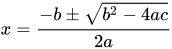
is a closed form of the solutions to the general quadratic equation

More generally, in the context of polynomial equations, a closed form of a solution is a solution in radicals; that is, a closed-form expression for which the allowed functions are only nth-roots and field operations In fact, field theory allows showing that if a solution of a polynomial equation has a closed form involving exponentials, logarithms or trigonometric functions, then it has also a closed form that does not involve these functions.[citation needed]

There are expressions in radicals for all solutions of cubic equations (degree 3) and quartic equations (degree 4). The size of these expressions increases significantly with the degree, limiting their usefulness.
In higher degrees, the Abel–Ruffini theorem states that there are equations whose solutions cannot be expressed in radicals, and, thus, have no closed forms. A simple example is the equation Galois theory provides an algorithmic method for deciding whether a particular polynomial equation can be solved in radicals.

Closed-form expression
In mathematics, an expression or formula (including equations and inequalities) is in closed form if it is formed with constants, variables, and a set of functions considered as basic and connected by arithmetic operations (+, −, ×, /, and integer powers) and function composition. Commonly, the basic functions that are allowed in closed forms are nth root, exponential function, logarithm, and trigonometric functions. However, the set of basic functions depends on the context. For example, if one adds polynomial roots to the basic functions, the functions that have a closed form are called elementary functions.
The closed-form problem arises when new ways are introduced for specifying mathematical objects, such as limits, series, and integrals: given an object specified with such tools, a natural problem is to find, if possible, a closed-form expression of this object; that is, an expression of this object in terms of previous ways of specifying it.
is a closed form of the solutions to the general quadratic equation
More generally, in the context of polynomial equations, a closed form of a solution is a solution in radicals; that is, a closed-form expression for which the allowed functions are only nth-roots and field operations In fact, field theory allows showing that if a solution of a polynomial equation has a closed form involving exponentials, logarithms or trigonometric functions, then it has also a closed form that does not involve these functions.[citation needed]
There are expressions in radicals for all solutions of cubic equations (degree 3) and quartic equations (degree 4). The size of these expressions increases significantly with the degree, limiting their usefulness.
In higher degrees, the Abel–Ruffini theorem states that there are equations whose solutions cannot be expressed in radicals, and, thus, have no closed forms. A simple example is the equation Galois theory provides an algorithmic method for deciding whether a particular polynomial equation can be solved in radicals.