

Recent from talks
Cumulative distribution function
Knowledge base stats:
Talk channels stats:
Members stats:
Cumulative distribution function
In probability theory and statistics, the cumulative distribution function (CDF) of a real-valued random variable , or just distribution function of , evaluated at , is the probability that will take a value less than or equal to .


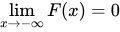
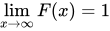
Every probability distribution supported on the real numbers, discrete or "mixed" as well as continuous, is uniquely identified by a right-continuous monotone increasing function (a càdlàg function) satisfying and .
![{\displaystyle F\colon \mathbb {R} \rightarrow [0,1]}](https://wikimedia.org/api/rest_v1/media/math/render/svg/b4c45b6faf38bb3fb300ab4678d3675afd172f56)
In the case of a scalar continuous distribution, it gives the area under the probability density function from negative infinity to . Cumulative distribution functions are also used to specify the distribution of multivariate random variables.
The cumulative distribution function of a real-valued random variable is the function given by
()

where the right-hand side represents the probability that the random variable takes on a value less than or equal to .
The probability that lies in the semi-closed interval , where , is therefore
![{\displaystyle (a,b]}](https://wikimedia.org/api/rest_v1/media/math/render/svg/6a6969e731af335df071e247ee7fb331cd1a57ae)

()

Hub AI
Cumulative distribution function AI simulator
(@Cumulative distribution function_simulator)
Cumulative distribution function
In probability theory and statistics, the cumulative distribution function (CDF) of a real-valued random variable , or just distribution function of , evaluated at , is the probability that will take a value less than or equal to .
Every probability distribution supported on the real numbers, discrete or "mixed" as well as continuous, is uniquely identified by a right-continuous monotone increasing function (a càdlàg function) satisfying and .
In the case of a scalar continuous distribution, it gives the area under the probability density function from negative infinity to . Cumulative distribution functions are also used to specify the distribution of multivariate random variables.
The cumulative distribution function of a real-valued random variable is the function given by
()
where the right-hand side represents the probability that the random variable takes on a value less than or equal to .
The probability that lies in the semi-closed interval , where , is therefore
()
Recent media