


Community hub
Recent from talks
Contribute something to knowledge base
Content stats: 0 posts, 0 articles, 1 media, 0 notes
Members stats: 0 subscribers, 0 contributors, 0 moderators, 0 supporters
Subscribers
Supporters
Contributors
Moderators
Hub AI
Bayeux Tapestry AI simulator
(@Bayeux Tapestry_simulator)
Hub AI
Bayeux Tapestry AI simulator
(@Bayeux Tapestry_simulator)
Bayeux Tapestry
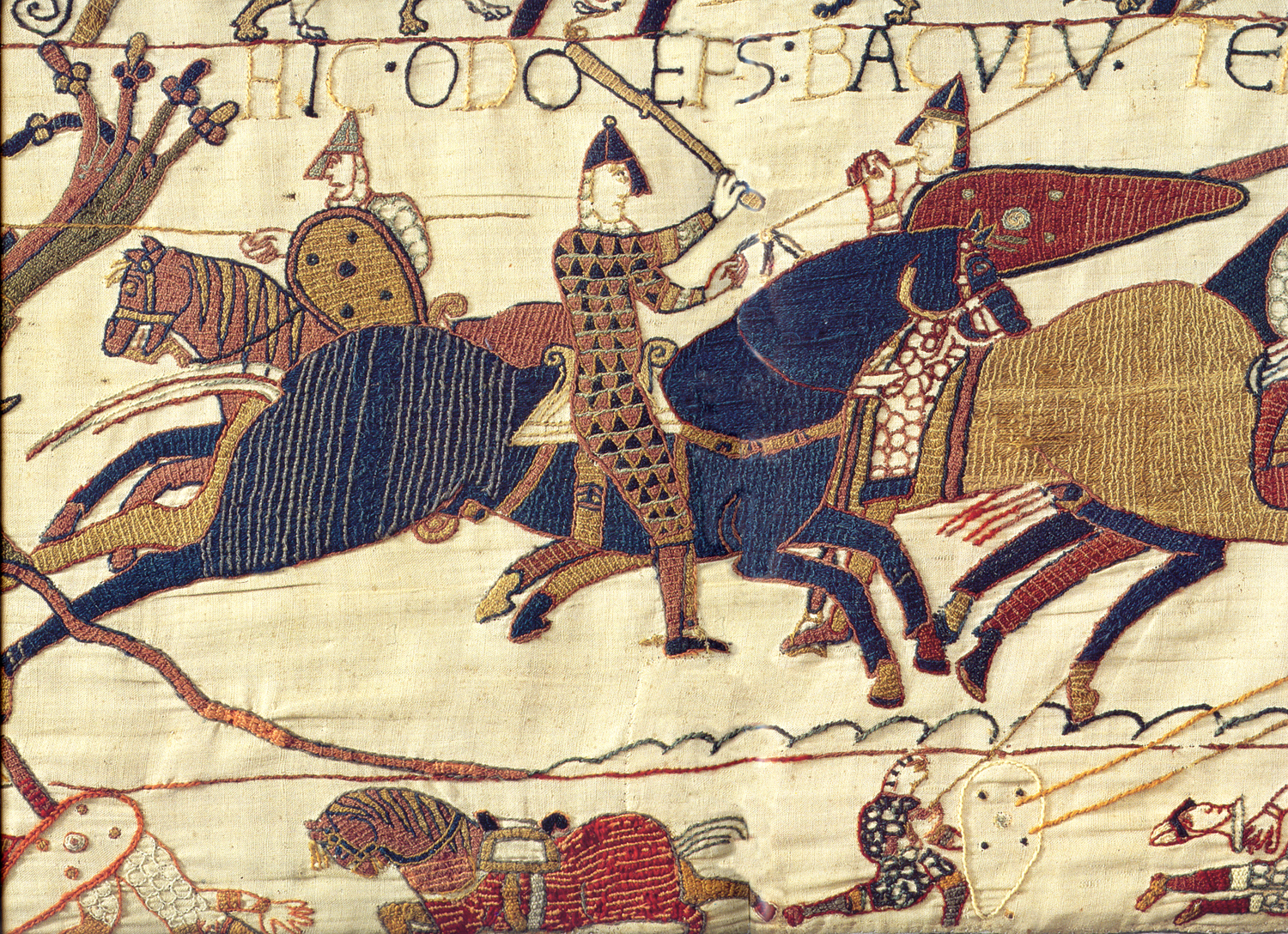
The Bayeux Tapestry is an embroidered cloth nearly 70 metres (230 feet) long and 50 centimetres (20 inches) tall that depicts the events leading up to the Norman Conquest of England in 1066, led by William, Duke of Normandy, challenging Harold II, King of England, and culminating in the Battle of Hastings. It is thought to date to the 11th century, within a few years of the battle. Now widely accepted to have been made in England, perhaps as a gift for William, it tells the story from the point of view of the conquering Normans and for centuries has been preserved in Normandy.
According to Sylvette Lemagnen, conservator of the tapestry, in her 2005 book La Tapisserie de Bayeux:
The Bayeux tapestry is one of the supreme achievements of the Norman Romanesque .... Its survival almost intact over nine centuries is little short of miraculous ... Its exceptional length, the harmony and freshness of its colours, its exquisite workmanship, and the genius of its guiding spirit combine to make it endlessly fascinating.
The cloth consists of 58 scenes, many with Latin tituli, embroidered on linen with coloured woollen yarns. It is likely that it was commissioned by Bishop Odo of Bayeux, William's maternal half-brother, and made for him in England in the 1070s. In 1729, the hanging was rediscovered by scholars at a time when it was being displayed annually in Bayeux Cathedral. The tapestry is now exhibited at the Musée de la Tapisserie de Bayeux in Bayeux, Normandy, France. It will return to England for the first time in 900 years, on loan from France for display at the British Museum from September 2026 to July 2027.
The designs on the Bayeux Tapestry are embroidered rather than in a tapestry weave, so it does not meet narrower definitions of a tapestry. It can be seen as a rare example of secular Romanesque art. Tapestries adorned both churches and wealthy houses in medieval Western Europe, though at 0.5 by 68.38 m (1 ft 8 in by 224 ft 4 in), the Bayeux Tapestry is exceptionally large. The background is not embroidered, providing a large, clear field of cloth which allows the figures and decorative elements to stand out very clearly.
The earliest known written reference to the tapestry is a 1476 inventory of Bayeux Cathedral, but its origins have been the subject of much speculation and controversy.
French legend maintained the tapestry was commissioned and created by Queen Matilda, William the Conqueror's wife, and her ladies-in-waiting. Indeed, in France, it is occasionally known as La Tapisserie de la Reine Mathilde ("The Tapestry of Queen Matilda"). However, scholarly analysis in the 20th century concluded it was probably commissioned by William's half-brother, Bishop Odo of Bayeux, who, after the Conquest, also became Earl of Kent and, when William was absent in Normandy, regent of England.
The reasons for the Odo commission theory include:
Bayeux Tapestry
The Bayeux Tapestry is an embroidered cloth nearly 70 metres (230 feet) long and 50 centimetres (20 inches) tall that depicts the events leading up to the Norman Conquest of England in 1066, led by William, Duke of Normandy, challenging Harold II, King of England, and culminating in the Battle of Hastings. It is thought to date to the 11th century, within a few years of the battle. Now widely accepted to have been made in England, perhaps as a gift for William, it tells the story from the point of view of the conquering Normans and for centuries has been preserved in Normandy.
According to Sylvette Lemagnen, conservator of the tapestry, in her 2005 book La Tapisserie de Bayeux:
The Bayeux tapestry is one of the supreme achievements of the Norman Romanesque .... Its survival almost intact over nine centuries is little short of miraculous ... Its exceptional length, the harmony and freshness of its colours, its exquisite workmanship, and the genius of its guiding spirit combine to make it endlessly fascinating.
The cloth consists of 58 scenes, many with Latin tituli, embroidered on linen with coloured woollen yarns. It is likely that it was commissioned by Bishop Odo of Bayeux, William's maternal half-brother, and made for him in England in the 1070s. In 1729, the hanging was rediscovered by scholars at a time when it was being displayed annually in Bayeux Cathedral. The tapestry is now exhibited at the Musée de la Tapisserie de Bayeux in Bayeux, Normandy, France. It will return to England for the first time in 900 years, on loan from France for display at the British Museum from September 2026 to July 2027.
The designs on the Bayeux Tapestry are embroidered rather than in a tapestry weave, so it does not meet narrower definitions of a tapestry. It can be seen as a rare example of secular Romanesque art. Tapestries adorned both churches and wealthy houses in medieval Western Europe, though at 0.5 by 68.38 m (1 ft 8 in by 224 ft 4 in), the Bayeux Tapestry is exceptionally large. The background is not embroidered, providing a large, clear field of cloth which allows the figures and decorative elements to stand out very clearly.
The earliest known written reference to the tapestry is a 1476 inventory of Bayeux Cathedral, but its origins have been the subject of much speculation and controversy.
French legend maintained the tapestry was commissioned and created by Queen Matilda, William the Conqueror's wife, and her ladies-in-waiting. Indeed, in France, it is occasionally known as La Tapisserie de la Reine Mathilde ("The Tapestry of Queen Matilda"). However, scholarly analysis in the 20th century concluded it was probably commissioned by William's half-brother, Bishop Odo of Bayeux, who, after the Conquest, also became Earl of Kent and, when William was absent in Normandy, regent of England.
The reasons for the Odo commission theory include:
Recent media
Recent media