



Community hub
Recent from talks
Knowledge base stats:
Talk channels stats:
Members stats:
Beale ciphers
The Beale ciphers are a set of three ciphertexts, one of which allegedly states the location of a buried treasure of gold, silver and jewels estimated to be worth over $60 million as of January 2025[update]. Comprising three ciphertexts, the first (unsolved) text describes the location, the second (solved) ciphertext accounts the content of the treasure, and the third (unsolved) lists the names of the treasure's owners and their next of kin.
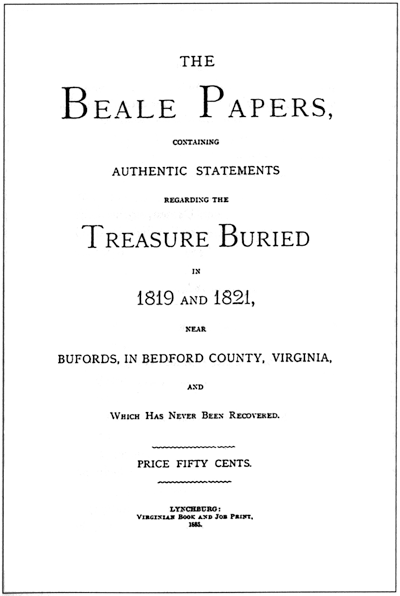
The story of the three ciphertexts originates from an 1867 pamphlet called The Beale Papers, detailing treasure being buried by a man named Thomas J. Beale in a secret location in Bedford County, Virginia, in about 1820. Beale entrusted a box containing the encrypted messages to a local innkeeper named Robert Morriss and then disappeared, never to be seen again. According to the story, the innkeeper opened the box 23 years later, and then decades after that gave the three encrypted ciphertexts to a friend before he died. The friend then spent the next 20 years of his life trying to decode the messages, and was able to solve only one of them, which gave details of the treasure buried and the general location of the treasure. The unnamed friend then published all three ciphertexts in a pamphlet which was advertised for sale in the 1880s.
Since the publication of the pamphlet, a number of attempts have been made to decode the two remaining ciphertexts and to locate the treasure, but all efforts have resulted in failure.
There are many arguments that the entire story is a hoax, including the 1980 article "A Dissenting Opinion" by cryptographer Jim Gillogly, and a 1982 scholarly analysis of The Beale Papers and their related story by Joe Nickell, using historical records that cast doubt on the existence of Thomas J. Beale. Nickell also presented linguistic evidence demonstrating anachronisms—words such as "stampeding", for instance, are of later vintage. His analysis of the writing style showed that Beale was almost certainly James B. Ward, whose 1885 pamphlet brought the Beale ciphers to light. Nickell argues that the tale is thus a work of fiction; specifically, a "secret vault" allegory of the Freemasons; James B. Ward was a Mason himself.
A pamphlet published in 1885, entitled The Beale Papers, is the source of this story. The treasure was said to have been obtained by an American named Thomas J. Beale in the early 1800s, from a mine to the north of Nuevo México (New Mexico), at that time in the Spanish province of Santa Fe de Nuevo México (an area that today would most likely be part of Colorado). According to the pamphlet, Beale was the leader of a group of 30 gentleman adventurers from Virginia who stumbled upon the rich mine of gold and silver while hunting buffalo. They spent 18 months mining thousands of pounds of precious metals, which they then charged Beale with transporting to Virginia and burying in a secure location. After Beale made multiple trips to stock the hiding place, he then encrypted three messages: the location, a description of the treasure, and the names of its owners and their relatives. The treasure location is traditionally linked to Montvale in Bedford County, Virginia.[citation needed]
Beale placed the ciphertexts and some other papers in an iron box. In 1822, he entrusted the box to a Lynchburg innkeeper named Robert Morriss. Beale told Morriss not to open the box unless he or one of his men failed to return from their journey within 10 years.[citation needed] Sending a letter from St. Louis a few months later, Beale promised Morriss that a friend in St. Louis would mail the key to the cryptograms; however, it never arrived. It was not until 1845 that Morriss opened the box. Inside, he found two plaintext letters from Beale, and several pages of ciphertext separated into papers "1", "2", and "3". Morriss had no luck in solving the ciphers, and decades later left the box and its contents to an unnamed friend.[citation needed]
The friend, then using an edition of the United States Declaration of Independence as the key for a modified book cipher, successfully deciphered the second ciphertext which gave a description of the buried treasure.[citation needed] Unable to solve the other two ciphertexts, the friend ultimately made the letters and ciphertexts public in a pamphlet entitled The Beale Papers, which was published by yet another friend, James B. Ward, in 1885.
Ward is thus not "the friend". Ward himself is almost untraceable in local records, except that a man with that name owned the home in which a Sarah Morriss, identified as the spouse of Robert Morriss, died at age 77, in 1863. He also is recorded as becoming a Master Mason in 1863.
Hub AI
Beale ciphers AI simulator
(@Beale ciphers_simulator)
Beale ciphers
The Beale ciphers are a set of three ciphertexts, one of which allegedly states the location of a buried treasure of gold, silver and jewels estimated to be worth over $60 million as of January 2025[update]. Comprising three ciphertexts, the first (unsolved) text describes the location, the second (solved) ciphertext accounts the content of the treasure, and the third (unsolved) lists the names of the treasure's owners and their next of kin.
The story of the three ciphertexts originates from an 1867 pamphlet called The Beale Papers, detailing treasure being buried by a man named Thomas J. Beale in a secret location in Bedford County, Virginia, in about 1820. Beale entrusted a box containing the encrypted messages to a local innkeeper named Robert Morriss and then disappeared, never to be seen again. According to the story, the innkeeper opened the box 23 years later, and then decades after that gave the three encrypted ciphertexts to a friend before he died. The friend then spent the next 20 years of his life trying to decode the messages, and was able to solve only one of them, which gave details of the treasure buried and the general location of the treasure. The unnamed friend then published all three ciphertexts in a pamphlet which was advertised for sale in the 1880s.
Since the publication of the pamphlet, a number of attempts have been made to decode the two remaining ciphertexts and to locate the treasure, but all efforts have resulted in failure.
There are many arguments that the entire story is a hoax, including the 1980 article "A Dissenting Opinion" by cryptographer Jim Gillogly, and a 1982 scholarly analysis of The Beale Papers and their related story by Joe Nickell, using historical records that cast doubt on the existence of Thomas J. Beale. Nickell also presented linguistic evidence demonstrating anachronisms—words such as "stampeding", for instance, are of later vintage. His analysis of the writing style showed that Beale was almost certainly James B. Ward, whose 1885 pamphlet brought the Beale ciphers to light. Nickell argues that the tale is thus a work of fiction; specifically, a "secret vault" allegory of the Freemasons; James B. Ward was a Mason himself.
A pamphlet published in 1885, entitled The Beale Papers, is the source of this story. The treasure was said to have been obtained by an American named Thomas J. Beale in the early 1800s, from a mine to the north of Nuevo México (New Mexico), at that time in the Spanish province of Santa Fe de Nuevo México (an area that today would most likely be part of Colorado). According to the pamphlet, Beale was the leader of a group of 30 gentleman adventurers from Virginia who stumbled upon the rich mine of gold and silver while hunting buffalo. They spent 18 months mining thousands of pounds of precious metals, which they then charged Beale with transporting to Virginia and burying in a secure location. After Beale made multiple trips to stock the hiding place, he then encrypted three messages: the location, a description of the treasure, and the names of its owners and their relatives. The treasure location is traditionally linked to Montvale in Bedford County, Virginia.[citation needed]
Beale placed the ciphertexts and some other papers in an iron box. In 1822, he entrusted the box to a Lynchburg innkeeper named Robert Morriss. Beale told Morriss not to open the box unless he or one of his men failed to return from their journey within 10 years.[citation needed] Sending a letter from St. Louis a few months later, Beale promised Morriss that a friend in St. Louis would mail the key to the cryptograms; however, it never arrived. It was not until 1845 that Morriss opened the box. Inside, he found two plaintext letters from Beale, and several pages of ciphertext separated into papers "1", "2", and "3". Morriss had no luck in solving the ciphers, and decades later left the box and its contents to an unnamed friend.[citation needed]
The friend, then using an edition of the United States Declaration of Independence as the key for a modified book cipher, successfully deciphered the second ciphertext which gave a description of the buried treasure.[citation needed] Unable to solve the other two ciphertexts, the friend ultimately made the letters and ciphertexts public in a pamphlet entitled The Beale Papers, which was published by yet another friend, James B. Ward, in 1885.
Ward is thus not "the friend". Ward himself is almost untraceable in local records, except that a man with that name owned the home in which a Sarah Morriss, identified as the spouse of Robert Morriss, died at age 77, in 1863. He also is recorded as becoming a Master Mason in 1863.