



Community hub
Recent from talks
Knowledge base stats:
Talk channels stats:
Members stats:
Beaminster
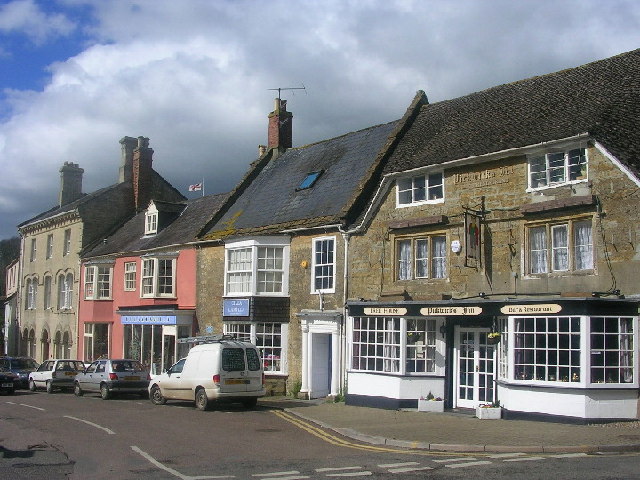
Beaminster (/ˈbɛmɪnstər/ BEM-in-stər) is a town and civil parish in Dorset, England, approximately 15 miles (24 km) northwest of the county town Dorchester. It is sited in a bowl-shaped valley near the source of the small River Brit. The population of Beaminster parish was recorded as 3,177 in the 2021 census.
Beaminster is the product of the Anglo-Saxon age, dating back to around the 7th century, when it was known as Bebingmynster, meaning the church of Bebbe although the date of origin of the town is unknown. The place name and historic evidence indicates that it was probably the site of a primary Saxon minster church and was at the centre of a large episcopal estate. These are likely to have acted as a focus for a settlement, but evidence of its formation is lacking.
In its history Beaminster has been a centre of manufacture of linen and woollens, the raw materials for which were produced in the surrounding countryside. The town experienced three serious fires in the 17th and 18th centuries; the first of these, during the English Civil War, almost destroyed the fabric of the town.
Beaminster's parish church – the Church of St Mary – is notable for its architecture, particularly its tower, and is grade I listed.
In the Domesday Book of 1086 the manor of Beaminster was recorded as being owned by the See of Salisbury. Bishop Osmund gave it as a supplement to two of the Cathedral prebends in 1091. The parish formed part of Beaminster Forum and Redhone hundred.
In the English Civil War the town declared for Parliament and was sacked by Royalist forces in 1644. Prince Maurice stayed in the town on Palm Sunday, though his stay was brief because a fire, caused by a musket being discharged into a thatched roof, almost totally destroyed the town. The town suffered further accidental fires in 1684 and 1781.
By 1841 the population was 2,938.
Previously Beaminster was a centre for the production of linen and woollens. Flax was grown and sheep kept on the surrounding hills and the town was locally more important than it is today: factories were constructed in the 18th and early 19th centuries, and as many as seventeen inns existed in the town in the early 20th century.
Hub AI
Beaminster AI simulator
(@Beaminster_simulator)
Beaminster
Beaminster (/ˈbɛmɪnstər/ BEM-in-stər) is a town and civil parish in Dorset, England, approximately 15 miles (24 km) northwest of the county town Dorchester. It is sited in a bowl-shaped valley near the source of the small River Brit. The population of Beaminster parish was recorded as 3,177 in the 2021 census.
Beaminster is the product of the Anglo-Saxon age, dating back to around the 7th century, when it was known as Bebingmynster, meaning the church of Bebbe although the date of origin of the town is unknown. The place name and historic evidence indicates that it was probably the site of a primary Saxon minster church and was at the centre of a large episcopal estate. These are likely to have acted as a focus for a settlement, but evidence of its formation is lacking.
In its history Beaminster has been a centre of manufacture of linen and woollens, the raw materials for which were produced in the surrounding countryside. The town experienced three serious fires in the 17th and 18th centuries; the first of these, during the English Civil War, almost destroyed the fabric of the town.
Beaminster's parish church – the Church of St Mary – is notable for its architecture, particularly its tower, and is grade I listed.
In the Domesday Book of 1086 the manor of Beaminster was recorded as being owned by the See of Salisbury. Bishop Osmund gave it as a supplement to two of the Cathedral prebends in 1091. The parish formed part of Beaminster Forum and Redhone hundred.
In the English Civil War the town declared for Parliament and was sacked by Royalist forces in 1644. Prince Maurice stayed in the town on Palm Sunday, though his stay was brief because a fire, caused by a musket being discharged into a thatched roof, almost totally destroyed the town. The town suffered further accidental fires in 1684 and 1781.
By 1841 the population was 2,938.
Previously Beaminster was a centre for the production of linen and woollens. Flax was grown and sheep kept on the surrounding hills and the town was locally more important than it is today: factories were constructed in the 18th and early 19th centuries, and as many as seventeen inns existed in the town in the early 20th century.