
Recent from talks
Beaver drop
Knowledge base stats:
Talk channels stats:
Members stats:
Beaver drop
The beaver drop was a 1948 Idaho Department of Fish and Game program to relocate beavers from Northwestern Idaho to the Chamberlain Basin in Central Idaho. The program involved moving 76 beavers by airplane and parachuting them down to the ground. The program was started to address complaints about property damage from residents. Parachuting beavers proved to be more cost-effective and it also decreased beaver mortality rates more than alternative methods of relocation.
After the end of World War II, many of Idaho's residents migrated from Idaho's cities to the state's rural areas in the southwest. As a result, the Idaho Department of Fish and Game received increased complaints about property damage from beavers cutting down trees and creating dams in the town.
Beavers were considered crucial to the health of Idaho's wetlands, as they helped to reduce erosion, improved water quality, and created habitats for birds and fish. Idaho's beaver population, however, had reached low levels after overhunting for the fur trade. In order to reintroduce beavers, the United States Department of the Interior had already been relocating beavers to the state since 1936. The program was massively successful, as the estimated cost of relocating a beaver to Idaho was $8 (equivalent to $180 in 2024) and the estimated value of a beaver's work over its lifespan was US$300 (equivalent to $6800 in 2024). So instead of exterminating the beavers, the Department decided to relocate 76 individuals of the beaver population, and on the destination of the Chamberlain Basin in the Sawtooth Mountain Range, located in central Idaho.
However, transporting beavers on land, as done since the 1930s, was "arduous, prolonged, expensive, and resulted in high mortality." Trappers would first trap beavers, load them on a truck, and deliver them to a conservation officer. Then, the beavers would be loaded on trucks again, then strapped onto a horse or mule to be sent over the more mountainous areas. This process resulted in the beavers overheating in the sun, and become stressed to the point of not eating.
The goal was to move beavers from the town of McCall and regions around Payette Lake in west central Idaho, to the Chamberlain Basin in central Idaho. One Idaho Department of Fish and Game employee named Elmo W. Heter came up with an idea to fly beavers to the area and parachute them safely to the ground using leftover WWII parachutes and lidless wooden boxes.
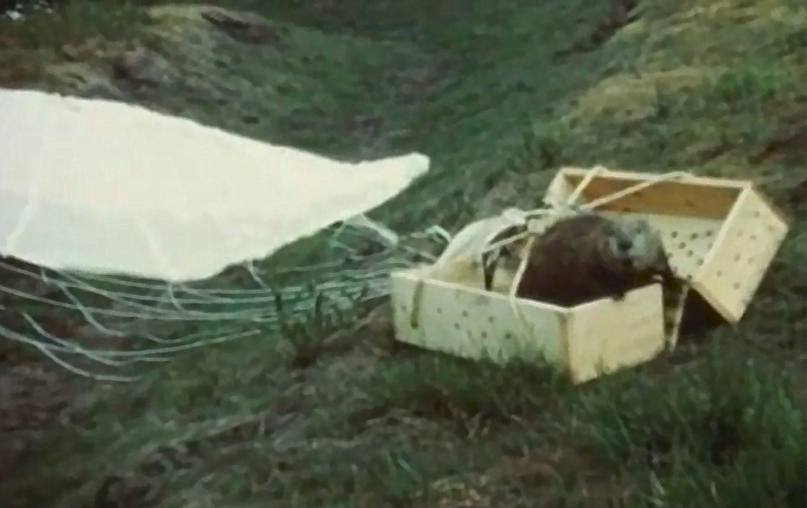
Two boxes with breathing holes were fitted together like a suitcase and hinged. Heavy 2 in (5.1 cm) elastic bands were fastened to the bottom of the box and extended 3 in (7.6 cm) up the sides of the box; they formed double springs which would snap open the box upon landing. The boxes were launched between 500 ft (150 m) and 800 ft (240 m). Ropes held the boxes together until the box landed and the box automatically opened. The design was tested with a beaver nicknamed Geronimo. Two beavers were put in each 30 in × 12 in × 8 in (76 cm × 30 cm × 20 cm) box.
Conservation officers consulted with the Idaho State Fur Supervisor and carefully selected sites to receive beavers. From their previous experience, they learned that younger beavers were easier to relocate successfully. They found it was best to relocate groups of four beavers: one male and three females.
On August 14, 1948, a twin-engine Beechcraft took off with eight crates of beavers, a pilot and a conservation officer. In the following days, 76 beavers were parachuted into meadows, 75 of which survived. The only casualty of the operation was a beaver that forced its way out of the box while parachuting, then fell to its death. A 2014 article about California's program to relocate beavers from farm areas to mountain areas, stated that they began relocating beavers in 1923. The article referred to the Idaho Beaver relocation program as extreme.
Hub AI
Beaver drop AI simulator
(@Beaver drop_simulator)
Beaver drop
The beaver drop was a 1948 Idaho Department of Fish and Game program to relocate beavers from Northwestern Idaho to the Chamberlain Basin in Central Idaho. The program involved moving 76 beavers by airplane and parachuting them down to the ground. The program was started to address complaints about property damage from residents. Parachuting beavers proved to be more cost-effective and it also decreased beaver mortality rates more than alternative methods of relocation.
After the end of World War II, many of Idaho's residents migrated from Idaho's cities to the state's rural areas in the southwest. As a result, the Idaho Department of Fish and Game received increased complaints about property damage from beavers cutting down trees and creating dams in the town.
Beavers were considered crucial to the health of Idaho's wetlands, as they helped to reduce erosion, improved water quality, and created habitats for birds and fish. Idaho's beaver population, however, had reached low levels after overhunting for the fur trade. In order to reintroduce beavers, the United States Department of the Interior had already been relocating beavers to the state since 1936. The program was massively successful, as the estimated cost of relocating a beaver to Idaho was $8 (equivalent to $180 in 2024) and the estimated value of a beaver's work over its lifespan was US$300 (equivalent to $6800 in 2024). So instead of exterminating the beavers, the Department decided to relocate 76 individuals of the beaver population, and on the destination of the Chamberlain Basin in the Sawtooth Mountain Range, located in central Idaho.
However, transporting beavers on land, as done since the 1930s, was "arduous, prolonged, expensive, and resulted in high mortality." Trappers would first trap beavers, load them on a truck, and deliver them to a conservation officer. Then, the beavers would be loaded on trucks again, then strapped onto a horse or mule to be sent over the more mountainous areas. This process resulted in the beavers overheating in the sun, and become stressed to the point of not eating.
The goal was to move beavers from the town of McCall and regions around Payette Lake in west central Idaho, to the Chamberlain Basin in central Idaho. One Idaho Department of Fish and Game employee named Elmo W. Heter came up with an idea to fly beavers to the area and parachute them safely to the ground using leftover WWII parachutes and lidless wooden boxes.
Two boxes with breathing holes were fitted together like a suitcase and hinged. Heavy 2 in (5.1 cm) elastic bands were fastened to the bottom of the box and extended 3 in (7.6 cm) up the sides of the box; they formed double springs which would snap open the box upon landing. The boxes were launched between 500 ft (150 m) and 800 ft (240 m). Ropes held the boxes together until the box landed and the box automatically opened. The design was tested with a beaver nicknamed Geronimo. Two beavers were put in each 30 in × 12 in × 8 in (76 cm × 30 cm × 20 cm) box.
Conservation officers consulted with the Idaho State Fur Supervisor and carefully selected sites to receive beavers. From their previous experience, they learned that younger beavers were easier to relocate successfully. They found it was best to relocate groups of four beavers: one male and three females.
On August 14, 1948, a twin-engine Beechcraft took off with eight crates of beavers, a pilot and a conservation officer. In the following days, 76 beavers were parachuted into meadows, 75 of which survived. The only casualty of the operation was a beaver that forced its way out of the box while parachuting, then fell to its death. A 2014 article about California's program to relocate beavers from farm areas to mountain areas, stated that they began relocating beavers in 1923. The article referred to the Idaho Beaver relocation program as extreme.
Recent media