
Recent from talks
Beckton
Knowledge base stats:
Talk channels stats:
Members stats:
Beckton
Beckton is a suburb in East London, England, located eight miles (thirteen kilometres) east of Charing Cross and part of the London Borough of Newham. Adjacent to the River Thames, the area consisted of unpopulated marshland known as the East Ham Levels in the parishes of Barking, East Ham, West Ham and Woolwich. The development of major industrial infrastructure in the 19th century to support the growing metropolis of London caused an increase in population with housing built in the area for workers of the Beckton Gas Works and Beckton Sewage Treatment Works. The area has a convoluted local government history and has formed part of Greater London since 1965. Between 1981 and 1995 it was within the London Docklands Development Corporation area, which caused the population to increase as new homes were built and the Docklands Light Railway was constructed.
Beckton is named after Simon Adams Beck, the governor of the Gas Light and Coke Company when work building Beckton Gas Works began in November 1868. The name New Beckton was used in 1881 for the workers estate at Cyprus.
Prior to industrialisation, the area that became Beckton was remote and unpopulated Thameside marshland, known as the East Ham Levels. Urban development took place in the south of the parish of East Ham, the part of the parish of Barking to the west of the River Roding and the part of Woolwich parish that was north of the River Thames. The western extremity was in the parish of West Ham. There was also a county boundary, with Barking, East Ham and West Ham in Essex and Woolwich in Kent. The whole area became part of the expanded Metropolitan Police District in 1840. Reflecting an increase in population and the need for more effective local government, local boards were formed for Woolwich in 1852, West Ham in 1856, East Ham in 1878 and Barking Town in 1882. The section in the detached part of Woolwich parish came within the Metropolitan Board of Works district in 1855 and in 1889 this area became the County of London under the control of the newly formed London County Council. The Barking Town and East Ham sections now came within the Essex County Council area, but West Ham instead formed a separate county borough because its population was high enough. East Ham was also elevated to this status in 1915. This continued until 1965 when the London Borough of Newham in Greater London was formed from territory that had been part of East Ham, West Ham, Barking and Woolwich. Beckton was within the London Docklands Development Corporation area from 1981 to 1995.
Beckton Sewage treatment works were first established in 1864 as part of Joseph Bazalgette's scheme to remove sewage (and hence reduce disease) from London by creating two large sewers from the capital, one on each side of the Thames and known as the Southern and Northern Outfall Sewers. The Beckton sewage works (TQ448823), at the end of the northern outfall sewer, is Europe's 7th largest and is now managed by Thames Water. The outfall sewer has been landscaped and now also serves as the Greenway cycle track through east London.
The site was mooted in 2005 as the location for a desalination plant, but the proposal was rejected by Mayor Ken Livingstone as environmentally unacceptable. The scheme has been resurrected by the successive mayor, Boris Johnson, as part of a deal with Thames Water to reduce delays in fixing roadworks throughout London. The sewerage works has been expanded to handle the flow from the Thames Tideway Scheme.
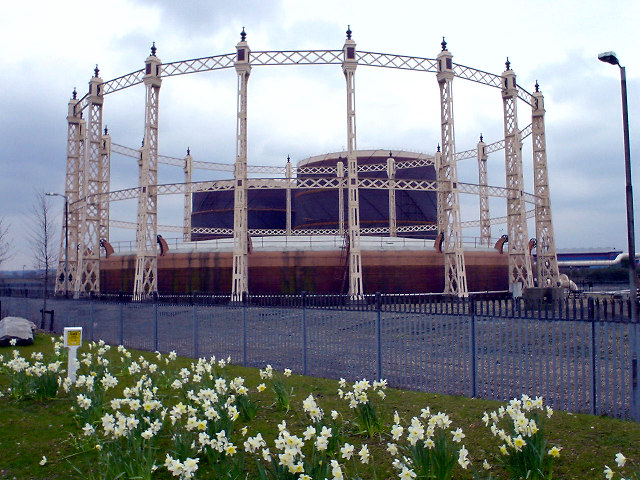
Situated north and east of the Royal Docks, the area was formerly heavily industrialised, and was the location of Beckton Gas Works, the largest gasworks in Europe, which served the capital. An adjacent by-products works also produced a wide variety of products including ink, dyes, mothballs, and fertilisers, all by-products of the process of turning coal to coke in the production of town gas. Britain converted from town gas to North Sea natural gas over the period 1966–77 and the Beckton gasworks were closed in 1976.
An extensive toxic spoil-heap from the Gasworks was known ironically as "Beckton Alps". Originally running from the Northern outfall sewer south to Winsor Terrace, this was landscaped in the 1980s. Part became a 25-metre-high (82 ft) Artificial ski slope for a time, opened by Diana, Princess of Wales, with a viewing platform at the summit and a Swiss-style bar at the foot. However, the site is now derelict.
Beckton railway station opened in 1874 as the eastern terminus of a branch from Custom House.
Hub AI
Beckton AI simulator
(@Beckton_simulator)
Beckton
Beckton is a suburb in East London, England, located eight miles (thirteen kilometres) east of Charing Cross and part of the London Borough of Newham. Adjacent to the River Thames, the area consisted of unpopulated marshland known as the East Ham Levels in the parishes of Barking, East Ham, West Ham and Woolwich. The development of major industrial infrastructure in the 19th century to support the growing metropolis of London caused an increase in population with housing built in the area for workers of the Beckton Gas Works and Beckton Sewage Treatment Works. The area has a convoluted local government history and has formed part of Greater London since 1965. Between 1981 and 1995 it was within the London Docklands Development Corporation area, which caused the population to increase as new homes were built and the Docklands Light Railway was constructed.
Beckton is named after Simon Adams Beck, the governor of the Gas Light and Coke Company when work building Beckton Gas Works began in November 1868. The name New Beckton was used in 1881 for the workers estate at Cyprus.
Prior to industrialisation, the area that became Beckton was remote and unpopulated Thameside marshland, known as the East Ham Levels. Urban development took place in the south of the parish of East Ham, the part of the parish of Barking to the west of the River Roding and the part of Woolwich parish that was north of the River Thames. The western extremity was in the parish of West Ham. There was also a county boundary, with Barking, East Ham and West Ham in Essex and Woolwich in Kent. The whole area became part of the expanded Metropolitan Police District in 1840. Reflecting an increase in population and the need for more effective local government, local boards were formed for Woolwich in 1852, West Ham in 1856, East Ham in 1878 and Barking Town in 1882. The section in the detached part of Woolwich parish came within the Metropolitan Board of Works district in 1855 and in 1889 this area became the County of London under the control of the newly formed London County Council. The Barking Town and East Ham sections now came within the Essex County Council area, but West Ham instead formed a separate county borough because its population was high enough. East Ham was also elevated to this status in 1915. This continued until 1965 when the London Borough of Newham in Greater London was formed from territory that had been part of East Ham, West Ham, Barking and Woolwich. Beckton was within the London Docklands Development Corporation area from 1981 to 1995.
Beckton Sewage treatment works were first established in 1864 as part of Joseph Bazalgette's scheme to remove sewage (and hence reduce disease) from London by creating two large sewers from the capital, one on each side of the Thames and known as the Southern and Northern Outfall Sewers. The Beckton sewage works (TQ448823), at the end of the northern outfall sewer, is Europe's 7th largest and is now managed by Thames Water. The outfall sewer has been landscaped and now also serves as the Greenway cycle track through east London.
The site was mooted in 2005 as the location for a desalination plant, but the proposal was rejected by Mayor Ken Livingstone as environmentally unacceptable. The scheme has been resurrected by the successive mayor, Boris Johnson, as part of a deal with Thames Water to reduce delays in fixing roadworks throughout London. The sewerage works has been expanded to handle the flow from the Thames Tideway Scheme.
Situated north and east of the Royal Docks, the area was formerly heavily industrialised, and was the location of Beckton Gas Works, the largest gasworks in Europe, which served the capital. An adjacent by-products works also produced a wide variety of products including ink, dyes, mothballs, and fertilisers, all by-products of the process of turning coal to coke in the production of town gas. Britain converted from town gas to North Sea natural gas over the period 1966–77 and the Beckton gasworks were closed in 1976.
An extensive toxic spoil-heap from the Gasworks was known ironically as "Beckton Alps". Originally running from the Northern outfall sewer south to Winsor Terrace, this was landscaped in the 1980s. Part became a 25-metre-high (82 ft) Artificial ski slope for a time, opened by Diana, Princess of Wales, with a viewing platform at the summit and a Swiss-style bar at the foot. However, the site is now derelict.
Beckton railway station opened in 1874 as the eastern terminus of a branch from Custom House.
Recent media