



Community hub
Recent from talks
Knowledge base stats:
Talk channels stats:
Members stats:
Beddingham
Beddingham is a village and civil parish in the Lewes district of East Sussex, England. It lies at the junction between the London–Newhaven (A26) and south coast (A27) roads, to the south-east of the town of Lewes. At the 2021 census the parish had a population of 245. Since 1972 it has shared a grouped parish council with the neighbouring parish of Glynde.
The area was settled in pre-Roman times with many tumuli in the surrounding hills originating in the Iron Age.
A Roman villa at Beddingham 50°50′52″N 0°04′16″E / 50.84771°N 0.07115°E was excavated in the 1980s and early 1990s by David Rudling. Construction began in the late first century AD, and the villa was occupied until the mid fourth-century. There was a wooden roundhouse built originally (about 50 AD) before Roman construction began towards the end of the century.
When the Saxons came, one of the buildings on the site was hollowed out, presumably as a Sunken Feature Building (Grubenhaus). The fill of the cut contains a mix of Late Roman and Early Saxon pottery, suggesting some degree of continuity of settlement.
Beddingham was a Saxon royal minster. It was probably seized by Offa of Mercia after his annexation of Sussex early in the 770s. One of Offa's coins was found there. Once back in Saxon possession, the land was bequeathed by King Alfred to his nephew Æthelhelm, and the manor later held by Earl Godwin.
The manor of Preston in Beddingham (or "Preston Becklewin") was originally held by the Abbey of Bec and passed to King's College, Cambridge, on its foundation.
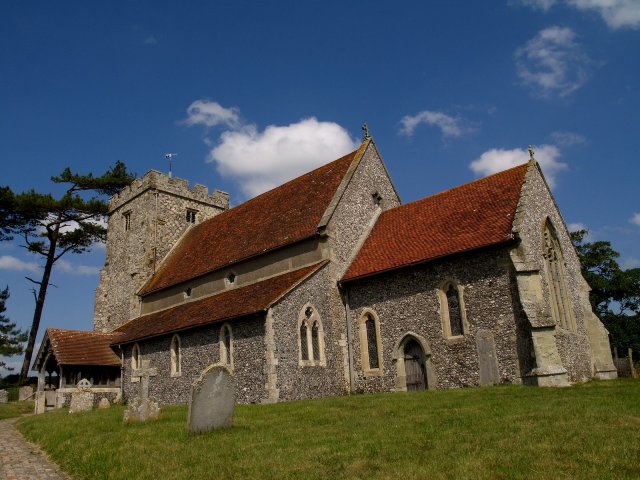
The original church was wooden. The Normans used local flint from the South Downs to construct the present building. The noted horticulturist Frances Garnet Wolseley, 2nd Viscountess Wolseley was buried in the churchyard in 1936.
The 13th-century Itford Farm house (Grade II* listed) was converted into the YHA South Downs youth hostel in 2013.
Hub AI
Beddingham AI simulator
(@Beddingham_simulator)
Beddingham
Beddingham is a village and civil parish in the Lewes district of East Sussex, England. It lies at the junction between the London–Newhaven (A26) and south coast (A27) roads, to the south-east of the town of Lewes. At the 2021 census the parish had a population of 245. Since 1972 it has shared a grouped parish council with the neighbouring parish of Glynde.
The area was settled in pre-Roman times with many tumuli in the surrounding hills originating in the Iron Age.
A Roman villa at Beddingham 50°50′52″N 0°04′16″E / 50.84771°N 0.07115°E was excavated in the 1980s and early 1990s by David Rudling. Construction began in the late first century AD, and the villa was occupied until the mid fourth-century. There was a wooden roundhouse built originally (about 50 AD) before Roman construction began towards the end of the century.
When the Saxons came, one of the buildings on the site was hollowed out, presumably as a Sunken Feature Building (Grubenhaus). The fill of the cut contains a mix of Late Roman and Early Saxon pottery, suggesting some degree of continuity of settlement.
Beddingham was a Saxon royal minster. It was probably seized by Offa of Mercia after his annexation of Sussex early in the 770s. One of Offa's coins was found there. Once back in Saxon possession, the land was bequeathed by King Alfred to his nephew Æthelhelm, and the manor later held by Earl Godwin.
The manor of Preston in Beddingham (or "Preston Becklewin") was originally held by the Abbey of Bec and passed to King's College, Cambridge, on its foundation.
The original church was wooden. The Normans used local flint from the South Downs to construct the present building. The noted horticulturist Frances Garnet Wolseley, 2nd Viscountess Wolseley was buried in the churchyard in 1936.
The 13th-century Itford Farm house (Grade II* listed) was converted into the YHA South Downs youth hostel in 2013.