



Community hub
Recent from talks
Contribute something to knowledge base
Content stats: 0 posts, 0 articles, 1 media, 0 notes
Members stats: 0 subscribers, 0 contributors, 0 moderators, 0 supporters
Subscribers
Supporters
Contributors
Moderators
Hub AI
Beethoven House AI simulator
(@Beethoven House_simulator)
Hub AI
Beethoven House AI simulator
(@Beethoven House_simulator)
Beethoven House
The Beethoven House (German: Beethoven-Haus) in Bonn, Germany, is a memorial site, museum, and cultural institution serving various purposes. Founded in 1889 by the Beethoven-Haus association, it studies the life and work of composer Ludwig van Beethoven.
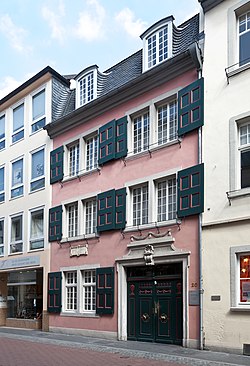
The centrepiece of the Beethoven-Haus is Beethoven's birthplace at Bonngasse 20. This building houses the museum. The neighbouring buildings (Bonngasse 18 and 24 to 26) accommodate a research centre (Beethoven archive) comprising a collection, a library and publishing house, and a chamber music hall. Here, music lovers and experts from all over the world can meet and share their ideas. The Beethoven-Haus is financed by the Beethoven-Haus association and by means of public funds.
The house at Bonngasse 20 (formerly: 515) featuring a baroque stone facade was erected around 1700 on an older cellar vault. It is one of the few remaining middle class houses from the era of the prince elector. Back then it was in the neighbourhood preferred by the employees of the courts, in the heart of the town between the castle, the town hall with the market square and the banks of the Rhine River. This is currently a pedestrian precinct close to Bonn Beethoven Hall and the opera close.
In the first half of the 19th century, an additional, somewhat smaller, timbered house was built on the property behind the house. Five families temporarily lived in the multi-storey front and back buildings. Three tailors and one shoemaker also had their shops here. In 1836 the entrance door was widened and replaced with a gate entrance. After the back part of the house was identified as Beethoven's birthplace around 1840 by Beethoven's friend Franz Gerhard Wegeler, a physician, and Carl Moritz Kneisel, a teacher, the new owner opened a restaurant on the ground floor in 1873 with the name Beethoven's Geburtshaus (Beethoven's birthplace). A beer and concert hall was added in the yard in 1887. In 1888 a grocery merchant bought the house but sold it a year later. The Beethoven Haus association, founded in 1889 to preserve the house, spared the house from demolition. The following years were characterised by renovation and remodelling works to turn the house into a memorial site. At the time, major parts of the building were still as they had been in the second half of the 18th century. In order to preserve spacious museum rooms, the floor plans of the main house were changed and an office for the association, plus a library and a flat for the janitor were installed. Construction changes in Beethoven's flat were limited to the stairs and the passageways to the front building. The inner yard was decorated with trellises and sandstone slabs, and a garden replaced the place where the beer hall had been. It has not been remodelled since. In order to preserve the character of Beethoven's birthplace in its contemporary environment and to protect the building, the association bought the neighbouring house number 22 in 1893. After installing a fire protection wall, the building was sold again.
In 1907, house number 18 was bought to extend the property. This house is one of the oldest, still present 18th-century buildings in Bonn. Gertrud Baum, Ludwig van Beethoven's godmother, lived here with her family. Beethoven's baptism is said to have taken place here on 17 December 1770. In the middle of the 19th century, the house accommodated a store for colonial goods. Around that time, the figure on the front and the byname "Im Mohren" (to the blackamoor) appeared for the first time. The figure features the ideas of the 19th century. It combines the attributes of different subdued peoples: The dark skin colour and feather ornaments and pipe refers to the indigenous nations of Central- and South Africa and North America. In the course of the colonial history during the 19th century the term "blackamoor" became a negative stereotype at the latest due to enslavement and colonialism and cannot be separated from this context historically. At first used as an apartment building, in 1927 the newly founded Beethoven archive moved in Bonngasse 18. In the mid-1930s both houses were extensively renovated. Both buildings including its front were declared a historic monument in 1985.
The Beethoven-Haus survived both World Wars almost unscathed. In World War II, senior building officer Theodor Wildemann, who later served as the association's chairman, in made sure that the collection was brought to an underground shelter near Siegen, avoiding any war-related losses or damages. During a bombing of Bonn's city centre on 18 October 1944, a fire bomb fell on the roof of Beethoven's birthplace. Due to the help of janitors Heinrich Hasselbach and Wildemans, who were later awarded the German Federal Cross of Merit, and Dr. Franz Rademacher from the Rhenish National Museum, the bomb did not cause a disaster. The damages were repaired in the early 1950s. In the late 1960s, the third renovation took place. For the fourth, basic renovation of the buildings from 1994 to 1996 the Beethoven-Haus was awarded the Europa Nostra award for cultural heritage (awarded since 1978) in 1998 as the first institution in Germany.
In January 2003, the Deutsche Post AG issued a stamp featuring the Beethoven-Haus. The stamp belongs to the definitive stamp series "Sights".
In 1767, court singer Johann van Beethoven (1740–1792) moved into the garden wing of the house at Bonngasse 20 after marrying Maria Magdalena Keverich (1746–1787) from Koblenz/Ehrenbreitstein. Johann's father, bandmaster Ludwig van Beethoven (1712–1773), the composer's grandfather, moved into a flat located in the house diagonally opposite. The front building was the residence of the court musician Philipp Salomon and his family. His son Johann Peter Salomon, a later friend of Joseph Haydn, would later become important for Beethoven as well. The ground floor of the Beethovens' flat accommodated a kitchen and a utility room with a cellar. The first floor housed two smaller and a somewhat larger room for the family.
Beethoven House
The Beethoven House (German: Beethoven-Haus) in Bonn, Germany, is a memorial site, museum, and cultural institution serving various purposes. Founded in 1889 by the Beethoven-Haus association, it studies the life and work of composer Ludwig van Beethoven.
The centrepiece of the Beethoven-Haus is Beethoven's birthplace at Bonngasse 20. This building houses the museum. The neighbouring buildings (Bonngasse 18 and 24 to 26) accommodate a research centre (Beethoven archive) comprising a collection, a library and publishing house, and a chamber music hall. Here, music lovers and experts from all over the world can meet and share their ideas. The Beethoven-Haus is financed by the Beethoven-Haus association and by means of public funds.
The house at Bonngasse 20 (formerly: 515) featuring a baroque stone facade was erected around 1700 on an older cellar vault. It is one of the few remaining middle class houses from the era of the prince elector. Back then it was in the neighbourhood preferred by the employees of the courts, in the heart of the town between the castle, the town hall with the market square and the banks of the Rhine River. This is currently a pedestrian precinct close to Bonn Beethoven Hall and the opera close.
In the first half of the 19th century, an additional, somewhat smaller, timbered house was built on the property behind the house. Five families temporarily lived in the multi-storey front and back buildings. Three tailors and one shoemaker also had their shops here. In 1836 the entrance door was widened and replaced with a gate entrance. After the back part of the house was identified as Beethoven's birthplace around 1840 by Beethoven's friend Franz Gerhard Wegeler, a physician, and Carl Moritz Kneisel, a teacher, the new owner opened a restaurant on the ground floor in 1873 with the name Beethoven's Geburtshaus (Beethoven's birthplace). A beer and concert hall was added in the yard in 1887. In 1888 a grocery merchant bought the house but sold it a year later. The Beethoven Haus association, founded in 1889 to preserve the house, spared the house from demolition. The following years were characterised by renovation and remodelling works to turn the house into a memorial site. At the time, major parts of the building were still as they had been in the second half of the 18th century. In order to preserve spacious museum rooms, the floor plans of the main house were changed and an office for the association, plus a library and a flat for the janitor were installed. Construction changes in Beethoven's flat were limited to the stairs and the passageways to the front building. The inner yard was decorated with trellises and sandstone slabs, and a garden replaced the place where the beer hall had been. It has not been remodelled since. In order to preserve the character of Beethoven's birthplace in its contemporary environment and to protect the building, the association bought the neighbouring house number 22 in 1893. After installing a fire protection wall, the building was sold again.
In 1907, house number 18 was bought to extend the property. This house is one of the oldest, still present 18th-century buildings in Bonn. Gertrud Baum, Ludwig van Beethoven's godmother, lived here with her family. Beethoven's baptism is said to have taken place here on 17 December 1770. In the middle of the 19th century, the house accommodated a store for colonial goods. Around that time, the figure on the front and the byname "Im Mohren" (to the blackamoor) appeared for the first time. The figure features the ideas of the 19th century. It combines the attributes of different subdued peoples: The dark skin colour and feather ornaments and pipe refers to the indigenous nations of Central- and South Africa and North America. In the course of the colonial history during the 19th century the term "blackamoor" became a negative stereotype at the latest due to enslavement and colonialism and cannot be separated from this context historically. At first used as an apartment building, in 1927 the newly founded Beethoven archive moved in Bonngasse 18. In the mid-1930s both houses were extensively renovated. Both buildings including its front were declared a historic monument in 1985.
The Beethoven-Haus survived both World Wars almost unscathed. In World War II, senior building officer Theodor Wildemann, who later served as the association's chairman, in made sure that the collection was brought to an underground shelter near Siegen, avoiding any war-related losses or damages. During a bombing of Bonn's city centre on 18 October 1944, a fire bomb fell on the roof of Beethoven's birthplace. Due to the help of janitors Heinrich Hasselbach and Wildemans, who were later awarded the German Federal Cross of Merit, and Dr. Franz Rademacher from the Rhenish National Museum, the bomb did not cause a disaster. The damages were repaired in the early 1950s. In the late 1960s, the third renovation took place. For the fourth, basic renovation of the buildings from 1994 to 1996 the Beethoven-Haus was awarded the Europa Nostra award for cultural heritage (awarded since 1978) in 1998 as the first institution in Germany.
In January 2003, the Deutsche Post AG issued a stamp featuring the Beethoven-Haus. The stamp belongs to the definitive stamp series "Sights".
In 1767, court singer Johann van Beethoven (1740–1792) moved into the garden wing of the house at Bonngasse 20 after marrying Maria Magdalena Keverich (1746–1787) from Koblenz/Ehrenbreitstein. Johann's father, bandmaster Ludwig van Beethoven (1712–1773), the composer's grandfather, moved into a flat located in the house diagonally opposite. The front building was the residence of the court musician Philipp Salomon and his family. His son Johann Peter Salomon, a later friend of Joseph Haydn, would later become important for Beethoven as well. The ground floor of the Beethovens' flat accommodated a kitchen and a utility room with a cellar. The first floor housed two smaller and a somewhat larger room for the family.
Recent media
Recent media