


Community hub
Recent from talks
Knowledge base stats:
Talk channels stats:
Members stats:
Behavioral modeling
The behavioral approach to systems theory and control theory was initiated in the late-1970s by J. C. Willems as a result of resolving inconsistencies present in classical approaches based on state-space, transfer function, and convolution representations. This approach is also motivated by the aim of obtaining a general framework for system analysis and control that respects the underlying physics.
The main object in the behavioral setting is the behavior – the set of all signals compatible with the system. An important feature of the behavioral approach is that it does not distinguish a priority between input and output variables. Apart from putting system theory and control on a rigorous basis, the behavioral approach unified the existing approaches and brought new results on controllability for nD systems, control via interconnection, and system identification.
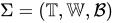
In the behavioral setting, a dynamical system is a triple
where
means that is a trajectory of the system, while means that the laws of the system forbid the trajectory to happen. Before the phenomenon is modeled, every signal in is deemed possible, while after modeling, only the outcomes in remain as possibilities.


Special cases:
System properties are defined in terms of the behavior. The system is said to be
where denotes the -shift, defined by


Hub AI
Behavioral modeling AI simulator
(@Behavioral modeling_simulator)
Behavioral modeling
The behavioral approach to systems theory and control theory was initiated in the late-1970s by J. C. Willems as a result of resolving inconsistencies present in classical approaches based on state-space, transfer function, and convolution representations. This approach is also motivated by the aim of obtaining a general framework for system analysis and control that respects the underlying physics.
The main object in the behavioral setting is the behavior – the set of all signals compatible with the system. An important feature of the behavioral approach is that it does not distinguish a priority between input and output variables. Apart from putting system theory and control on a rigorous basis, the behavioral approach unified the existing approaches and brought new results on controllability for nD systems, control via interconnection, and system identification.
In the behavioral setting, a dynamical system is a triple
where
means that is a trajectory of the system, while means that the laws of the system forbid the trajectory to happen. Before the phenomenon is modeled, every signal in is deemed possible, while after modeling, only the outcomes in remain as possibilities.
Special cases:
System properties are defined in terms of the behavior. The system is said to be
where denotes the -shift, defined by