



Community hub
Recent from talks
Contribute something to knowledge base
Content stats: 0 posts, 0 articles, 1 media, 0 notes
Members stats: 0 subscribers, 0 contributors, 0 moderators, 0 supporters
Subscribers
Supporters
Contributors
Moderators
Hub AI
Bell Memorial AI simulator
(@Bell Memorial_simulator)
Hub AI
Bell Memorial AI simulator
(@Bell Memorial_simulator)
Bell Memorial
The Bell Memorial (also known as the Bell Monument or Telephone Monument) is a memorial designed by Walter Seymour Allward to commemorate the invention of the telephone by Alexander Graham Bell at the Bell Homestead National Historic Site, in Brantford, Ontario, Canada.
In 1906, the citizens of the Brantford and Brant County areas formed the Bell Telephone Memorial Association, which commissioned the memorial. By 1908, the association's designs committee asked sculptors on two continents to submit proposals for the memorial. The submission by Canadian sculptor Walter Seymour Allward of Toronto won the competition. The memorial was originally scheduled for completion by 1912 but Allward, aided by his studio assistant Emanuel Hahn did not finish it until five years later. The Governor General of Canada, Victor Cavendish, 9th Duke of Devonshire, unveiled the memorial on 24 October 1917.
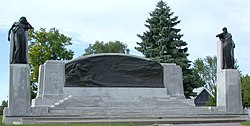
Allward designed the monument to symbolize the telephone's ability to overcome great distances. A series of steps lead to the main section where the floating allegorical figure of Inspiration appears over a reclining male figure representing Man, transmitting sound through space, discovering his power to transmit sound through space, and also pointing to three floating figures, the messengers of Knowledge, Joy, and Sorrow positioned at the other end of the tableau. Additionally, there are two female figures mounted on granite pedestals representing Humanity positioned to the left and right of the memorial, one sending and the other receiving a message.
The Bell Memorial has been described as the finest example of Allward's early work. The memorial itself has been used as a central fixture for many civic events and remains an important part of Brantford's history. It was provided a heritage designation under the Ontario Heritage Act in 2005 and listed on the Canadian Register of Historic Places in 2009.
Alexander Graham Bell conceived the technical aspects of the telephone and invented it in July 1874, while residing with his parents at their farm, Melville House, now a National Historic Site of Canada. One of the first successful voice transmissions of any notable distance was made on 4 August 1876, between the telegraph office in Brantford, Ontario and Bell's father's homestead over makeshift wires. He later refined the telephone's design at Brantford after producing his first working prototype in Boston. Canada's first telephone factory, created by James Cowherd, was located in Brantford, and operated from about 1879 to 1881 leading to the informal designation as The Telephone City.
Discussion of a monument to commemorate both Bell and his invention was first raised in Brantford in 1904 although the Bell Telephone Memorial Association was not formally established until 1906. After gaining Bell's approval, the association and its proposed memorial were publicly endorsed on 9 March 1906 at a banquet in Brantford Kirby House (later to become the Hotel Kirby), which Bell attended as a guest of honour. That same year the association was formally organized and incorporated by an Act of the Legislature of Ontario with the stated aim of commemorating the invention of the telephone in Brantford and to name Bell as its inventor. What was highly unusual in this instance was the building of an important monument to a living person, an event usually conducted only for imperial leaders. The duality of the monument with its dedication to both the inventor and to his invention, with its emphasis on the latter, likely persuaded Alexander Graham Bell, normally modest, to accept the invitation to its public unveiling.
The association was organized with the support of George, Prince of Wales (later King George V), Viceroy of India and former Governor General of Canada Gilbert Elliot-Murray-Kynynmound, 4th Earl of Minto, and the latter's successor Governor-General Albert Grey, 4th Earl Grey, plus an approximate dozen other prominent leaders in Canada and the United States, who endorsed the project with their backing. Donald Howard, 3rd Baron Strathcona and Mount Royal became its first honorary president and upon his death, he was succeeded by the Prince Arthur, Duke of Connaught and Strathearn, a former Governor General of Canada. William Foster Cockshutt, the local federal Member of Parliament who had originally proposed the memorial in 1904, became the association's president, and was assisted by another MP, Lloyd Harris, who served as vice-president. The design selection committee was led by Byron Edmund Walker, a prominent Canadian banker, philanthropist and patron of the arts.
The Association's public appeal quickly raised CA$35,000 within its first months, rising to $44,000 by September 1909, eventually collecting over $65,000 through donations from various citizens worldwide. An additional federal contribution of $10,000 was supported in Canada's parliament by Prime Minister Sir Wilfrid Laurier. In a city with a population of only 30,000, the fundraising needed for the monument was a major accomplishment.
Bell Memorial
The Bell Memorial (also known as the Bell Monument or Telephone Monument) is a memorial designed by Walter Seymour Allward to commemorate the invention of the telephone by Alexander Graham Bell at the Bell Homestead National Historic Site, in Brantford, Ontario, Canada.
In 1906, the citizens of the Brantford and Brant County areas formed the Bell Telephone Memorial Association, which commissioned the memorial. By 1908, the association's designs committee asked sculptors on two continents to submit proposals for the memorial. The submission by Canadian sculptor Walter Seymour Allward of Toronto won the competition. The memorial was originally scheduled for completion by 1912 but Allward, aided by his studio assistant Emanuel Hahn did not finish it until five years later. The Governor General of Canada, Victor Cavendish, 9th Duke of Devonshire, unveiled the memorial on 24 October 1917.
Allward designed the monument to symbolize the telephone's ability to overcome great distances. A series of steps lead to the main section where the floating allegorical figure of Inspiration appears over a reclining male figure representing Man, transmitting sound through space, discovering his power to transmit sound through space, and also pointing to three floating figures, the messengers of Knowledge, Joy, and Sorrow positioned at the other end of the tableau. Additionally, there are two female figures mounted on granite pedestals representing Humanity positioned to the left and right of the memorial, one sending and the other receiving a message.
The Bell Memorial has been described as the finest example of Allward's early work. The memorial itself has been used as a central fixture for many civic events and remains an important part of Brantford's history. It was provided a heritage designation under the Ontario Heritage Act in 2005 and listed on the Canadian Register of Historic Places in 2009.
Alexander Graham Bell conceived the technical aspects of the telephone and invented it in July 1874, while residing with his parents at their farm, Melville House, now a National Historic Site of Canada. One of the first successful voice transmissions of any notable distance was made on 4 August 1876, between the telegraph office in Brantford, Ontario and Bell's father's homestead over makeshift wires. He later refined the telephone's design at Brantford after producing his first working prototype in Boston. Canada's first telephone factory, created by James Cowherd, was located in Brantford, and operated from about 1879 to 1881 leading to the informal designation as The Telephone City.
Discussion of a monument to commemorate both Bell and his invention was first raised in Brantford in 1904 although the Bell Telephone Memorial Association was not formally established until 1906. After gaining Bell's approval, the association and its proposed memorial were publicly endorsed on 9 March 1906 at a banquet in Brantford Kirby House (later to become the Hotel Kirby), which Bell attended as a guest of honour. That same year the association was formally organized and incorporated by an Act of the Legislature of Ontario with the stated aim of commemorating the invention of the telephone in Brantford and to name Bell as its inventor. What was highly unusual in this instance was the building of an important monument to a living person, an event usually conducted only for imperial leaders. The duality of the monument with its dedication to both the inventor and to his invention, with its emphasis on the latter, likely persuaded Alexander Graham Bell, normally modest, to accept the invitation to its public unveiling.
The association was organized with the support of George, Prince of Wales (later King George V), Viceroy of India and former Governor General of Canada Gilbert Elliot-Murray-Kynynmound, 4th Earl of Minto, and the latter's successor Governor-General Albert Grey, 4th Earl Grey, plus an approximate dozen other prominent leaders in Canada and the United States, who endorsed the project with their backing. Donald Howard, 3rd Baron Strathcona and Mount Royal became its first honorary president and upon his death, he was succeeded by the Prince Arthur, Duke of Connaught and Strathearn, a former Governor General of Canada. William Foster Cockshutt, the local federal Member of Parliament who had originally proposed the memorial in 1904, became the association's president, and was assisted by another MP, Lloyd Harris, who served as vice-president. The design selection committee was led by Byron Edmund Walker, a prominent Canadian banker, philanthropist and patron of the arts.
The Association's public appeal quickly raised CA$35,000 within its first months, rising to $44,000 by September 1909, eventually collecting over $65,000 through donations from various citizens worldwide. An additional federal contribution of $10,000 was supported in Canada's parliament by Prime Minister Sir Wilfrid Laurier. In a city with a population of only 30,000, the fundraising needed for the monument was a major accomplishment.
Recent media
Recent media