



Community hub
Recent from talks
Knowledge base stats:
Talk channels stats:
Members stats:
Brantford
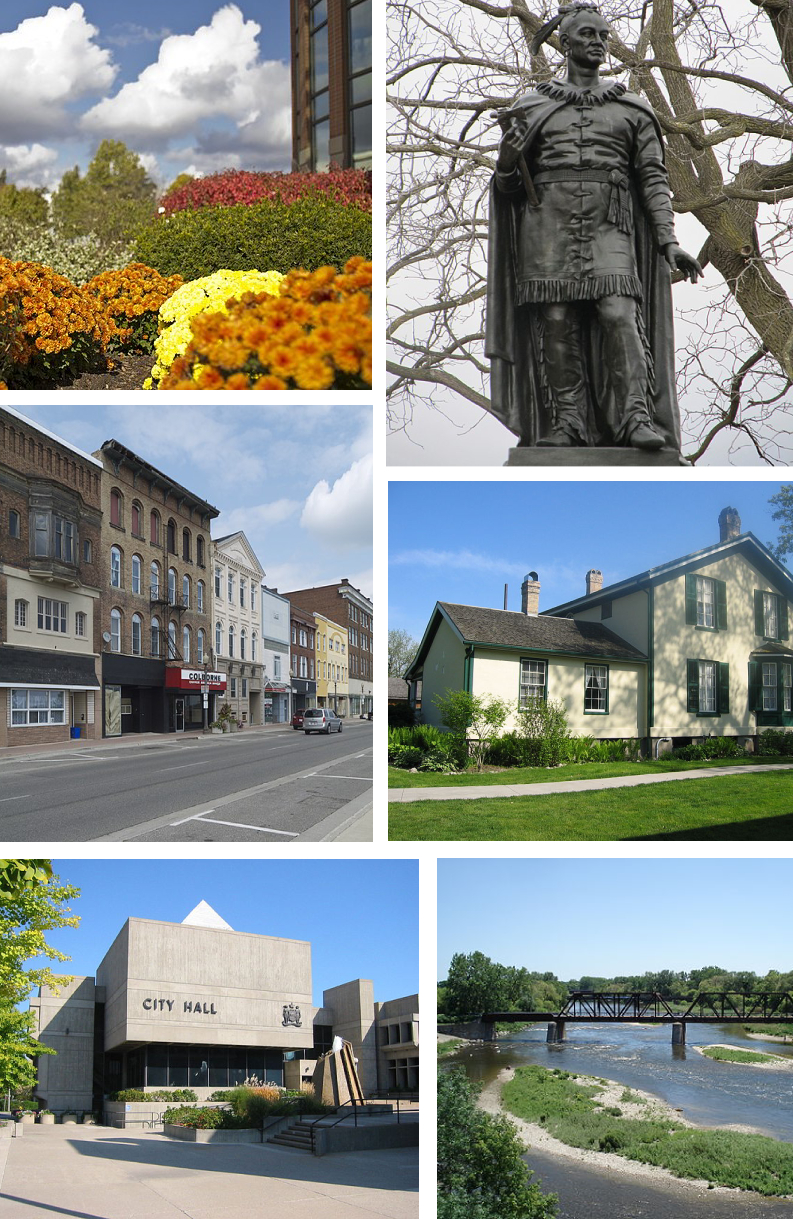
Brantford (2021 population: 104,688) is a city in Ontario, Canada, founded on the Grand River in Southwestern Ontario. It is surrounded by Brant County but is politically separate with a municipal government of its own that is fully independent of the county's municipal government.
Brantford is situated on the Haldimand Tract, and is named after Joseph Brant, a Mohawk leader, soldier, farmer and slave owner. Brant was an important Loyalist leader during the American Revolutionary War and later, after the Haudenosaunee moved to the Brantford area in Upper Canada. Many of his descendants and other First Nations people live on the nearby Six Nations of the Grand River reserve south of Brantford; it is the most populous reserve in Canada.
Brantford is known as the "Telephone City" because the city's famous resident, Alexander Graham Bell, invented the first telephone at his father's homestead, Melville House, now the Bell Homestead, located in Tutela Heights south of the city. Brantford is also known as the birthplace and hometown of Wayne Gretzky and Phil Hartman.
The Iroquoian-speaking Attawandaron, known in English as the Neutral Nation, lived in the Grand River valley area before the 17th century; their main village and seat of the chief, Kandoucho, was identified by 19th-century historians as having been located on the Grand River where present-day Brantford developed. This community, like the rest of their settlements, was destroyed when the Iroquois declared war in 1650 over the fur trade and exterminated the Neutral nation.
In 1784, Captain Joseph Brant and the Mohawk people of the Iroquois Confederacy left New York State for Canada. As a reward for their loyalty to the British Crown, they were given a large land grant, referred to as the Haldimand Tract, on the Grand River. The original Mohawk settlement was on the south edge of the present-day city at a location favourable for landing canoes. Brant's crossing (or fording) of the river gave the original name to the area: Brant's ford The Glebe Farm Indian Reserve exists at the original site today.
The area began to grow from a small settlement in the 1820s as the Hamilton and London Road was improved. By the 1830s, Brantford became a stop on the Underground Railroad, and a sizable number of runaway African-Americans settled in the town. From the 1830s to the 1860s – several hundred people of African descent settled in the area around Murray Street, and in Cainsville. In Brantford, they established their own school and church, now known as the S.R. Drake Memorial Church. In 1846, it is estimated 2000 residents lived in the city's core while 5199 lived in the outlying rural areas. There were eight churches in Brantford at this time – Episcopal, Presbyterian, Catholic, two Methodist, Baptist, Congregational, and one for the African-Canadian residents.
By 1847, Europeans began to settle further up the river at a ford in the Grand River and named their village Brantford. The population increased after 1848 when river navigation to Brantford was opened and again in 1854 with the arrival of the railway to Brantford.
Because of the ease of navigation from new roads and the Grand River, several manufacturing companies could be found in the town by 1869. Some of these factories included Brantford Engine Works, Victoria Foundry and Britannia Foundry. Several major farm implement manufacturers, starting with Cockshutt and Harris, opened for business in the 1870s.
Hub AI
Brantford AI simulator
(@Brantford_simulator)
Brantford
Brantford (2021 population: 104,688) is a city in Ontario, Canada, founded on the Grand River in Southwestern Ontario. It is surrounded by Brant County but is politically separate with a municipal government of its own that is fully independent of the county's municipal government.
Brantford is situated on the Haldimand Tract, and is named after Joseph Brant, a Mohawk leader, soldier, farmer and slave owner. Brant was an important Loyalist leader during the American Revolutionary War and later, after the Haudenosaunee moved to the Brantford area in Upper Canada. Many of his descendants and other First Nations people live on the nearby Six Nations of the Grand River reserve south of Brantford; it is the most populous reserve in Canada.
Brantford is known as the "Telephone City" because the city's famous resident, Alexander Graham Bell, invented the first telephone at his father's homestead, Melville House, now the Bell Homestead, located in Tutela Heights south of the city. Brantford is also known as the birthplace and hometown of Wayne Gretzky and Phil Hartman.
The Iroquoian-speaking Attawandaron, known in English as the Neutral Nation, lived in the Grand River valley area before the 17th century; their main village and seat of the chief, Kandoucho, was identified by 19th-century historians as having been located on the Grand River where present-day Brantford developed. This community, like the rest of their settlements, was destroyed when the Iroquois declared war in 1650 over the fur trade and exterminated the Neutral nation.
In 1784, Captain Joseph Brant and the Mohawk people of the Iroquois Confederacy left New York State for Canada. As a reward for their loyalty to the British Crown, they were given a large land grant, referred to as the Haldimand Tract, on the Grand River. The original Mohawk settlement was on the south edge of the present-day city at a location favourable for landing canoes. Brant's crossing (or fording) of the river gave the original name to the area: Brant's ford The Glebe Farm Indian Reserve exists at the original site today.
The area began to grow from a small settlement in the 1820s as the Hamilton and London Road was improved. By the 1830s, Brantford became a stop on the Underground Railroad, and a sizable number of runaway African-Americans settled in the town. From the 1830s to the 1860s – several hundred people of African descent settled in the area around Murray Street, and in Cainsville. In Brantford, they established their own school and church, now known as the S.R. Drake Memorial Church. In 1846, it is estimated 2000 residents lived in the city's core while 5199 lived in the outlying rural areas. There were eight churches in Brantford at this time – Episcopal, Presbyterian, Catholic, two Methodist, Baptist, Congregational, and one for the African-Canadian residents.
By 1847, Europeans began to settle further up the river at a ford in the Grand River and named their village Brantford. The population increased after 1848 when river navigation to Brantford was opened and again in 1854 with the arrival of the railway to Brantford.
Because of the ease of navigation from new roads and the Grand River, several manufacturing companies could be found in the town by 1869. Some of these factories included Brantford Engine Works, Victoria Foundry and Britannia Foundry. Several major farm implement manufacturers, starting with Cockshutt and Harris, opened for business in the 1870s.