


Community hub
Recent from talks
Contribute something
Nothing was collected or created yet.
Ben Weasel
View on Wikipedia
Key Information


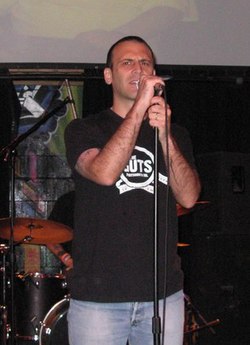
Benjamin Foster (born April 8, 1968), also known as Ben Weasel, is an American musician best known as the lead singer and guitarist of the punk rock band Screeching Weasel.
Early life
[edit]Foster was born in 1968, and was raised in Prospect Heights, Illinois. He attended River Trails Middle School in Mount Prospect, Illinois, where he first met future Screeching Weasel co-founder John Pierson.[1] Weasel was expelled from John Hersey High School and St. Viator High School.[2] He was eventually sent to the Élan School in Poland, Maine for his behavior issues.[3]
Music career
[edit]Screeching Weasel
[edit]When Foster returned to Illinois from the Élan School, he got a job at a local movie theater, and formed the band Screeching Weasel with co-worker and former junior high classmate John Pierson, aka Jughead.[4]
Screeching Weasel have released 15 studio albums: Screeching Weasel (1987), Boogadaboogadaboogada! (1988), My Brain Hurts (1991), Ramones (1992), Wiggle (1993), Anthem for a New Tomorrow (1993), How to Make Enemies and Irritate People (1994), Bark Like a Dog (1996), Television City Dream (1998), Emo (1999), Teen Punks in Heat (2000), First World Manifesto (2011), a rock opera entitled Baby Fat: Act 1 on Recess Records (2015), Some Freaks of Atavism (2020), and most recently The Awful Disclosures of Screeching Weasel (2022).
The Riverdales and The Vindictives
[edit]After an initial break-up in 1989, Screeching Weasel reformed in 1991 and broke up for a second time in 1994. Following the second breakup, Foster formed a new band, the Riverdales, with Screeching Weasel members Dan Vapid, and Dan Panic.
In the early 1990s, Foster founded The Gore Gore Girls (unrelated to the later band of the same name) with SW guitarist Jughead, Glynis Johnson (also of Red Red Meat) and Russ Forester (founder of Underdog Records). The Gore Gore Girls lasted only three shows and made an appearance on a compilation EP, Mouthful of Monkey Bile (1992). He also played 2nd guitar in The Vindictives, to be replaced by Billy Blastoff. Foster appeared on the first 4 EPs released by the band. In 1996, Lookout! Records released a 7-inch EP by The Shotdowns which included Foster, Jughead, and rock critic Jim DeRogatis. Foster was credited as "Pappy Le Pew".
Foster reunited with Screeching Weasel again in 1996. The band lasted until 2001 before breaking up again. On March 27, 2009, Foster announced he was reforming Screeching Weasel. He and Danny Vapid were the only returning members.
Solo albums
[edit]In 2002, Foster released his first solo album, Fidatevi. His second album, These Ones Are Bitter, was released in June 2007. A live album (featuring all Screeching Weasel songs, including the majority of the album My Brain Hurts), titled The Brain That Wouldn't Die, appeared in 2009 and featured Screeching Weasel member Danny Vapid as well as Jon Phillip.
Panic Button Records
[edit]Foster formed Chicago-based record label, Panic Button Records, in 1997 with Pierson. The label was later purchased by Lookout! Records.[5]
Other ventures
[edit]Writing
[edit]In the early 1990s, Foster published the fanzine Panic Button. He published two chapbooks through Oyster Publications, Brady Bunch Behemoth (1991) and Stab! Stab! Stab! (1992). Weasel also wrote for other various zines, including Razorcake, Non-Stop Banter, Jersey Beat, Hit List and 10 Things Jesus Wants You To Know. He also had a long-running column in MAXIMUM ROCKNROLL, one of the most prominent punk rock fanzines. He wrote a novel in 2001 called Like Hell and put out a collection of his columns and articles in 2002 entitled Punk is a Four Letter Word. Both books were published by Hope and Nonthings, a small publishing house based in Chicago run by former bandmate John Jughead.
Acting and directing
[edit]In 1990 Foster wrote, produced, directed and starred in a low-budget "gay vampire" film entitled Disgusteen.
Foster appeared as himself in the 1994 Bruce LaBruce film Super 8½ in a scene in which he receives fellatio.
Weasel Radio
[edit]Foster co-hosted a weekly radio show with Owen Murphy called Weasel Radio which premiered on ESPN 1070. Weasel Radio eventually became a podcast and its last episode was released on May 5, 2016.
Foster appeared on Ken Reid's TV Guidance Counselor Podcast on September 11, 2015.
He was a guest host on Dying Scene Radio episode 017.
SXSW incident
[edit]On Friday, March 18, 2011, at Austin, Texas's SXSW Festival, Foster was involved in an altercation with two women during a Screeching Weasel performance.[6][7][8] The first woman threw ice cubes at Foster. Upon being hit with more ice Foster found an unruly woman was the source of the ice. Foster originally stated he "can't kick a girl's ass" and offered money for another woman to handle the attacker. As the ice and spitting continued Foster threatened to beat the woman up himself. The woman then threw beer at Foster, who responded by attacking her. A club owner, also female, then came on stage and grabbed Foster from behind. He pushed her and punched her before being pulled to the other side of the stage by a bouncer.[9]
On March 20, Foster posted an apology[10] on his website BenWeasel.com[11] stating
"I want to apologize to both the club owner and audience member involved for my actions during our show at SXSW on Friday night. While their actions were outside of my control, my regretful reaction is wholly my responsibility. Whatever my feelings are about fans crossing the line like that, I wish I could have that moment back and deal with it in the same spirit as I did the preceding 60 minutes. Since I can't, an apology is all I've got and I sincerely hope those people will accept it. Up front, I wish to say that I am sorry to the fan and any others who were involved. As a husband, father, and a musician on the public stage, I understand that it is my duty to always take responsibility for my actions in a socially acceptable way, and most especially in the face of confrontation."
— Ben Foster.
Following the incident, several bands who were slated to appear at Weasel Fest in Chicago dropped out, including Chinese Telephones, Chixdiggit, The Soviettes, Teenage Bottlerocket and Kepi Ghoulie.[12] On March 23, 2011, the other four members of Screeching Weasel all resigned from the band citing the SXSW incident as the reason.[13] On March 31 it was announced that the entire Weasel Fest had been cancelled.[14] In August, Weasel issued a full article on Screeching Weasel's website describing his whole point of view on the situation.[15]
Personal life
[edit]On November 30, 2010, Foster appeared on Last Call with Carson Daly and revealed that he has anxiety, panic attacks, and bouts of agoraphobia.[16]
Foster lives with his wife and 3 children in Madison, Wisconsin. He used to be a Buddhist but then became Catholic.[17]
Discography
[edit]
With Screeching Weasel
[edit]- Screeching Weasel (1987)
- Boogadaboogadaboogada! (1988)
- My Brain Hurts (1991)
- Ramones (1992)
- Wiggle (1993)
- Anthem for a New Tomorrow (1993)
- How to Make Enemies and Irritate People (1994)
- Bark Like a Dog (1996)
- Television City Dream (1998)
- Emo (1999)
- Teen Punks in Heat (2000)
- First World Manifesto (2011)
- Baby Fat: Act I (2015)
- Some Freaks of Atavism (2020)
- The Awful Disclosures of Screeching Weasel (2022)
With Riverdales
[edit]- Riverdales (1995)
- Storm the Streets (1997)
- Phase Three (2003)
- Invasion U.S.A (2009)
- Tarantula (2010)
Solo
[edit]- Fidatevi (2002)
- These Ones Are Bitter (2007)
- The Brain That Wouldn't Die (2009)
References
[edit]- ^ "John Jughead's Writings and Activities: WRESTLING WITH WEASELS". Johnjugheadpierson.blogspot.com. April 15, 2013. Retrieved September 17, 2020.
- ^ "Daily Herald | Bands with suburban roots a big part of annual punk-rock fest". Archived from the original on August 13, 2013. Retrieved August 13, 2013.
- ^ DeRogatis, Jim (March 2001). "SCREECHING HALT". Spin. Retrieved March 23, 2011.
- ^ Jim DeRogatis (October 15, 2000). "Screech goes on for Ben Weasel". Chicago Sun-Times. Archived from the original on February 29, 2016. Retrieved September 8, 2012 – via HighBeam Research.
- ^ Harvilla, Rob (September 14, 2005). "Kerplunk – The rise and fall of the Lookout Records empire". East Bay Express. Retrieved September 8, 2012.
- ^ "Screeching Weasel – Cool Kids Club and Ben Weasel picks a fight with drunk girls". YouTube. Archived from the original on December 21, 2021. Retrieved September 17, 2020.
- ^ "Ben Weasel gets in a FIGHT!!!!". YouTube. Archived from the original on December 21, 2021. Retrieved September 17, 2020.
- ^ "Ben Weasel Fights 2 Women in Slow Motion". YouTube. Archived from the original on December 21, 2021. Retrieved September 17, 2020.
- ^ Martens, Todd (March 19, 2011). "SXSW 2011: Screeching Weasel reluctantly performs, show ends in a scuffle". Los Angeles Times. Retrieved March 23, 2011.
- ^ August, Justin (March 21, 2011). "Ben Weasel apologizes to fan, club owner and band for actions at SXSW". Punknews.org. Retrieved March 23, 2011.
- ^ [1] [permanent dead link]
- ^ Yancey, Byrne (March 21, 2011). "The Soviettes, Chinese Telephones, Teenage Bottlerocket drop from Weasel Fest". Punknews.org. Retrieved March 23, 2011.
- ^ Paul, Aubin (March 23, 2011). "Screeching Weasel members resign". Punknews.org. Retrieved March 23, 2011.
- ^ "Weasel Fest canceled". Punknews.org. Retrieved September 17, 2020.
- ^ "Screeching Weasel (Aka just Ben) release statement +++ schedule gig @ Reggie's". Archived from the original on April 7, 2014. Retrieved April 4, 2014.
- ^ "Ben Weasel featured on Carson Daly". Punknews.org. Retrieved September 17, 2020.
- ^ McDonald, Jim (July 2007). "Ben Weasel Interview". 1340 Mag. Archived from the original on August 22, 2007. Retrieved March 23, 2011.
External links
[edit]- Lookout Records at the Wayback Machine (archived December 23, 2014)
- Deprecated link at archive.today (archived December 4, 2012)
- Fat Wreck Chords
- Ben Weasel's Weblog
| International | |
|---|---|
| National | |
| Artists | |
| Other | |

Ben Weasel
View on GrokipediaEarly Life
Childhood and Initial Influences
Benjamin Foster, professionally known as Ben Weasel, was born on April 8, 1968, and raised in the Chicago suburb of Arlington Heights, Illinois.[7] Growing up in this middle-class suburban setting, Foster displayed an opinionated and rebellious streak as a teenager, rejecting the conformity associated with such environments.[8] His initial exposure to punk rock came in the summer of 1986, when he attended a Ramones concert that profoundly influenced his musical direction and prompted him to pursue music through grassroots channels rather than formal training or privileged networks.[9] This event marked a pivotal shift, drawing him away from mainstream trends toward the DIY ethos of early punk acts like the Ramones, whose simple, high-energy style shaped his self-taught approach to guitar and songwriting.[10] Foster's early involvement in the scene involved attending local Chicago punk shows and engaging with the underground community via informal networks, laying the foundation for his rejection of suburban norms and embrace of punk's anti-establishment principles.[7]Entry into the Chicago Punk Scene
In the mid-1980s, Ben Weasel, born Benjamin Foster, became involved in Chicago's burgeoning DIY punk subculture after discovering the genre through the 1984 film Repo Man, which inspired him and childhood friend John "Jughead" Pierson to emulate the fast, melodic style of the Ramones.[11] [12] Operating from the suburbs of Prospect Heights, Illinois, they formed their first band in 1986 without prior musical experience or institutional backing, initially naming it All Night Garage Sale before renaming it Screeching Weasel.[13] This reflected the era's punk ethos of self-reliance, where aspiring musicians relied on grassroots networks rather than established industry pathways, often facing rejection from labels that favored more conventional acts.[11] Weasel's entry emphasized organic connections through tape trading with out-of-town punk bands and local scene participation, bypassing nepotistic gatekeepers in favor of merit-driven survival via raw output.[14] The band's debut efforts included a 27-song demo tape recorded that year, prioritizing unpolished energy and speed over professional production, which captured the DIY spirit amid Chicago's hardcore influences like Naked Raygun but carved a distinct pop-punk niche.[15] Early live performances in suburban and city venues honed this approach, avoiding the ideological factions that would later fragment broader punk communities, and leading to their self-titled LP release on the independent Underdog Records in 1987.[15]Musical Career
Founding and Development of Screeching Weasel
Screeching Weasel was founded in 1986 in the Chicago suburbs by vocalist and guitarist Ben Weasel (born Ben Foster) and guitarist John "Jughead" Pierson, emerging from the local punk scene with an initial focus on raw, fast-paced punk rock.[16] The band's early output included a self-released demo tape in 1986, followed by their debut self-titled album in 1987 on Underdog Records and Boogadaboogadaboogada! in 1988 on Roadkill Records, both characterized by aggressive, hardcore-influenced energy but limited production and distribution that confined them to underground circuits.[17] These releases featured frequent lineup flux, with Weasel as the creative anchor, but the band disbanded in 1989 amid internal strains and lack of momentum.[18] The band reformed in early 1991 at the encouragement of Lookout! Records founder Lawrence Livermore, who signed them as the label's first act from outside the Bay Area punk scene, leading to a pivotal shift toward a more melodic pop-punk style heavily inspired by the Ramones' concise song structures and humorous lyrics.[19] This era's debut on Lookout, My Brain Hurts, released on September 1, 1991, refined their sound with tighter riffs, pop hooks, and Weasel's prolific songwriting—penning all tracks—capturing themes of suburban angst and marking a commercial breakthrough within punk subcultures despite no mainstream radio play.[20] Follow-up Anthem for a New Tomorrow, issued in 1993, amplified this fusion, incorporating 18 tracks of high-tempo anthems that solidified their niche appeal, with Weasel handling lead vocals, guitar, and primary composition amid rotating rhythm sections including bassist Danny Vapid and drummer Dan Panic.[21] Throughout the 1990s, Screeching Weasel navigated multiple lineup changes driven by Weasel's uncompromising vision for rapid output and stylistic consistency, releasing additional Lookout albums like Wiggle (1993) and How to Make Enemies and Irritate People (1994), which blended punk velocity with pop accessibility amid the broader punk shift from hardcore to skate-oriented pop-punk.[22] The band disbanded in 1994 primarily due to Weasel's burnout from relentless touring and recording schedules, as well as departures like Jughead's intermittent exits, though reformations ensued, yielding further albums such as Bark Like Carnivore False Teeth? (1997, self-released initially) and Television City Dream (1998 on Fat Wreck Chords), the latter benefiting from Fat's wider distribution networks to expand their cult following without chart success.[23] Another breakup occurred in 2001, again attributed to exhaustion and member attrition, yet the band's persistence under Weasel's direction produced over 15 studio albums by the early 2000s, fostering a dedicated fanbase through DIY ethic and thematic consistency rather than broad commercial metrics.[9]Side Projects and Collaborations
Ben Weasel formed the Riverdales in 1995 with fellow Screeching Weasel alumni Dan Vapid on bass and vocals and Dan Panic on drums, crafting a sound explicitly modeled after the Ramones through concise, melodic pop-punk tracks and dual lead vocals between Weasel and Vapid.[24] [25] The band's self-titled debut album, released that year on Lookout! Records, featured 14 songs averaging under two minutes each, capturing a raw homage to 1960s influences filtered through punk velocity.[26] A follow-up, Storm the Streets, emerged in 1997 on Fat Wreck Chords, maintaining the high-energy format amid the band's initial dissolution later that year.[27] The Riverdales reformed sporadically, issuing Phase Three in 2003 and Tarantula in 2010, with outputs totaling five albums before a final split in March 2011 tied to broader Screeching Weasel turmoil.[27] These efforts highlighted Weasel's drive for stylistic experimentation within pop-punk constraints, yielding innovative riffs on Ramones-esque simplicity while underscoring the projects' brevity—often limited to 2-3 years of activity per iteration—due to Weasel's central songwriting and production roles.[28] Parallel to these, Weasel contributed to the Vindictives as guitarist and backing vocalist from 1990 to 1992, influencing their blistering, hyper-accelerated punk style that diverged from Screeching Weasel's evolving pop leanings toward more relentless speed and absurdity.[29][30] The band, led by Joey Vindictive, produced a string of EPs and full-lengths in the early 1990s, including the compilation Original Masters (2003, aggregating early VML Records output with Weasel's tracks) and The Many Moods of the Vindictives on Lookout! Records, emphasizing satirical lyrics and breakneck tempos.[30] Weasel's early tenure facilitated cross-pollination within Chicago's punk ecosystem, though the Vindictives persisted independently post his exit, releasing further material into the late 1990s. These side endeavors underscored Weasel's collaborations with core Chicago punk figures like Vapid and Panic, serving as controlled creative valves for thematic shifts—Ramones worship in the Riverdales versus velocity experiments in the Vindictives—without diluting his primary band's momentum, though their ephemeral runs reflected a pattern of rapid formation and disbandment aligned with his singular vision over extended group commitments.Solo Work and Independent Releases
Ben Weasel's solo endeavors commenced in the early 2000s amid Screeching Weasel's hiatus following the band's 2001 breakup, enabling him to pursue unfiltered creative autonomy outside collaborative constraints. His debut solo album, Fidatevi, issued in 2002 on Recess Records, marked a departure from punk's frenetic pace toward more introspective and mature compositions, emphasizing lyrical depth and subdued arrangements that reflected personal introspection rather than group energy.[31] The title, Italian for "trust me," underscored themes of individual conviction, with tracks blending acoustic elements and pop sensibilities to experiment beyond band formulas.[32] In 2007, Weasel released his second solo effort, These Ones Are Bitter, under the moniker Ben Weasel and His Iron String Quartet via Suburban Home Records, further highlighting his independent streak through self-directed production and distribution via niche punk outlets. Produced by Mike Kennerty of The All-American Rejects, the album adopted an even poppier orientation, incorporating string quartet arrangements to contrast Screeching Weasel's raw sound while critiquing mainstream music's formulaic gatekeeping in favor of direct artist-fan connections unmediated by major labels.[13] This release, timed during ongoing band inactivity, prioritized experimentation with orchestral punk hybrids, allowing Weasel to maintain output and engage core audiences through limited-run vinyl and digital platforms without industry intermediaries.[33] These independent projects exemplified Weasel's ethos of bypassing traditional gatekeepers, leveraging small labels and personal networks for distribution, which facilitated sustained fan interaction via merchandise and shows despite limited commercial metrics; for instance, These Ones Are Bitter garnered niche acclaim in punk circles for its bold stylistic risks.[34] By self-managing releases during the 2002–2009 period, Weasel preserved creative control, releasing material that prioritized artistic integrity over market-driven compromises.[35]Record Label Operations
Panic Button Records was co-founded by Ben Weasel (Ben Foster) and John Jughead Pierson in Chicago, Illinois, in 1997, capitalizing on the momentum from Screeching Weasel's mid-1990s resurgence to establish a platform for punk rock releases. The label's debut output was The Riverdales' album Major Label Debut that year, followed by projects tied to Weasel's circle, including reissues like Screeching Weasel's Formula 27 in 1998 and the 2000 compilation Teen Punks in Heat, which featured 20 tracks from acts such as The Queers, The Lillingtons, and Moral Crux.[36][37][38] Operating within the DIY punk ecosystem, Panic Button emphasized direct artist involvement and niche distribution networks, enabling control over production and promotion in an era dominated by major labels' consolidation of retail and radio channels. This approach sustained profitability through mail-order sales, limited-edition vinyl, and ties to independent venues, though it incurred risks from low-volume runs and fluctuating fan demand in a subcultural market. Weasel's hands-on role underscored a pragmatic balance between punk's anti-corporate ethos and entrepreneurial necessities, as evidenced by the label's catalog of over a dozen titles by 2001, including Vindictives and Sludgeworth material.[39][36] The label ceased independent operations in 2001 when it was acquired by Lookout! Records, coinciding with Screeching Weasel's latest dissolution and Weasel's shift toward other pursuits; this transition reflected the vulnerabilities of small-scale ventures reliant on personal bandwidth amid band instability and evolving digital distribution threats. While the sale preserved catalog access, it highlighted trade-offs: relinquished autonomy for financial stability, contrasting the DIY control that initially attracted punk acts wary of mainstream co-option. No revivals occurred post-sale, as Lookout! integrated the releases into its roster before its own 2000s upheavals.[36]Creative Ventures Beyond Music
Writing and Literary Contributions
Ben Weasel initiated his writing through punk zines, producing his own publication Panic Button and contributing essays to outlets such as Maximum Rocknroll, Razorcake, Jersey Beat, and Hit List.[40][33] These pieces frequently dissected inconsistencies in punk subculture, challenging idealized narratives of rebellion while emphasizing individual authenticity over collective dogma.[41][42] Expanding from zine formats, Weasel self-published chapbooks via Oyster Publications, including Brady Bunch Behemoth in 1991 and Stab! Stab! Stab! in 1992, which satirized pop culture and personal grievances through punk lenses.[40] In 2001, he released the novel Like Hell, a semi-autobiographical tale of a Chicago punk band's internal strife and external pressures, drawing parallels to real-world scene dynamics without romanticizing them.[13] His essay collection Punk Is a Four-Letter Word: Columns, Articles and Essays 1991-2002, published in 2003, aggregates prior zine work with new entries critiquing punk's commodification and ideological rigidities, such as enforced conformity under anti-authoritarian guises.[41][42] More recently, under the pseudonym Benjamin Foster, he authored the 2020 novel Crow-Black The Night, a 266-page story of faded fame and personal reckoning in artistic circles.[43] Weasel's literary output consistently prioritizes unvarnished critique, targeting hypocrisies like punk's tolerance for authoritarian streaks in leftist-leaning factions, as seen in essays decrying scene "orthodoxy" that stifles dissent.[44][45] This approach has elicited polarized responses: admirers value its commitment to punk's core defiance of norms, while detractors, often aligned with progressive subcultural gatekeepers, dismiss it as abrasive or contrarian.[42] In an October 2025 newsletter, Weasel announced plans for a new book release in 2026, signaling continued exploration of these themes amid his ongoing creative pursuits.[46]Media Productions: Acting, Directing, and Broadcasting
Ben Weasel directed and starred in the 1990 short horror film Disgusteen, a low-budget DIY production reflecting his punk ethos of self-produced media independent of mainstream film channels.[47] He also appeared as an actor in Bruce LaBruce's 1994 experimental film SUPER 8½, contributing to its underground queer cinema aesthetic amid his early music career.[48] These ventures exemplify Weasel's extension of punk's do-it-yourself principles into visual media, prioritizing raw, unpolished content over commercial viability, though they received limited distribution and critical attention beyond niche punk and indie film circles.[49] In broadcasting, Weasel co-hosted Weasel Radio, a weekly show launched in the early 2010s with collaborator Owen Murphy, evolving into a podcast offering unfiltered commentary on the music industry from an insider's punk perspective.[50] The program featured discussions on band dynamics, label operations, and industry critiques, often including guests like former Screeching Weasel members, and ran until its final episode on May 5, 2016.[51] Episodes emphasized rejecting corporate media gatekeeping in favor of direct, amateur-style audio platforms, fostering listener loyalty among punk audiences valuing authenticity over professional polish—critics noted its rough production quality but praised its candid avoidance of sanitized narratives.[52] Distributed via independent channels like SoundCloud and Apple Podcasts, Weasel Radio built a dedicated following by prioritizing unmoderated punk voices, aligning with Weasel's broader resistance to institutionalized media control.[53]Controversies
The 2011 SXSW Incident
During Screeching Weasel's March 18, 2011, performance at the Scoot Inn in Austin, Texas, as part of the South by Southwest (SXSW) festival's Fat Wreck Chords showcase, an onstage altercation erupted near the end of the set. While performing the song "Cool Kids" during the encore amid a crowd surge, a woman in the audience threw ice that struck frontman Ben Weasel (Ben Foster) near the eye; witnesses reported she also spat beer or water at him. Weasel then jumped into the crowd to confront her, punching her in the face. A second woman—described in accounts as either a venue staff member or an intervening fan—approached to restrain him, at which point Weasel struck her as well, leading security to drag him offstage and abruptly end the show. Video footage of the incident, widely circulated online, depicts the punches amid general onstage and crowd chaos consistent with punk show physicality, including moshing and stage diving.[54][55][56] Weasel addressed the event in a statement posted on his website on March 20, 2011, framing his actions as a regrettable response to fans "crossing the line" in the frenzy but taking full responsibility without explicitly denying the physical contact. He apologized to the women involved, the club owner, his bandmates, management, label, support acts, and fans affected by the cancellation of the following day's San Antonio performance, stating as a husband, father, and public figure he should have handled the confrontation differently and hoping for acceptance of his remorse. The women involved described the strikes as unprovoked assaults, while Weasel and some eyewitnesses emphasized the initial provocation and the normative aggression of punk environments, where performers often face grabbing or projectiles without legal repercussions. No police charges were filed, as the women had departed by the time authorities arrived.[4][57][55] In the immediate aftermath, drummer Dan Lumley quit the band onstage, citing disapproval of Weasel's conduct. Guitarist John "Jughead" Pierson and bassist Mike Hunchback soon followed, with the departures tied directly to the altercation's fallout among the group's four non-Weasel members. The incident prompted cancellations and withdrawals from Weaselfest, a planned two-night Chicago event on May 27–28, 2011, including Teenage Bottlerocket and Chinese Telephones pulling out in protest.[58][57][58]Band Internal Conflicts and Breakups
Screeching Weasel disbanded in 1994 after releasing the album How to Make Enemies and Irritate People, with core members Ben Weasel, Dan Vapid, and Dan Panic immediately forming the Ramones-influenced side project the Riverdales, suggesting underlying tensions over musical direction or band dynamics.[59] This marked the first major fracture, reflecting Weasel's pattern of reallocating personnel to align with his vision rather than sustaining an unstable lineup. The band's high turnover—over 20 members across its runs—stemmed empirically from Weasel's insistence on controlling songwriting and production, which prioritized output consistency but often clashed with collaborators' input or commitment levels.[60] The group reformed in the late 1990s but dissolved again on July 6, 2001, as announced by Weasel himself, amid a protracted legal dispute with co-founder John "Jughead" Pierson over ownership of the band's assets and business operations.[23][44] Pierson later detailed experiences of mistreatment under Weasel's leadership during the writing of his book Weasels in a Box, highlighting patterns of mental strain from Weasel's dominant role, though Weasel framed such exits as natural attrition in pursuit of sustained productivity.[61] Weasel has attributed lineup instability to varying member dedication, stating in a 2009 interview that "people come and go for a variety of reasons and you just keep going," underscoring his rationale for merit-based continuity over relational consensus.[62] Similar fractures occurred in side projects like the Riverdales, where initial equitable songwriting gave way to Weasel's creative oversight, mirroring main-band issues and leading to Vapid's eventual departure to form Dan Vapid and the Cheats amid reported meltdowns.[63][64] This approach ensured stylistic coherence—evident in the bands' prolific discographies—but alienated participants unwilling to match Weasel's rigorous standards, as Vapid noted in interviews the challenges of navigating Weasel's intensity while contributing.[63] Causally, Weasel's centralized control filtered out inconsistencies, yielding enduring punk output, though at the cost of repeated collaborations dissolving when members prioritized autonomy or personal limits over his demands.[65]Public Backlash and Defenses Against Cancel Culture
Following the 2011 SXSW altercation, numerous media outlets portrayed Ben Weasel (Ben Foster) as engaging in unprovoked violence against women, framing the incident as emblematic of misogyny within punk rock despite eyewitness accounts and video footage indicating the women had rushed the stage and initiated physical contact.[58][66] This coverage, primarily from sources with progressive leanings such as Rolling Stone and Spin, contributed to immediate consequences including the resignation of four band members on March 23, 2011, and the cancellation of associated events like Weaselfest.[67] Foster issued an initial apology on March 21, 2011, via the band's website, acknowledging his actions but emphasizing the chaotic context, though subsequent reporting often omitted nuances of mutual aggression.[4] Foster has consistently countered such narratives in public statements and open letters, arguing that the punk scene's shift toward heightened sensitivity undermines its foundational ethos of resilience and direct confrontation. In a detailed response published five months after the incident, he critiqued the selective outrage and victimhood framing, asserting self-defense and decrying how amplified media stories distorted facts to fit ideological agendas.[68] Through platforms like his Twitch broadcasts and podcasts, including episodes of My Right with Ben Weasel starting in 2019, Foster has elaborated on these themes, positioning himself against what he describes as an erosion of punk's "toughness" in favor of performative moralism.[69] These defenses highlight empirical patterns, such as the band's ability to reform with new members and sustain operations amid criticism, evidenced by the 2022 release of The Awful Disclosures of Screeching Weasel, which received positive reviews for maintaining the group's signature style.[70] Public reactions reveal a divide: progressive-leaning critics and former collaborators pursued cancellations, including scrapped documentary projects and festival pullouts, while a core fanbase has rallied around Foster's unapologetic stance, supporting reunions and new material as authentic to punk's irreverent roots.[71] This support manifested in sold-out performances, such as Screeching Weasel's Riot Fest set on September 21, 2025, where Foster halted the show to have security eject an audience member who raised a middle finger in antagonism—mirroring his prior insistence on boundaries against disruption and underscoring consistency rather than hypocrisy.[72] Such incidents challenge one-sided villain narratives by demonstrating reciprocal dynamics in live settings, with the band's enduring draw—evidenced by continued album sales and festival bookings—indicating that backlash has not materially diminished their influence among adherents valuing candor over conformity.[73][74]Personal Life and Ideology
Relationships and Family
Benjamin Foster, professionally known as Ben Weasel, has maintained a long-term marriage to his wife Sara, with the couple relocating from the Chicago area to Madison, Wisconsin, around 2006.[75][76] They have resided in the Madison suburbs since, prioritizing family stability over extensive public disclosure of personal matters.[77] Foster and Sara are parents to three children: twin daughters born circa 2010 and a son born circa 2012.[6] In interviews, Foster has described his primary post-relocation role as that of a stay-at-home father, handling child-rearing duties that have grounded his life amid the demands of intermittent musical activities.[44][78] This domestic focus has persisted through professional upheavals, including band breakups and public scandals, presenting a low-conflict family dynamic atypical for punk musicians, who often publicize relational volatility.[78] Details beyond basic family composition remain scarce, reflecting a deliberate emphasis on privacy.[6]Philosophical and Political Views
Ben Weasel has consistently rejected identity politics and "woke" ideology, viewing them as irrational cults that prioritize feelings over evidence and reason. In a 2021 Substack post, he argued that critical theory underpinning woke ideology "explicitly attacks reason as a tool of white privilege," leading to a dismissal of logic and proof as mere distractions.[79] He further critiqued identity politics in a 2022 piece titled "Identity Politics Are a Harsh Mistress," portraying it as unstable and self-undermining when allegiance shifts based on personal grievances rather than merit or consistency.[80] This stance reflects his broader opposition to collectivist groupthink, whether in "Wokeistan" or opposing ideological camps, favoring individual reasoning and self-directed accountability over dogmatic affiliations.[79] Weasel's advocacy for free speech positions him against censorship trends in punk and broader culture, particularly efforts to suppress expression that offends sensibilities. In a 2021 interview, he warned that restricting the First Amendment "because certain things make people 'feel' bad" undermines art and fosters self-censorship, noting the irony of the American left—traditionally a free speech champion—driving such restrictions.[78] He attributes his contrarian reputation in punk to challenging its predominant left-wing orthodoxy, stating, "The reason people say that I’m right wing, even though I’m not, is because the predominant voice in punk is left wing, and I have to criticize it."[78] This pro-individual liberty outlook emphasizes unthinking allegiance to no cause, aligning with punk's original appeal as a space for unrestrained personal expression.[78] Philosophically, Weasel prioritizes realism and the human condition over political solutions, critiquing modern society's drift toward puritanical self-religions that replace organized faith with unconscious identity-based moralism.[78] His views have sparked debate within punk, preserving the subculture's confrontational edge against perceived dilutions from ideological conformity, though they have distanced him from ideologues who demand alignment with collectivist norms.[81] This resilience stems from his commitment to merit-based critique over consensus, enabling sustained relevance amid backlash.[78]Later Developments and Legacy
Post-Hiatus Reunions and Recent Activities
Screeching Weasel emerged from hiatus with a return to live performances in 2025, following over a decade of inactivity after the band's 2011 dissolution. The group's first show in this resurgence occurred on March 28, 2025, at Reggie's Rock Club in Chicago, where Ben Weasel performed with a new lineup including guitarist Mike Hunchback.[82] This event drew positive fan reception, highlighting sustained interest despite prior controversies.[82] Subsequent touring expanded the band's schedule, with confirmed dates including October 5, 2025, at Punk in the Park in San Pedro, California; October 15, 2025, at St. Andrew's Hall in Detroit, Michigan; and October 17, 2025, at The King of Clubs in Columbus, Ohio.[83] These appearances, promoted via the band's official Instagram account, underscore a fan-supported revival focused on live energy and punk authenticity rather than mainstream validation.[84] In an October 3, 2025, newsletter, Weasel announced forthcoming projects for 2026, including a new studio album produced with Mass Giorgini, expanded merchandise lines, and a personal book detailing his experiences.[46] This output signals ongoing productivity and commitment to the band's pop-punk catalog, with the group actively developing new material alongside tour commitments.[46]Influence on Punk Genres and Broader Impact
Screeching Weasel's adherence to a raw, Ramones-derived formula of short, melodic punk songs distinguished the band within the 1990s pop-punk resurgence, serving as a bridge between 1970s punk progenitors and later acts by emphasizing bubblegum hooks over hardcore aggression. This approach, characterized by Ben Weasel's snotty vocals and insistence on fidelity to Joey Ramone's delivery, helped revive interest in unadorned punk structures amid the era's shift toward polished alternatives.[81] Bands such as Green Day acknowledged this lineage, with early collaborations like bassist Mike Dirnt's guest appearance on Screeching Weasel's 1994 album How to Make Enemies and Irritate People, reflecting mutual East Bay-Chicago scene exchanges that propelled the genre's DIY momentum.[85] Similarly, Blink-182 cited Weasel's influence on their own pop-punk formulations, underscoring a traceable causal chain from Screeching Weasel's output to mainstream commercialization of the style.[65] As one of the first non-local acts signed to Lookout! Records in 1991, Screeching Weasel catalyzed the label's expansion beyond Berkeley, contributing albums like My Brain Hurts (1991) and Anthem for a New Tomorrow (1993) that defined the imprint's pop-punk blueprint and influenced subsequent rosters including Green Day and the Queers.[19] This role extended to the broader Fat Wreck Chords ecosystem post-1998, where Weasel's persistence in self-releasing and touring modeled anti-corporate resilience, embedding a DIY ethic that prioritized fan-driven distribution over major-label pursuits.[86] Empirical markers of impact include the band's role in sustaining underground circuits, with successors like the Vindictives and Riverdales (Weasel's side project) perpetuating the template of high-output, low-fidelity recordings that countered punk's commodification trends.[87] Weasel's legacy elicits divided assessments: proponents credit his uncompromised authenticity for preserving punk's irreverent core against dilution, as evidenced by tributes from scene veterans who view Screeching Weasel as the "baby daddy" of modern pop-punk's tuneful snarl.[10] Detractors, however, highlight his abrasive persona as a barrier to wider adoption, arguing it overshadowed musical merits and alienated potential adopters, though this polarization arguably reinforced the band's cult status by prioritizing substantive critique over consensus. Overall, the empirical footprint—via cited influences on genre-defining acts and label trajectories—affirms a substantive, if contentious, imprint on punk's evolution toward accessible rebellion, undiminished by personal controversies.[88]Discography
Screeching Weasel Albums
Screeching Weasel's debut studio album, the self-titled Screeching Weasel, was released in 1987 on Underdog Records.[15]- Boogadaboogadaboogada! (1988, Lookout! Records), marking the band's first release on the influential punk label Lookout!.[17]
- My Brain Hurts (November 25, 1991, Lookout! Records), a pivotal early full-length featuring refined pop-punk production.[89]
- Kill Your Idols (1993, Lookout! Records), continuing the band's rapid output with 22 tracks recorded in Chicago studios.[17]
- Anthem for a New Tomorrow (October 8, 1993, Lookout! Records), produced with a denser songwriting approach post-lineup changes.[90][21]
- Bark Like a Dog (November 5, 1996, Fat Wreck Chords), the first album on Fat Wreck Chords after departing Lookout!, recorded with a core lineup including Ben Weasel and John "Jughead" Pierson.[91][92]
- Television's Okay (1997, Lookout! Records), a brief return to the prior label amid internal shifts.
- Emo (1999, Lookout! Records), featuring experimental elements in its 19 tracks.
- Teen Punks in Heat (2000, Lookout! Records), the final pre-hiatus studio album, released as the band dissolved amid conflicts.
- First World Manifesto (March 15, 2011, Fat Wreck Chords), marking the post-reunion return after an 11-year gap.[93]
- Baby Fat: Act 1 (2013, self-released via Bandcamp), an archival release of early recordings.
- Baby Fat: Act 2 (2015, self-released).
- The Awful Disclosures of Screeching Weasel (2023, self-released), a recent studio effort with remixed elements from prior sessions.[94]
Riverdales and Other Band Albums
The Riverdales, formed in 1994 by Ben Weasel on vocals and guitar alongside Dan Vapid on bass and other Screeching Weasel alumni, functioned as a Ramones-inspired pop-punk side project emphasizing melodic hooks and short, energetic songs. Their self-titled debut album, released in 1995 on Lookout! Records, featured 14 tracks capturing a bubblegum punk aesthetic distinct from Screeching Weasel's rawer edge.[96] The band followed with Storm the Streets in 1997, which included covers and originals before disbanding temporarily that year.[97] Upon reforming in the early 2000s with lineup changes including drummer Dan Lumley and later Adam Cargin, they produced Phase Three in 2003 on Thick Records, Invasion U.S.A. in 2009, and Tarantula in 2010, the latter marking their final release before splitting in 2011.[27] The Vindictives, a Chicago punk outfit active from 1990 to around 1996 with sporadic later activity, counted Ben Weasel among its original members as rhythm guitarist during its formative years. The band's early output culminated in The Many Moods of the Vindictives in 1995, a collection of singles and demos presented as a cohesive punk album on Dragnet Records.[98] Their primary full-length studio effort, Hypno-Punko, arrived in 1998 via Thick Records, blending hyper-speed punk with satirical lyrics under Joey Vindictive's leadership, though Weasel's direct involvement had waned by then.[99]Solo and Miscellaneous Releases
Ben Weasel's first solo album, Fidatevi, was released on June 18, 2002, by Panic Button Records in collaboration with Lookout! Records.[100][101] The album, recorded at ACME Recording in Chicago, Illinois, features 14 tracks in a pop punk style and represents Weasel's initial foray into independent releases outside his band projects.[102] It was issued in both CD and vinyl formats, with the latter limited in availability, reflecting early self-distribution efforts through smaller punk labels.[103] His second solo effort, These Ones Are Bitter, credited to Ben Weasel and His Iron String Quartet, followed on June 26, 2007, via Edmond Records.[104][105] Recorded across studios in Beltsville, Maryland; Madison, Wisconsin; and Chicago, the album adopts a poppier punk rock direction, produced by Mike Kennerty of The All-American Rejects.[106] Available in limited-edition tan/green swirl vinyl and CD, it underscores Weasel's shift toward niche, direct-to-fan distribution amid the rise of digital platforms, though physical copies remain rare.[107] No further solo albums have been released, with subsequent output channeled into band reunions and compilations.[108]| Title | Release Date | Label | Format |
|---|---|---|---|
| Fidatevi | June 18, 2002 | Panic Button / Lookout! | CD, LP |
| These Ones Are Bitter (as Ben Weasel and His Iron String Quartet) | June 26, 2007 | Edmond Records | CD, LP (limited) |