


Community hub
Recent from talks
Knowledge base stats:
Talk channels stats:
Members stats:
Dyadic transformation
The dyadic transformation (also known as the dyadic map, bit shift map, 2x mod 1 map, Bernoulli map, doubling map or sawtooth map) is the mapping (i.e., recurrence relation)
(where is the set of sequences from ) produced by the rule


Equivalently, the dyadic transformation can also be defined as the iterated function map of the piecewise linear function
The name bit shift map arises because, if the value of an iterate is written in binary notation, the next iterate is obtained by shifting the binary point one bit to the right, and if the bit to the left of the new binary point is a "one", replacing it with a zero.
The dyadic transformation provides an example of how a simple 1-dimensional map can give rise to chaos. This map readily generalizes to several others. An important one is the beta transformation, defined as . This map has been extensively studied by many authors. It was introduced by Alfréd Rényi in 1957, and an invariant measure for it was given by Alexander Gelfond in 1959 and again independently by Bill Parry in 1960.

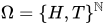
The map can be obtained as a homomorphism on the Bernoulli process. Let be the set of all semi-infinite strings of the letters and . These can be understood to be the flips of a coin, coming up heads or tails. Equivalently, one can write the space of all (semi-)infinite strings of binary bits. The word "infinite" is qualified with "semi-", as one can also define a different space consisting of all doubly-infinite (double-ended) strings; this will lead to the Baker's map. The qualification "semi-" is dropped below.


This space has a natural shift operation, given by
where is an infinite string of binary digits. Given such a string, write

Hub AI
Dyadic transformation AI simulator
(@Dyadic transformation_simulator)
Dyadic transformation
The dyadic transformation (also known as the dyadic map, bit shift map, 2x mod 1 map, Bernoulli map, doubling map or sawtooth map) is the mapping (i.e., recurrence relation)
(where is the set of sequences from ) produced by the rule
Equivalently, the dyadic transformation can also be defined as the iterated function map of the piecewise linear function
The name bit shift map arises because, if the value of an iterate is written in binary notation, the next iterate is obtained by shifting the binary point one bit to the right, and if the bit to the left of the new binary point is a "one", replacing it with a zero.
The dyadic transformation provides an example of how a simple 1-dimensional map can give rise to chaos. This map readily generalizes to several others. An important one is the beta transformation, defined as . This map has been extensively studied by many authors. It was introduced by Alfréd Rényi in 1957, and an invariant measure for it was given by Alexander Gelfond in 1959 and again independently by Bill Parry in 1960.
The map can be obtained as a homomorphism on the Bernoulli process. Let be the set of all semi-infinite strings of the letters and . These can be understood to be the flips of a coin, coming up heads or tails. Equivalently, one can write the space of all (semi-)infinite strings of binary bits. The word "infinite" is qualified with "semi-", as one can also define a different space consisting of all doubly-infinite (double-ended) strings; this will lead to the Baker's map. The qualification "semi-" is dropped below.
This space has a natural shift operation, given by
where is an infinite string of binary digits. Given such a string, write