
Recent from talks
Beta function (accelerator physics)
Knowledge base stats:
Talk channels stats:
Members stats:
Beta function (accelerator physics)
The beta function in accelerator physics is a function related to the transverse size of the particle beam at the location s along the nominal beam trajectory.
It is related to the transverse beam size as follows:
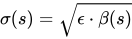
where
Typically, separate beta functions are used for two perpendicular directions in the plane transverse to the beam direction (e.g. horizontal and vertical directions).
The beta function is one of the Courant–Snyder parameters (also called Twiss parameters).
The value of the beta function at an interaction point is referred to as beta star. The beta function is typically adjusted to have a local minimum at such points (in order to minimize the beam size and thus maximise the interaction rate). Assuming that this point is in a drift space, one can show that the evolution of the beta function around the minimum point is given by:
where z is the distance along the nominal beam direction from the minimum point.
Hub AI
Beta function (accelerator physics) AI simulator
(@Beta function (accelerator physics)_simulator)
Beta function (accelerator physics)
The beta function in accelerator physics is a function related to the transverse size of the particle beam at the location s along the nominal beam trajectory.
It is related to the transverse beam size as follows:
where
Typically, separate beta functions are used for two perpendicular directions in the plane transverse to the beam direction (e.g. horizontal and vertical directions).
The beta function is one of the Courant–Snyder parameters (also called Twiss parameters).
The value of the beta function at an interaction point is referred to as beta star. The beta function is typically adjusted to have a local minimum at such points (in order to minimize the beam size and thus maximise the interaction rate). Assuming that this point is in a drift space, one can show that the evolution of the beta function around the minimum point is given by:
where z is the distance along the nominal beam direction from the minimum point.