
Recent from talks
Betula populifolia
Knowledge base stats:
Talk channels stats:
Members stats:
Betula populifolia
Betula populifolia, known as the gray (or grey) birch, is a deciduous tree in the family Betulaceae. It is native to eastern North America and is most commonly found in the northeast United States as well as southern Quebec, New Brunswick, and Nova Scotia. The tree is a pioneer species that is commonly found in sites following disturbance, such as fire or logging. Gray birches don't have as much economic value as other birch species but are still commonly used as ornamental trees.
Betula populifolia is a small tree that reaches heights of 20 to 30 feet (6 to 9 m) with a diameter at breast height (DBH) of 4 to 8 inches (10 to 20 cm). The tree is often found with multiple stems. The crown is pyramidal with somewhat drooping branches.
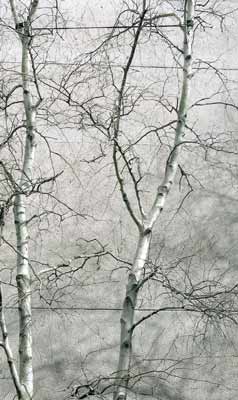
The bark is smooth, a grayish-white or chalky color with visible lenticels and black triangular patches located at the base of branches. It is commonly confused for paper birch (Betula papyrifera) by means of its bark, but it is differentiable as gray birch bark does not exfoliate (peel) as readily as paper birch. It is also occasionally confused for quaking aspen (Populus tremuloides), which has similar bark, but different leaves and buds.
Twigs are slender, wiry, hairless, dull gray or brown in color, and have a warty or rough texture. Buds are pointed, green-brown in color, shiny, and have a gummy coating. Betula populifolia lacks terminal buds.
The leaves are 2.5 to 3 inches (5 to 7 cm) in length, alternate, simple, pinnately-veined, and taper to an elongated tip. They are dark green and glabrous above and paler below, with doubly serrate margins. Like other members of the Betula genus, leaves turn yellow in autumn.
The flowers are wind-pollinated catkins 2 to 3 inches (5 to 8 cm) long, the male catkins pendulous and the female catkins erect. The fruit, maturing in autumn, is composed of many tiny winged seeds packed between the catkin bracts.
Betula populifolia means "birch with poplar-like leaves" when translated from Latin to English, and is derived from the behavior of gray birch leaves, which flutter similarly to poplar leaves in the wind.
Gray birch can be found in the northeast United States and small portions of Canada. It ranges from southeastern Quebec along the St. Lawrence River east to parts of New Brunswick and Nova Scotia, south through New England and upstate New York to Pennsylvania and New Jersey. There are also disjunct populations in Ohio, western Pennsylvania, Virginia, and North Carolina. Gray birch has been listed as extinct in Delaware, extirpated in Illinois, and rare in Maryland.
Hub AI
Betula populifolia AI simulator
(@Betula populifolia_simulator)
Betula populifolia
Betula populifolia, known as the gray (or grey) birch, is a deciduous tree in the family Betulaceae. It is native to eastern North America and is most commonly found in the northeast United States as well as southern Quebec, New Brunswick, and Nova Scotia. The tree is a pioneer species that is commonly found in sites following disturbance, such as fire or logging. Gray birches don't have as much economic value as other birch species but are still commonly used as ornamental trees.
Betula populifolia is a small tree that reaches heights of 20 to 30 feet (6 to 9 m) with a diameter at breast height (DBH) of 4 to 8 inches (10 to 20 cm). The tree is often found with multiple stems. The crown is pyramidal with somewhat drooping branches.
The bark is smooth, a grayish-white or chalky color with visible lenticels and black triangular patches located at the base of branches. It is commonly confused for paper birch (Betula papyrifera) by means of its bark, but it is differentiable as gray birch bark does not exfoliate (peel) as readily as paper birch. It is also occasionally confused for quaking aspen (Populus tremuloides), which has similar bark, but different leaves and buds.
Twigs are slender, wiry, hairless, dull gray or brown in color, and have a warty or rough texture. Buds are pointed, green-brown in color, shiny, and have a gummy coating. Betula populifolia lacks terminal buds.
The leaves are 2.5 to 3 inches (5 to 7 cm) in length, alternate, simple, pinnately-veined, and taper to an elongated tip. They are dark green and glabrous above and paler below, with doubly serrate margins. Like other members of the Betula genus, leaves turn yellow in autumn.
The flowers are wind-pollinated catkins 2 to 3 inches (5 to 8 cm) long, the male catkins pendulous and the female catkins erect. The fruit, maturing in autumn, is composed of many tiny winged seeds packed between the catkin bracts.
Betula populifolia means "birch with poplar-like leaves" when translated from Latin to English, and is derived from the behavior of gray birch leaves, which flutter similarly to poplar leaves in the wind.
Gray birch can be found in the northeast United States and small portions of Canada. It ranges from southeastern Quebec along the St. Lawrence River east to parts of New Brunswick and Nova Scotia, south through New England and upstate New York to Pennsylvania and New Jersey. There are also disjunct populations in Ohio, western Pennsylvania, Virginia, and North Carolina. Gray birch has been listed as extinct in Delaware, extirpated in Illinois, and rare in Maryland.
Recent media