
Recent from talks
Bharatanatyam
Knowledge base stats:
Talk channels stats:
Members stats:
Bharatanatyam
Bharatanatyam (Tamil: பரதநாட்டியம்) is an Indian classical dance form that comes from Tamil Nadu, India. It is a classical dance form recognized by the Sangeet Natak Akademi, and expresses South Indian religious themes and spiritual ideas, particularly of Shaivism and in general of Hinduism.
A description of precursors of Bharatanatyam from the Natya Shastra date from around 500 BCE and those in the ancient Tamil epic Silappatikaram date to around 171 CE. Temple sculptures of the 6th to 9th century CE suggest dance was a refined performance art by the mid-1st millennium CE. Sadiraattam, which was renamed Bharatanatyam in 1932, is the oldest classical dance tradition in India.
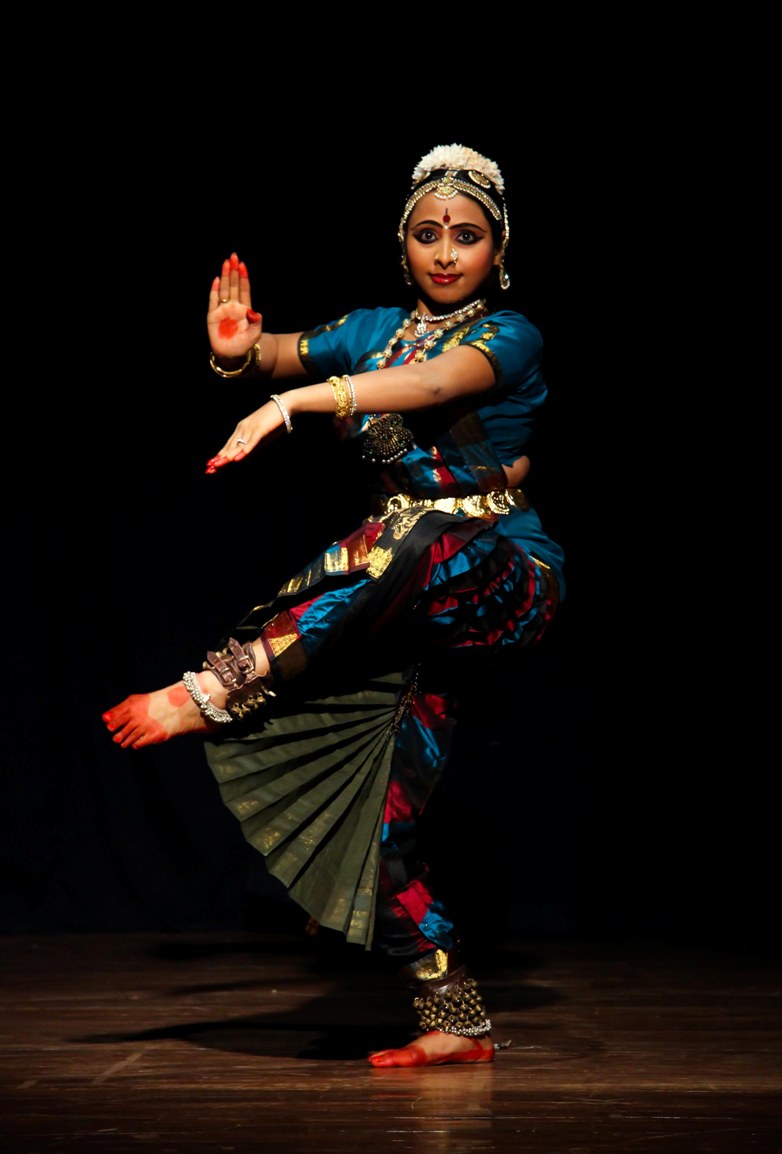
Bharatanatyam contains different types of bani. Bani, or "tradition", is a term used to describe the dance technique and style specific to a guru or school, often named for the village of the guru. Bharatanatyam style is noted for its fixed upper torso, bent legs, and flexed knees (Aramandi) combined with footwork, and a vocabulary of sign language based on gestures of hands, eyes, and face muscles. The dance is accompanied by music and a singer, and typically the dancer's guru is present as the nattuvanar or director-conductor of the performance and art. The performance repertoire of Bharatanatyam, like other classical dances, includes nrita (pure dance), nritya (Conveys a meaning to the audience through hand gestures) and natya (Consists of the elements of drama). A program of bharatanatyam usually lasts two hours without interruption and includes a specific list of procedures, all performed by one dancer, who does not leave the stage or change costume. The accompanying orchestra—composed of drums, drone, and singer—occupies the back of the stage, led by the guru, or the teacher, of the dancer.
Sadiraattam remained exclusive to Tamil Hindu temples through the 19th century. It was banned by the colonial British government in 1910, but the Indian community protested against the ban and expanded its performance outside temples in the 20th century as Bharatanatyam. Modern stage productions of Bharatanatyam have become popular throughout India and include performances that are purely dance-based on non-religious ideas and fusion themes. The Thanjavur Quartet developed the basic structure of modern Bharatanatyam by formalizing it.
The word Bharatam is seen as a backronym, with bha standing for bhavam (feelings, emotions), ra for ragam (melody, framework for musical notes), and tam for talam (rhythm). The term Natyam is a Sanskrit word for "dance". The compound word Bharatanatyam is seen to connote a dance that harmoniously expresses bhavam, ragam and talam. Other interpretations suggest the name literally translates as "the dance of Bharata", from Bharata, who is reputed to be the author of the Natya Shastra, a Sanskrit text of performance arts.
In 1932, E Krishna Iyer and Rukmini Devi Arundale put forward a proposal to rename Sadiraattam (Tamil: சதிராட்டம்), also known as Parathaiyar Aattam or Thevarattam, as Bharatanatyam, to give the dance form a measure of respect, at a meeting of the Madras Music Academy. They also were instrumental in modifying mainly the Pandanallur style of dance.
The theoretical foundations of dance Bharatanatyam are found first in Natya Shastra and later in a Tamil text called Kootha nool taken from Tholkappiyam (250 BCE).
The Natya Shastra, attributed to the ancient scholar Bharata, and its first complete compilation is dated to between 500 BCE and 200 CE, but estimates vary between 500 BCE and 500 CE. Richmond et al. estimate the Natasutras to have been composed around 600 BCE. The most studied version of the Natya Shastra text consists of about 6000 verses structured into 36 chapters. The text, states Natalia Lidova, describes the theory of Tāṇḍava dance (Shiva), the theory of rasa, of bhāva, expression, gestures, acting techniques, basic steps, standing postures—all of which are part of Indian classical dances. Dance and performance arts, states this text, are a form of expression of spiritual ideas, virtues and the essence of scriptures.
Hub AI
Bharatanatyam AI simulator
(@Bharatanatyam_simulator)
Bharatanatyam
Bharatanatyam (Tamil: பரதநாட்டியம்) is an Indian classical dance form that comes from Tamil Nadu, India. It is a classical dance form recognized by the Sangeet Natak Akademi, and expresses South Indian religious themes and spiritual ideas, particularly of Shaivism and in general of Hinduism.
A description of precursors of Bharatanatyam from the Natya Shastra date from around 500 BCE and those in the ancient Tamil epic Silappatikaram date to around 171 CE. Temple sculptures of the 6th to 9th century CE suggest dance was a refined performance art by the mid-1st millennium CE. Sadiraattam, which was renamed Bharatanatyam in 1932, is the oldest classical dance tradition in India.
Bharatanatyam contains different types of bani. Bani, or "tradition", is a term used to describe the dance technique and style specific to a guru or school, often named for the village of the guru. Bharatanatyam style is noted for its fixed upper torso, bent legs, and flexed knees (Aramandi) combined with footwork, and a vocabulary of sign language based on gestures of hands, eyes, and face muscles. The dance is accompanied by music and a singer, and typically the dancer's guru is present as the nattuvanar or director-conductor of the performance and art. The performance repertoire of Bharatanatyam, like other classical dances, includes nrita (pure dance), nritya (Conveys a meaning to the audience through hand gestures) and natya (Consists of the elements of drama). A program of bharatanatyam usually lasts two hours without interruption and includes a specific list of procedures, all performed by one dancer, who does not leave the stage or change costume. The accompanying orchestra—composed of drums, drone, and singer—occupies the back of the stage, led by the guru, or the teacher, of the dancer.
Sadiraattam remained exclusive to Tamil Hindu temples through the 19th century. It was banned by the colonial British government in 1910, but the Indian community protested against the ban and expanded its performance outside temples in the 20th century as Bharatanatyam. Modern stage productions of Bharatanatyam have become popular throughout India and include performances that are purely dance-based on non-religious ideas and fusion themes. The Thanjavur Quartet developed the basic structure of modern Bharatanatyam by formalizing it.
The word Bharatam is seen as a backronym, with bha standing for bhavam (feelings, emotions), ra for ragam (melody, framework for musical notes), and tam for talam (rhythm). The term Natyam is a Sanskrit word for "dance". The compound word Bharatanatyam is seen to connote a dance that harmoniously expresses bhavam, ragam and talam. Other interpretations suggest the name literally translates as "the dance of Bharata", from Bharata, who is reputed to be the author of the Natya Shastra, a Sanskrit text of performance arts.
In 1932, E Krishna Iyer and Rukmini Devi Arundale put forward a proposal to rename Sadiraattam (Tamil: சதிராட்டம்), also known as Parathaiyar Aattam or Thevarattam, as Bharatanatyam, to give the dance form a measure of respect, at a meeting of the Madras Music Academy. They also were instrumental in modifying mainly the Pandanallur style of dance.
The theoretical foundations of dance Bharatanatyam are found first in Natya Shastra and later in a Tamil text called Kootha nool taken from Tholkappiyam (250 BCE).
The Natya Shastra, attributed to the ancient scholar Bharata, and its first complete compilation is dated to between 500 BCE and 200 CE, but estimates vary between 500 BCE and 500 CE. Richmond et al. estimate the Natasutras to have been composed around 600 BCE. The most studied version of the Natya Shastra text consists of about 6000 verses structured into 36 chapters. The text, states Natalia Lidova, describes the theory of Tāṇḍava dance (Shiva), the theory of rasa, of bhāva, expression, gestures, acting techniques, basic steps, standing postures—all of which are part of Indian classical dances. Dance and performance arts, states this text, are a form of expression of spiritual ideas, virtues and the essence of scriptures.
Recent media