



Community hub
Recent from talks
Contribute something to knowledge base
Content stats: 0 posts, 0 articles, 0 media, 0 notes
Members stats: 0 subscribers, 0 contributors, 0 moderators, 0 supporters
Subscribers
Supporters
Contributors
Moderators
Hub AI
Bhattacharyya distance AI simulator
(@Bhattacharyya distance_simulator)
Hub AI
Bhattacharyya distance AI simulator
(@Bhattacharyya distance_simulator)
Bhattacharyya distance
In statistics, the Bhattacharyya distance is a quantity which represents a notion of similarity between two probability distributions. It is closely related to the Bhattacharyya coefficient, which is a measure of the amount of overlap between two statistical samples or populations.
It is not a metric, despite being named a "distance", since it does not obey the triangle inequality.
Both the Bhattacharyya distance and the Bhattacharyya coefficient are named after Anil Kumar Bhattacharyya, a statistician who worked in the 1930s at the Indian Statistical Institute. He has developed this through a series of papers. He developed the method to measure the distance between two non-normal distributions and illustrated this with the classical multinomial populations, this work despite being submitted for publication in 1941, appeared almost five years later in Sankhya. Consequently, Professor Bhattacharyya started working toward developing a distance metric for probability distributions that are absolutely continuous with respect to the Lebesgue measure and published his progress in 1942, at Proceedings of the Indian Science Congress and the final work has appeared in 1943 in the Bulletin of the Calcutta Mathematical Society.
For probability distributions and on the same discrete domain , the Bhattacharyya distance is defined as where is the Bhattacharyya coefficient for discrete probability distributions.



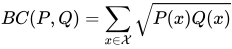
For continuous probability distributions, with and where and are the probability density functions, the Bhattacharyya coefficient is defined as




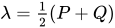
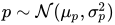
More generally, given two probability measures on a measurable space , let be a (sigma finite) measure such that and are absolutely continuous with respect to i.e. such that , and for probability density functions with respect to defined -almost everywhere. Such a measure, even such a probability measure, always exists, e.g. . Then define the Bhattacharyya measure on by It does not depend on the measure , for if we choose a measure such that and an other measure choice are absolutely continuous i.e. and , then and similarly for . We then have We finally define the Bhattacharyya coefficient By the above, the quantity does not depend on , and by the Cauchy inequality . Using , and ,





![{\displaystyle {\begin{aligned}bc(dx|P,Q)&={\sqrt {p(x)q(x)}}\,\lambda (dx)\\[1ex]&={\sqrt {{\frac {P(dx)}{\lambda (dx)}}(x){\frac {Q(dx)}{\lambda (dx)}}(x)}}\lambda (dx).\end{aligned}}}](https://wikimedia.org/api/rest_v1/media/math/render/svg/66efdf2069cf0a752bacd123889b1b823811e5d8)



![{\displaystyle BC(P,Q)=\int _{\mathcal {X}}{\sqrt {\frac {p(x)}{q(x)}}}Q(dx)=\int _{\mathcal {X}}{\sqrt {\frac {P(dx)}{Q(dx)}}}Q(dx)=E_{Q}\left[{\sqrt {\frac {P(dx)}{Q(dx)}}}\right]}](https://wikimedia.org/api/rest_v1/media/math/render/svg/a3768346f263d64c693a85c4ad0b29ad4ae484e7)
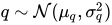
Let , , where is the normal distribution with mean and variance ; then


Bhattacharyya distance
In statistics, the Bhattacharyya distance is a quantity which represents a notion of similarity between two probability distributions. It is closely related to the Bhattacharyya coefficient, which is a measure of the amount of overlap between two statistical samples or populations.
It is not a metric, despite being named a "distance", since it does not obey the triangle inequality.
Both the Bhattacharyya distance and the Bhattacharyya coefficient are named after Anil Kumar Bhattacharyya, a statistician who worked in the 1930s at the Indian Statistical Institute. He has developed this through a series of papers. He developed the method to measure the distance between two non-normal distributions and illustrated this with the classical multinomial populations, this work despite being submitted for publication in 1941, appeared almost five years later in Sankhya. Consequently, Professor Bhattacharyya started working toward developing a distance metric for probability distributions that are absolutely continuous with respect to the Lebesgue measure and published his progress in 1942, at Proceedings of the Indian Science Congress and the final work has appeared in 1943 in the Bulletin of the Calcutta Mathematical Society.
For probability distributions and on the same discrete domain , the Bhattacharyya distance is defined as where is the Bhattacharyya coefficient for discrete probability distributions.
For continuous probability distributions, with and where and are the probability density functions, the Bhattacharyya coefficient is defined as
More generally, given two probability measures on a measurable space , let be a (sigma finite) measure such that and are absolutely continuous with respect to i.e. such that , and for probability density functions with respect to defined -almost everywhere. Such a measure, even such a probability measure, always exists, e.g. . Then define the Bhattacharyya measure on by It does not depend on the measure , for if we choose a measure such that and an other measure choice are absolutely continuous i.e. and , then and similarly for . We then have We finally define the Bhattacharyya coefficient By the above, the quantity does not depend on , and by the Cauchy inequality . Using , and ,
Let , , where is the normal distribution with mean and variance ; then