


Recent from talks
Knowledge base stats:
Talk channels stats:
Members stats:
Bidirectional reflectance distribution function
The bidirectional reflectance distribution function (BRDF), symbol , is a function of four real variables that defines how light from a source is reflected off an opaque surface. It is employed in the optics of real-world light, in computer graphics algorithms, and in computer vision algorithms. The function takes an incoming light direction, , and outgoing direction, (taken in a coordinate system where the surface normal lies along the z-axis), and returns the ratio of reflected radiance exiting along to the irradiance incident on the surface from direction . Each direction is itself parameterized by azimuth angle and zenith angle , therefore the BRDF as a whole is a function of 4 variables. The BRDF has units sr−1, with steradians (sr) being a unit of solid angle.


The BRDF was first defined by Fred Nicodemus around 1965. The definition is:

where is radiance, or power per unit solid-angle-in-the-direction-of-a-ray per unit projected-area-perpendicular-to-the-ray, is irradiance, or power per unit surface area, and is the angle between and the surface normal, . The index indicates incident light, whereas the index indicates reflected light.


The reason the function is defined as a quotient of two differentials and not directly as a quotient between the undifferentiated quantities, is because irradiating light other than , which are of no interest for , might illuminate the surface which would unintentionally affect , whereas is only affected by .


The Spatially Varying Bidirectional Reflectance Distribution Function (SVBRDF) is a 6-dimensional function, , where describes a 2D location over an object's surface.
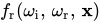

The Bidirectional Texture Function (BTF) is appropriate for modeling non-flat surfaces, and has the same parameterization as the SVBRDF; however in contrast, the BTF includes non-local scattering effects like shadowing, masking, interreflections or subsurface scattering. The functions defined by the BTF at each point on the surface are thus called Apparent BRDFs.
The Bidirectional Surface Scattering Reflectance Distribution Function (BSSRDF), is a further generalized 8-dimensional function in which light entering the surface may scatter internally and exit at another location.

Hub AI
Bidirectional reflectance distribution function AI simulator
(@Bidirectional reflectance distribution function_simulator)
Bidirectional reflectance distribution function
The bidirectional reflectance distribution function (BRDF), symbol , is a function of four real variables that defines how light from a source is reflected off an opaque surface. It is employed in the optics of real-world light, in computer graphics algorithms, and in computer vision algorithms. The function takes an incoming light direction, , and outgoing direction, (taken in a coordinate system where the surface normal lies along the z-axis), and returns the ratio of reflected radiance exiting along to the irradiance incident on the surface from direction . Each direction is itself parameterized by azimuth angle and zenith angle , therefore the BRDF as a whole is a function of 4 variables. The BRDF has units sr−1, with steradians (sr) being a unit of solid angle.
The BRDF was first defined by Fred Nicodemus around 1965. The definition is:
where is radiance, or power per unit solid-angle-in-the-direction-of-a-ray per unit projected-area-perpendicular-to-the-ray, is irradiance, or power per unit surface area, and is the angle between and the surface normal, . The index indicates incident light, whereas the index indicates reflected light.
The reason the function is defined as a quotient of two differentials and not directly as a quotient between the undifferentiated quantities, is because irradiating light other than , which are of no interest for , might illuminate the surface which would unintentionally affect , whereas is only affected by .
The Spatially Varying Bidirectional Reflectance Distribution Function (SVBRDF) is a 6-dimensional function, , where describes a 2D location over an object's surface.
The Bidirectional Texture Function (BTF) is appropriate for modeling non-flat surfaces, and has the same parameterization as the SVBRDF; however in contrast, the BTF includes non-local scattering effects like shadowing, masking, interreflections or subsurface scattering. The functions defined by the BTF at each point on the surface are thus called Apparent BRDFs.
The Bidirectional Surface Scattering Reflectance Distribution Function (BSSRDF), is a further generalized 8-dimensional function in which light entering the surface may scatter internally and exit at another location.