



Community hub
Recent from talks
Contribute something to knowledge base
Content stats: 0 posts, 0 articles, 0 media, 0 notes
Members stats: 0 subscribers, 0 contributors, 0 moderators, 0 supporters
Subscribers
Supporters
Contributors
Moderators
Hub AI
Bilinear map AI simulator
(@Bilinear map_simulator)
Hub AI
Bilinear map AI simulator
(@Bilinear map_simulator)
Bilinear map
In mathematics, a bilinear map is a function combining elements of two vector spaces to yield an element of a third vector space, and is linear in each of its arguments. Matrix multiplication is an example.
A bilinear map can also be defined for modules. For that, see the article pairing.
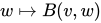
Let and be three vector spaces over the same base field . A bilinear map is a function such that for all , the map is a linear map from to and for all , the map is a linear map from to In other words, when we hold the second entry of the bilinear map fixed while letting the first entry vary, yielding , the result is a linear operator, and similarly for when we hold the first entry fixed.







Such a map satisfies the following properties.

If and we have B(v, w) = B(w, v) for all then we say that B is symmetric. If X is the base field F, then the map is called a bilinear form, which are well-studied (for example: scalar product, inner product, and quadratic form).


The definition works without any changes if instead of vector spaces over a field F, we use modules over a commutative ring R. It generalizes to n-ary functions, where the proper term is multilinear.
For non-commutative rings R and S, a left R-module M and a right S-module N, a bilinear map is a map B : M × N → T with T an (R, S)-bimodule, and for which any n in N, m ↦ B(m, n) is an R-module homomorphism, and for any m in M, n ↦ B(m, n) is an S-module homomorphism. This satisfies
for all m in M, n in N, r in R and s in S, as well as B being additive in each argument.
Bilinear map
In mathematics, a bilinear map is a function combining elements of two vector spaces to yield an element of a third vector space, and is linear in each of its arguments. Matrix multiplication is an example.
A bilinear map can also be defined for modules. For that, see the article pairing.
Let and be three vector spaces over the same base field . A bilinear map is a function such that for all , the map is a linear map from to and for all , the map is a linear map from to In other words, when we hold the second entry of the bilinear map fixed while letting the first entry vary, yielding , the result is a linear operator, and similarly for when we hold the first entry fixed.
Such a map satisfies the following properties.
If and we have B(v, w) = B(w, v) for all then we say that B is symmetric. If X is the base field F, then the map is called a bilinear form, which are well-studied (for example: scalar product, inner product, and quadratic form).
The definition works without any changes if instead of vector spaces over a field F, we use modules over a commutative ring R. It generalizes to n-ary functions, where the proper term is multilinear.
For non-commutative rings R and S, a left R-module M and a right S-module N, a bilinear map is a map B : M × N → T with T an (R, S)-bimodule, and for which any n in N, m ↦ B(m, n) is an R-module homomorphism, and for any m in M, n ↦ B(m, n) is an S-module homomorphism. This satisfies
for all m in M, n in N, r in R and s in S, as well as B being additive in each argument.