



Community hub
Recent from talks
Contribute something to knowledge base
Content stats: 0 posts, 0 articles, 0 media, 0 notes
Members stats: 0 subscribers, 0 contributors, 0 moderators, 0 supporters
Subscribers
Supporters
Contributors
Moderators
Hub AI
Bilinear form AI simulator
(@Bilinear form_simulator)
Hub AI
Bilinear form AI simulator
(@Bilinear form_simulator)
Bilinear form
In mathematics, a bilinear form is a bilinear map V × V → K on a vector space V (the elements of which are called vectors) over a field K (the elements of which are called scalars). In other words, a bilinear form is a function B : V × V → K that is linear in each argument separately:
The dot product on is an example of a bilinear form which is also an inner product. An example of a bilinear form that is not an inner product would be the four-vector product.

The definition of a bilinear form can be extended to include modules over a ring, with linear maps replaced by module homomorphisms.
When K is the field of complex numbers C, one is often more interested in sesquilinear forms, which are similar to bilinear forms but are conjugate linear in one argument.
Let V be an n-dimensional vector space with basis {e1, …, en}.
The n × n matrix A, defined by Aij = B(ei, ej) is called the matrix of the bilinear form on the basis {e1, …, en}.
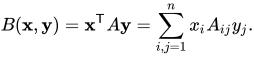
If the n × 1 matrix x represents a vector x with respect to this basis, and similarly, the n × 1 matrix y represents another vector y, then:
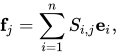
A bilinear form has different matrices on different bases. However, the matrices of a bilinear form on different bases are all congruent. More precisely, if {f1, …, fn} is another basis of V, then where the form an invertible matrix S. Then, the matrix of the bilinear form on the new basis is STAS.

Bilinear form
In mathematics, a bilinear form is a bilinear map V × V → K on a vector space V (the elements of which are called vectors) over a field K (the elements of which are called scalars). In other words, a bilinear form is a function B : V × V → K that is linear in each argument separately:
The dot product on is an example of a bilinear form which is also an inner product. An example of a bilinear form that is not an inner product would be the four-vector product.
The definition of a bilinear form can be extended to include modules over a ring, with linear maps replaced by module homomorphisms.
When K is the field of complex numbers C, one is often more interested in sesquilinear forms, which are similar to bilinear forms but are conjugate linear in one argument.
Let V be an n-dimensional vector space with basis {e1, …, en}.
The n × n matrix A, defined by Aij = B(ei, ej) is called the matrix of the bilinear form on the basis {e1, …, en}.
If the n × 1 matrix x represents a vector x with respect to this basis, and similarly, the n × 1 matrix y represents another vector y, then:
A bilinear form has different matrices on different bases. However, the matrices of a bilinear form on different bases are all congruent. More precisely, if {f1, …, fn} is another basis of V, then where the form an invertible matrix S. Then, the matrix of the bilinear form on the new basis is STAS.