


Community hub
Recent from talks
Contribute something
Nothing was collected or created yet.
Billy Knight
View on Wikipedia
William R. Knight (born June 9, 1952) is an American former professional basketball player and executive. Playing with the Indiana Pacers in both the American Basketball Association (ABA) and later the National Basketball Association (NBA), he was both an ABA and NBA All-Star. He played college basketball with the Pittsburgh Panthers, who retired his No. 34.
Key Information


In college, Knight was a consensus second-team All-American in 1974. He began his pro career with the Indiana Pacers, earning ABA All-Rookie First Team honors in 1975. He continued with the Pacers in the NBA, and he also played in the league for the Buffalo Braves, Boston Celtics, Kansas City Kings and San Antonio Spurs. Knight finished his playing career with a season in France. He became an executive with the Pacers and the Vancouver/Memphis Grizzlies. He last served as the executive vice president and general manager of the Atlanta Hawks from 2003 to 2008.
Early life
[edit]Knight was born and raised in Braddock, Pennsylvania, a suburb of Pittsburgh, where he attended Braddock High School. He was a member of the 1970 Section High School Basketball Champions Braddock Tigers.
University of Pittsburgh
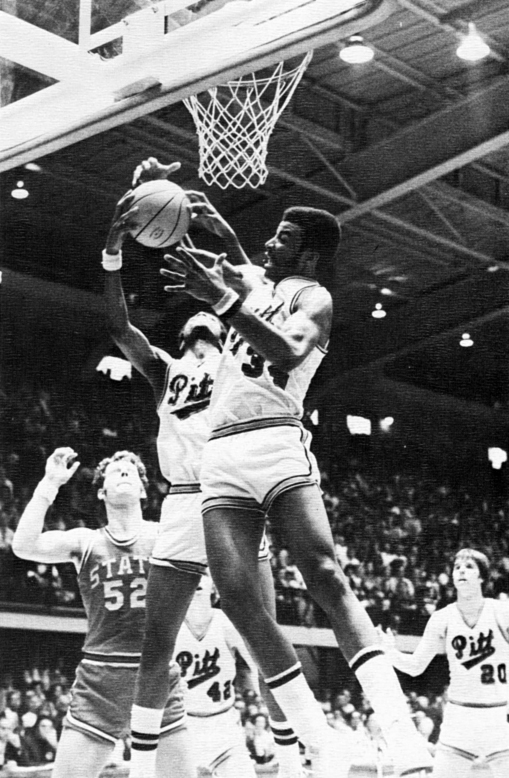
[edit]A 6'6" guard/forward, he then attended the University of Pittsburgh (Pitt), where he starred, and along with Mickey Martin and Kirk Bruce, Knight led the Panthers to the East Regional Finals in the 1974 NCAA Men's Division I Basketball Tournament, where they lost to eventual NCAA Champion North Carolina State, in a matchup between Knight and NCSU's David Thompson. The game was played in Raleigh, North Carolina. NCSU went on to defeat UCLA & Marquette for the National title in Greensboro, North Carolina.
Knight's performance during the 1973–1974 season, in which Pitt went 25–4 and won a school record, 22 games in a row, earned him 2nd team All-American team status. He is considered one of Pitt's best players ever and was voted to Pitt's all-time starting five.[1]
Knight had his number 34 jersey retired by the University of Pittsburgh on February 20, 1989.[2]
Professional career
[edit]Knight spent 11 seasons, from 1974 to 1985, in the ABA and NBA as a member of the Indiana Pacers, Buffalo Braves, Boston Celtics, Kansas City Kings, and San Antonio Spurs. He scored 13,901 points in his ABA/NBA career and appeared in two All-Star games as well as one ABA all-star game.
Indiana Pacers (1975–77, first stint)
[edit]Knight's best years were with the Indiana Pacers, after being selected by both the Pacers and the LA Lakers in the player draft. Knight was voted 1st team ABA All-Star for the 1975–1976 season, his second year in the league after averaging 28.1 ppg. This was the last year of the ABA before the Indiana Pacers merged into the NBA. The following year Knight maintained All-Star status, this time in the NBA after averaging 26.6 ppg — second best in the league that season.
Buffalo Braves (1978)
[edit]Following a brief but successful tenure with the Buffalo Braves in the 1978 season, Knight's play slowly began to decline. A primary reason for Knight's initial success in the NBA was the poor state of the Braves franchise upon his arrival.[citation needed] Having recently lost their MVP talent Bob McAdoo, the directionless Braves won only 27 games in Knight's lone season with the franchise. Knight's averages of 23 points and 7 rebounds would nevertheless be enough for the forward to make his third and final career all-star team.
Boston Celtics (1978–79)
[edit]Knight departed from Buffalo via a trade that sent Knight, fellow all star Tiny Archibald, Marvin Barnes, and a 1981 2nd round draft pick that would become Danny Ainge to the Boston Celtics in exchange for Sidney Wicks, Kermit Washington, Freeman Williams, and Kevin Kunnert. In Boston, Knight's scoring numbers dropped from 22.9 to 13.9.
Indiana Pacers (1979–83, second stint), and later career
[edit]After less than one year in Boston, Knight was traded back to the Pacers for rookie Rick Robey.[3] On November 11, 1980, Knight scored 52 points, grabbed 5 rebounds, and recorded 5 steals during a 119–113 win over the San Antonio Spurs.[4] The 52 point total was a career-high for Knight, and resulted in him winning NBA Player of the Week.[5] Knight remained a reliable player throughout the remainder of his career, averaging between 12 and 18 points for the next five consecutive seasons. He ended his career as a member of the San Antonio Spurs, where he played alongside future Hall of Famers George Gervin and Artis Gilmore for 52 games.
Knight is the Indiana Pacers 3rd all-time leading scorer and is in several other Top 5 all-time categories for the Pacers. His 1976 statline of 28.1 points per game still remains the highest points average by a Pacer in a single season. Knight is one of twenty-three players in NBA/ABA history to average 28 points and 10 rebounds in a season, joining the likes of Wilt Chamberlain (x7), Kareem Abdul-Jabbar (x5), Shaquille O'Neal (x5), Elgin Baylor (x4), Karl Malone (x4), Giannis Antetokounmpo (x3), Bob McAdoo (x3), Bob Pettit (x3), Oscar Robertson (x3), Anthony Davis (x2), Joel Embiid (x2), Julius Erving (x2), Elvin Hayes (x2), Spencer Haywood (x2), Dan Issel (x2), Charles Barkley, Walt Bellamy, Larry Bird, Patrick Ewing, Moses Malone, George McGinnis, George Mikan, and David Robinson. Among these players, Knight remains the only one out of the eligible names to put up such a statline and not be inducted into the Naismith Memorial Basketball Hall of Fame. Furthermore, himself, Oscar Robertson, Julius Erving and Larry Bird are the only four to achieve such a statline while not playing at the center or power forward position. A versatile wing player, it was commonplace for Knight to switch between playing the small forward and shooting guard positions over the course of his eleven-year professional career.
Front office career
[edit]Prior to joining the Hawks organization in 2002, Knight worked as a front office executive with the Pacers and the Vancouver/Memphis Grizzlies.
Atlanta Hawks (2003–08)
[edit]Knight's reign as GM of the Atlanta Hawks was marred by a mix of successful and poor draft selections.[6] In 2004, he drafted Josh Childress over future All-Stars Luol Deng and Andre Iguodala. Childress wound up leaving the Atlanta Hawks to join a Greek franchise Olympiakos.[7] In 2005, Billy Knight drafted UNC freshman phenom Marvin Williams over consensus top point guard and future 9-time All Star and 7-time All-NBA team point guard Chris Paul despite the roster's need for a point guard and glut of young players at the swing position between Josh Childress and Josh Smith. 2006 led to the selection of Sheldon Williams, an undersized power forward, despite glaring needs at guard and future all-star Brandon Roy available.
On May 7, 2008, Knight stepped down as Hawks GM. When announcing his resignation from the team he stated that he had left the Hawks "in much better shape than it was in when I took over."[8]
Personal life
[edit]Knight currently lives in Atlanta, and continues to play tennis, a game he enjoys and began playing around the age of 30.[9]
ABA/NBA career statistics
[edit]| GP | Games played | GS | Games started | MPG | Minutes per game |
| FG% | Field goal percentage | 3P% | 3-point field goal percentage | FT% | Free throw percentage |
| RPG | Rebounds per game | APG | Assists per game | SPG | Steals per game |
| BPG | Blocks per game | PPG | Points per game | Bold | Career high |
| * | Led the league |
| ‡ | ABA record |
Regular season
[edit]| Year | Team | GP | GS | MPG | FG% | 3P% | FT% | RPG | APG | SPG | BPG | PPG |
|---|---|---|---|---|---|---|---|---|---|---|---|---|
| 1974–75 | Indiana (ABA) | 80 | – | 32.0 | .534 | .250 | .799 | 7.9 | 2.1 | 1.4 | .4 | 17.1 |
| 1975–76 | Indiana (ABA) | 70 | – | 39.6 | .494 | .400 | .828 | 10.1 | 3.7 | 1.3 | .3 | 28.1 |
| 1976–77 | Indiana | 78 | – | 40.0 | .493 | – | .816 | 7.5 | 3.3 | 1.5 | .2 | 26.6 |
| 1977–78 | Buffalo | 53 | – | 40.7 | .494 | – | .809 | 7.2 | 3.0 | 1.5 | .2 | 22.9 |
| 1978–79 | Boston | 40 | – | 28.0 | .502 | – | .808 | 4.3 | 1.7 | .8 | .1 | 13.9 |
| 1978–79 | Indiana | 39 | – | 25.0 | .556 | – | .873 | 4.5 | 2.2 | .8 | .1 | 14.7 |
| 1979–80 | Indiana | 75 | – | 25.5 | .533 | .267 | .809 | 4.8 | 2.1 | 1.1 | .1 | 13.1 |
| 1980–81 | Indiana | 82 | – | 29.1 | .533 | .158 | .832 | 5.0 | 1.9 | 1.0 | .1 | 17.5 |
| 1981–82 | Indiana | 81 | 19 | 22.3 | .495 | .281 | .826 | 3.2 | 1.5 | .8 | .2 | 12.3 |
| 1982–83 | Indiana | 80 | 54 | 28.3 | .520 | .158 | .841 | 4.1 | 2.4 | .8 | .1 | 17.1 |
| 1983–84 | Kansas City | 75 | 39 | 25.1 | .491 | .286 | .859 | 3.4 | 2.1 | .7 | .1 | 12.8 |
| 1984–85 | Kansas City | 16 | 0 | 11.8 | .449 | 1.000 | .813 | 1.4 | 1.3 | .1 | .1 | 4.8 |
| 1984–85 | San Antonio | 52 | 1 | 11.8 | .439 | .417 | .895 | 1.8 | 1.1 | .3 | .0 | 6.0 |
| Career ABA | 150 | 35.6 | .510 | .323 | .818 | 8.9 | 2.8 | 1.4 | 0.3 | 22.3 | ||
| Career NBA | 671 | 113 | 27.4 | .506 | .274 | .830 | 4.5 | 2.1 | 0.9 | 0.1 | 15.7 | |
| Career total | 821 | 113 | 28.9 | .507 | .284 | .827 | 5.3 | 2.3 | 1.0 | .2 | 16.9 | |
| All-Star | 2 | 0 | 17.5 | .526 | .000 | 1.000 | 7.5 | 1.0 | 1.0 | .0 | 12.0 | |
Playoffs
[edit]| Year | Team | GP | GS | MPG | FG% | 3P% | FT% | RPG | APG | SPG | BPG | PPG |
|---|---|---|---|---|---|---|---|---|---|---|---|---|
| 1975 | Indiana(ABA) | 18 | – | 42.4 | .568 | .000 | .845 | 8.9 | 2.4 | .9 | .1 | 24.1 |
| 1976 | Indiana(ABA) | 3 | – | 47.7 | .554 | .000 | .864 | 10.7 | 4.0 | .7 | .0 | 33.7 |
| 1981 | Indiana | 2 | – | 35.5 | .533 | – | .625 | 6.0 | 2.5 | .5 | .0 | 18.5 |
| 1984 | Kansas City | 3 | – | 12.3 | .333 | – | 1.000 | 1.0 | .7 | .0 | .0 | 6.0 |
| 1985 | San Antonio | 5 | 0 | 9.0 | .533 | .000 | – | 1.2 | .6 | .4 | .0 | 3.2 |
| Career ABA | 21 | 43.1 | .565‡ | .000 | .849 | 9.1 | 2.6 | 0.9 | 0.0 | 25.5 | ||
| Career NBA | 10 | 15.3 | .464 | .000 | .700 | 2.1 | 1.0 | 0.3 | 0.0 | 7.1 | ||
| Career total | 31 | 0 | 34.2 | .550 | .000 | .837 | 6.9 | 2.1 | .7 | .0 | 19.5 | |
References
[edit]- ^ Stonesifer, Jared. "Pitt Panthers Basketball: 5 Best Players in Team History". Bleacher Report. Retrieved April 8, 2021.
- ^ Sam Sciullo, Jr (August 22, 2002). "Panther Pride: University of Pittsburgh Men's Basketball". ISBN 9780738510699. Retrieved March 4, 2013.
- ^ Billy Knight Transactions
- ^ Indiana Pacers at San Antonio Spurs Box Score, November 11, 1980
- ^ Billy Knight of the Indiana Pacers, who scored 52 points against the San Antonio Spurs, Monday was named the NBA Player of the Week
- ^ "Hawks GM Knight to resign after 6 years with team". ESPN.com. May 7, 2008. Retrieved April 8, 2021.
- ^ "So long, Atlanta: Childress leaves NBA for Greece". ESPN.com. July 23, 2008. Retrieved April 8, 2021.
- ^ "Knight to step down after leading Hawks out of playoff drought". ESPN.com. May 7, 2008. Retrieved March 27, 2009.
- ^ Meyer, Craig (July 23, 2018), "Former Braddock and Pitt great Billy Knight reconnects with his roots", Pittsburgh Post-Gazette
External links
[edit]
- Career stats at basketball-reference.com
- Profile at nba.com
Billy Knight
View on GrokipediaEarly years
Childhood and high school
Billy Knight was born on June 9, 1952, in Braddock, Pennsylvania, a historic steel mill town known for its working-class roots tied to the industrial boom of the late 19th century.[1][10] His upbringing in this Monongahela Valley community, centered around the Edgar Thomson Steel Works, fostered an early passion for basketball amid the local sports culture.[11] Knight's family played a key role in nurturing this interest, including his younger brother Terry, who later pursued basketball at the University of Pittsburgh.[12] Knight honed his skills at Braddock High School, where he emerged as a standout player on the varsity team during the late 1960s.[3] In his senior year of 1970, he helped lead the Bulldogs to the WPIAL Class A section championship before advancing to the playoffs.[13] The team reached the WPIAL semifinals, falling to Mohawk 69-56 at the Civic Arena in front of over 9,000 fans, with Knight contributing 30 points and 29 rebounds in the loss.[3] Earlier in the tournament, during a quarterfinal victory over Penn Joint (79-63), he recorded 41 points and 21 rebounds, a performance that tied for sixth-best scoring in WPIAL playoff history at the time.[13] Knight's high school prowess earned him recognition as a basketball All-American and a spot in the prestigious Dapper Dan Roundball Classic, an all-star game featuring top Pennsylvania talent.[14] These accomplishments highlighted his scoring ability and rebounding dominance, setting the stage for his recruitment to the University of Pittsburgh, where he continued his basketball journey.[1]College career
Knight enrolled at the University of Pittsburgh in 1970 after a standout high school career at Braddock High School that drew significant recruiting interest, ultimately choosing Pitt to remain close to home.[15] His freshman year was spent on the junior varsity team, but he transitioned to the varsity squad for the 1971–72 season under head coach Buzz Ridl.[16] Over his three varsity seasons from 1971 to 1974, Knight established himself as a dominant forward, averaging 22.2 points and 12.0 rebounds per game while shooting 52.2 percent from the field. He became the first player in Pitt history to average at least 20 points and 10 rebounds over three consecutive seasons.[17] In his sophomore breakout year of 1971–72, Knight posted 21.0 points and 11.5 rebounds per game across 24 contests. As a junior in 1972–73, he elevated his scoring to 23.7 points and added 11.0 rebounds per game in 26 appearances.[18] Knight's senior season in 1973–74 marked the pinnacle of his college career, as he averaged 21.8 points and a team-high 13.4 rebounds per game, helping lead the Panthers to a 25–4 record that included a school-record 22-game winning streak. Under Ridl's guidance, Pitt rose to national prominence, reaching the NCAA Tournament's Elite Eight after defeating St. Joseph's and Furman in the East Regional before falling to eventual champion North Carolina State.[19][20] For his efforts, Knight earned consensus second-team All-America honors.[18][21] He concluded his Pitt tenure with 1,731 points and 938 rebounds, totals that ranked him among the program's all-time leaders at graduation.[21]Professional playing career
ABA years with Indiana Pacers (1974–1976)
Billy Knight entered professional basketball after being selected by the Indiana Pacers with the sixth overall pick in the first round of the 1974 ABA Draft.[22] He was also chosen by the Los Angeles Lakers in the second round (21st overall pick) of the concurrent 1974 NBA Draft.[1] His selection by the Pacers followed a standout senior year at the University of Pittsburgh, where he earned consensus second-team All-American honors after averaging 20.7 points and 10.5 rebounds per game.[18] Opting for the ABA, Knight signed with Indiana, joining a contending team led by George McGinnis and Bob Netolicky, and quickly adapted to the league's fast-paced, high-scoring style as a 6-foot-6 forward.[1] In his rookie season of 1974–75, Knight appeared in 80 games for the Pacers, averaging 17.1 points and 7.9 rebounds per game while shooting 53.5% from the field. His efficient scoring and rebounding earned him a spot on the ABA All-Rookie First Team, recognizing his seamless transition to professional play despite the physical demands of the league.[23] Knight's contributions were instrumental in helping the Pacers secure a 44–40 regular-season record and advance to the ABA Finals, where they faced the Kentucky Colonels.[24] Knight's development accelerated in his sophomore year of 1975–76, when he emerged as one of the ABA's top scorers, finishing second in the league with a 28.1 points per game average across 70 games, alongside 10.1 rebounds and a career-high 49.4% field goal percentage.[25] His breakout performance led to his selection as an ABA All-Star, where he started and scored 20 points in 23 minutes.[26] As a key secondary scorer behind McGinnis, Knight complemented the Pacers' offense, though the team finished with a 39–45 record and missed the playoffs; in the prior year's Finals, he had averaged 22.8 points and 8.0 rebounds over five games against Kentucky.[27] At 6 feet 6 inches, Knight excelled as an efficient mid-range shooter and tenacious rebounder, using his athleticism and smooth shooting stroke to thrive in the ABA's wide-open play.[1] His ability to score from various angles and crash the boards made him a versatile forward, often described as a "quiet assassin" for his understated yet prolific production on the court.[28]Early NBA stints with Indiana Pacers (1976–1977)
Following the ABA-NBA merger in June 1976, the Indiana Pacers transitioned to the NBA as one of four former ABA franchises to join the league, retaining key players like Billy Knight on their roster. This move marked the end of the ABA and integrated Knight into the established NBA landscape, where he continued to build on his scoring prowess from the prior season, in which he had finished second in ABA scoring average.[23] In the 1976–77 NBA season, Knight emerged as a dominant force for the Pacers, averaging 26.6 points per game to rank second in league scoring behind Pete Maravich's 31.1 ppg for the New Orleans Jazz.[29] He also contributed 7.5 rebounds per game while playing nearly 40 minutes per contest across 78 games, showcasing his versatility as a small forward.[1] His performance earned him a selection to the 1977 NBA All-Star Game, where he represented the Pacers alongside teammate Don Buse.[30] Knight's scoring output was instrumental in guiding the Pacers to a 36–46 record in their inaugural NBA campaign, though the team finished fifth in the Midwest Division and ninth in the Western Conference, missing the playoffs.[31] This season solidified his milestone as the only player to finish second in scoring in consecutive seasons spanning the ABA and NBA.[32]Trades to Buffalo Braves and Boston Celtics (1977–1979)
In September 1977, following a strong scoring season with the Indiana Pacers where he averaged 26.6 points per game, Billy Knight was traded to the Buffalo Braves in exchange for rookie Adrian Dantley and forward Mike Bantom.[1][33] This move bolstered the Braves' offense with Knight's proven production, as the team sought to improve amid ownership uncertainties.[34] During the 1977–78 season, Knight delivered consistent performance for the Braves, appearing in 53 games and averaging 22.9 points and 7.2 rebounds per game while shooting 49.4% from the field.[1] His contributions earned him a selection to the 1978 NBA All-Star Game, where he scored 8 points in limited minutes.[35] Despite the team's struggles, finishing with a 30–52 record and last place in the Atlantic Division, Knight's scoring reliability stood out amid front-office instability that foreshadowed the franchise's relocation.[36] The Braves relocated to San Diego as the Clippers prior to the 1978–79 season, part of a broader ownership swap approved by the NBA in June 1978.[37] On August 4, 1978, shortly after the move, Knight was traded to the Boston Celtics along with Nate Archibald and Marvin Barnes in exchange for Kermit Washington, Sidney Wicks, Kevin Kunnert, and a second-round draft pick.[38] This deal facilitated roster retooling for the rebuilding Clippers in their new market while adding scoring depth to Boston's lineup.[39] In the 1978–79 season, Knight played 40 games for the Celtics, averaging 13.9 points and 4.3 rebounds per game, providing bench scoring during a campaign that saw Boston win 58 games and advance to the Eastern Conference Finals.[1] His role complemented the team's veteran core, though his stint in Boston was brief as the franchise navigated post-trade adjustments.Return to Indiana Pacers (1979–1983)
After a brief stint with the Boston Celtics during the 1978-79 season, Billy Knight was traded back to the Indiana Pacers on January 16, 1979, in exchange for center Rick Robey.[40][38] This midseason return marked the beginning of Knight's second tenure with the Pacers, providing stability after his transient moves to Buffalo and Boston.[1] In the 1979-80 season, Knight appeared in 75 games for the Pacers, averaging 13.1 points per game while shooting 53.3% from the field, though injuries limited his starts to 43 games.[1] The team finished with a 37-45 record, placing fourth in the Central Division and missing the playoffs.[41] Knight's scoring output totaled 986 points that year.[1] Knight's performance peaked in the 1980-81 season, where he played all 82 games, starting 70, and averaged 17.5 points, 5.0 rebounds, and 1.9 assists per game, leading the team in scoring.[1] He scored a career-high 52 points in a November 11, 1980, road win against the San Antonio Spurs.[42] The Pacers achieved their first winning NBA record at 44-38, finishing third in the Central Division and qualifying for the playoffs for the first time in franchise NBA history, though they were swept 0-2 by the Philadelphia 76ers in the first round.[43][44] Knight contributed 18.5 points per game in the two playoff contests.[45] The 1981-82 season saw a dip in Knight's production and role, as he averaged 12.3 points and 3.2 rebounds across 81 games, starting only 19.[1] His total points reached 998.[1] The Pacers regressed to a 35-47 record, again finishing fourth in the Central Division without a playoff berth.[46] Knight rebounded in 1982-83, averaging 17.1 points, 4.1 rebounds, and 2.4 assists in 80 games, starting 54, and scoring 1,370 total points.[1] However, the team struggled to a league-worst 20-62 record, placing sixth in the Central Division and missing the playoffs.[47] Over his four full seasons back with Indiana, Knight scored over 1,000 points in three campaigns (1978-79 partial, 1980-81, and 1982-83), serving as a consistent scoring presence amid the team's fluctuating fortunes.[1] During this period, Knight transitioned from a primary scoring option to a veteran contributor, playing both shooting guard and small forward while providing offensive reliability on rosters featuring emerging talents like Clark Kellogg, whom Knight supported as a teammate in 1982-83.[1][48]Final NBA seasons with Kansas City Kings and San Antonio Spurs (1983–1985)
In September 1983, Billy Knight was traded from the Indiana Pacers to the Kansas City Kings in a multi-team deal that also involved the New York Knicks.[49] During the 1983–84 season, he appeared in 75 games for the Kings, starting 39 of them while primarily serving as a key reserve forward off the bench, averaging 25.1 minutes and contributing 12.8 points, 3.4 rebounds, and 2.1 assists per game.[1] The Kings finished the season with a 38–44 record, placing fourth in the Midwest Division and qualifying for the playoffs, where Knight averaged 8.0 points in three games before the team was swept by the Houston Rockets.[50] Knight returned to the Kings for the start of the 1984–85 season but saw his role diminish significantly, playing in just 16 games with limited minutes of 11.8 per game and averaging 4.8 points as a reserve.[1] On December 14, 1984, he was traded to the San Antonio Spurs in exchange for center Mark McNamara.[51] With the Spurs, Knight provided veteran depth off the bench as a reserve forward, appearing in 52 games and averaging 11.8 minutes, 6.0 points, 1.8 rebounds, and 1.1 assists per game for the season.[1] Across both teams in 1984–85, he totaled 5.7 points per game in 68 appearances, with only one start.[1] Following the 1984–85 season, at age 32, Knight retired from professional basketball after 11 seasons spanning the ABA and NBA, having amassed 15,901 points in 879 games for a career average of 18.1 points per game.[1] His leadership experience from earlier stints with the Pacers influenced his post-playing ambitions.[12] Knight expressed motivation to remain involved in the sport, eyeing opportunities in coaching or front-office roles to leverage his on-court knowledge and organizational insights.[12]Executive career
Indiana Pacers (1990–2000)
After retiring from playing, Knight returned to the Indiana Pacers organization, where he had spent significant portions of his professional career, joining the coaching staff as an assistant under head coach Bob Hill in 1990.[52] He served in this role for three seasons through the 1992–93 campaign, contributing to the team's on-court preparations during a period of transition for the franchise.[53] In 1993, following Hill's departure, Knight transitioned to the front office as director of player personnel, a scouting-focused position that leveraged his extensive basketball experience.[53] He held various executive roles over the next several years, rising through the ranks amid the Pacers' growing competitiveness in the late 1990s. By July 1998, Knight was promoted to senior vice president of basketball operations, reporting to general manager Donnie Walsh and president Larry Bird.[54] In this capacity, he oversaw key aspects of roster construction, including scouting, draft preparations, trades, and salary cap management. Knight's executive tenure played a role in assembling the core that propelled the Pacers to the Eastern Conference Finals in 2000, their deepest playoff run since joining the NBA.[55] Notable among his contributions was involvement in the 1999 NBA Draft, where the Pacers acquired the draft rights to forward Jonathan Bender—the fifth overall pick—by trading center Antonio Davis to the Toronto Raptors.[56] This move added long-term potential to a contending roster featuring Reggie Miller and Jermaine O'Neal, emphasizing strategic asset allocation under tight financial constraints.[57]Vancouver/Memphis Grizzlies (2000–2002)
In May 2000, Billy Knight was hired as general manager of the Vancouver Grizzlies, drawing on his executive experience with the Indiana Pacers to lead the franchise's rebuilding efforts under new owner Michael Heisley.[55][58] Knight's appointment came amid the team's ongoing struggles as an expansion club, with the goal of assembling a competitive young roster through drafts and trades. A pivotal moment in Knight's tenure occurred during the 2001 NBA Draft, where he engineered a blockbuster trade with the Atlanta Hawks, sending forward Shareef Abdur-Rahim, guard Jason Terry, and forward Stromile Swift in exchange for the third overall pick; the Grizzlies selected Spanish center Pau Gasol from FC Barcelona, a move widely regarded as foundational for the franchise's future.[59] The team also drafted forward Shane Battier sixth overall, adding defensive versatility to the lineup. Later that draft night, Knight swapped point guard Mike Bibby and Brent Price to the Sacramento Kings for Jason Williams and Nick Anderson, aiming to energize the backcourt with Williams' playmaking ability while prioritizing youth around Gasol and Battier.[60][61] These roster adjustments reflected Knight's strategy to build a core of emerging talent for long-term growth, even as the franchise relocated to Memphis following the 2000–01 season. However, the Grizzlies posted identical 23–59 records in both 2000–01 and 2001–02, finishing last in the Midwest Division and missing the playoffs.[62][63] Gasol provided a highlight, winning the NBA Rookie of the Year award in 2002 after leading all newcomers with averages of 17.6 points, 8.9 rebounds, and 2.1 blocks per game.[64][65] Despite Gasol's immediate impact, the back-to-back losing seasons led to Knight's dismissal on April 19, 2002, as owner Heisley sought a new direction for the organization.[66][67]Atlanta Hawks (2003–2008)
Billy Knight joined the Atlanta Hawks as executive vice president and general manager on April 2, 2003, following a stint as the team's director of basketball operations during the 2002–03 season.[68] His appointment came amid a franchise struggling with poor performance and ownership instability, building on his prior executive experience with the Vancouver/Memphis Grizzlies, where he had helped establish a competitive foundation.[69] Knight's initial focus was on rebuilding through strategic acquisitions and draft selections to inject youth and versatility into the roster. A pivotal move occurred in August 2005, when Knight executed a sign-and-trade deal to acquire All-Star guard Joe Johnson from the Phoenix Suns in exchange for forward Boris Diaw and two first-round draft picks.[70] This transaction provided the Hawks with a reliable scoring option and offensive leader, addressing a critical need in the backcourt. Knight continued to prioritize talent evaluation in the draft, notably selecting power forward Al Horford third overall in 2007 for his defensive prowess and basketball IQ, and point guard Acie Law IV eighteenth overall to bolster the team's playmaking depth.[71] These additions complemented emerging talents like Josh Smith, whom Knight had drafted in 2004, forming the core of a revitalized lineup. Under Knight's direction, the Hawks showed marked improvement, advancing from a league-worst 13–69 record in the 2004–05 season to 37–45 in 2007–08, clinching the eighth seed in the Eastern Conference and returning to the playoffs for the first time since 1999.[72][73] Despite a 4–0 first-round sweep by the Boston Celtics, the postseason berth highlighted the team's progress in defensive intensity and young player development. Knight resigned effective July 1, 2008, after five seasons, leaving behind a cultural shift toward accountability and a foundation of homegrown talent that positioned the franchise for sustained contention.Personal life and legacy
Personal life
Billy Knight was born and raised in Braddock, Pennsylvania, where he developed a strong connection to his hometown community that persists to this day.[12] He maintains close ties to the area, frequently visiting friends and participating in local events, including a 2018 reunion where Braddock Mayor John Fetterman declared July 21 as Billy Knight Day in his honor.[12] Knight occasionally engages in speaking appearances related to basketball, sharing insights from his career at gatherings like university alumni events.[74] Knight's family includes his younger brother, Terry Knight, who also pursued basketball and played at the University of Pittsburgh alongside Billy.[12] Knight has daughters, but no further public details are available regarding his spouse or children. His roots in Braddock, one of 11 children in his family, shaped his early life and continue to influence his personal outlook.[75] Since his tenure as general manager of the Atlanta Hawks from 2003 to 2008, Knight has resided in Atlanta, Georgia.[12] Outside of basketball, he discovered a passion for tennis around the age of 30 and remains an avid player, using the sport for fitness and recreation.[12]Awards and honors
During his professional playing career, Billy Knight earned several notable accolades in both the American Basketball Association (ABA) and National Basketball Association (NBA). In the ABA, he was selected to the All-Rookie First Team in 1975 after averaging 17.1 points and 7.9 rebounds per game as a rookie with the Indiana Pacers.[1] The following season, Knight made the ABA All-Star Game in 1976, where he started and scored 20 points in 23 minutes, and was named to the All-ABA First Team while finishing second in the league in scoring at 28.1 points per game.[23][32] Transitioning to the NBA after the 1976 merger, Knight appeared in the 1977 All-Star Game as a reserve for the East team and repeated the honor in 1978, though he did not play due to injury; that same 1976-77 season, he ranked second in NBA scoring with 26.6 points per game.[30][76][29] At the University of Pittsburgh, Knight received consensus second-team All-American honors in 1974 as a senior, leading the Panthers to a 25-4 record and an NCAA Elite Eight appearance while averaging 21.8 points and 13.4 rebounds per game.[77][18] He concluded his college career with 1,731 points, ranking among Pitt's top scorers at the time and holding a spot in the program's all-time starting five; his jersey number 34 was retired by the Panthers in 1989. In recognition of his contributions to basketball, Knight was inducted into the Pitt Athletics Hall of Fame in 2018 as part of the 1974 class.[21] The following year, he entered the Western Pennsylvania Interscholastic Athletic League (WPIAL) Hall of Fame in 2019, honoring his high school dominance at Braddock High School and subsequent achievements.[3] Knight's legacy spans his role as a key player bridging the ABA and NBA eras, where his scoring prowess helped define the transition period, and his later executive career, during which he contributed to drafting impactful talents such as Pau Gasol (2001, Vancouver Grizzlies) and Al Horford (2007, Atlanta Hawks).[23][78] As of 2025, he has not been inducted into the Naismith Memorial Basketball Hall of Fame.[79]Career statistics
Regular season
Over the course of his 11 professional seasons in the ABA and NBA, Billy Knight appeared in 821 regular-season games, accumulating 13,901 points, 4,377 rebounds, and 1,862 assists.[1] In his two ABA seasons with the Indiana Pacers from 1974 to 1976, he averaged 22.2 points, 8.9 rebounds, and 2.8 assists per game across 150 contests.[1] Knight's nine NBA seasons, spanning 1976 to 1985 with teams including the Indiana Pacers, Buffalo Braves, Boston Celtics, Kansas City Kings, and San Antonio Spurs, saw him average 15.7 points, 4.5 rebounds, and 2.1 assists per game in 671 games.[1] The following table details Knight's regular-season per-game averages by year, highlighting his scoring prowess early in his career.| Season | Team | League | G | PTS | TRB | AST | FG% |
|---|---|---|---|---|---|---|---|
| 1974-75 | INA | ABA | 80 | 17.1 | 7.9 | 2.1 | .534 |
| 1975-76 | INA | ABA | 70 | 28.1 | 10.1 | 3.7 | .494 |
| 1976-77 | IND | NBA | 78 | 26.6 | 7.5 | 3.3 | .493 |
| 1977-78 | BUF | NBA | 53 | 22.9 | 7.2 | 3.0 | .494 |
| 1978-79 | 2TM | NBA | 79 | 14.3 | 4.4 | 1.9 | .528 |
| 1979-80 | IND | NBA | 75 | 13.1 | 4.8 | 2.1 | .533 |
| 1980-81 | IND | NBA | 82 | 17.5 | 5.0 | 1.9 | .533 |
| 1981-82 | IND | NBA | 81 | 12.3 | 3.2 | 1.5 | .495 |
| 1982-83 | IND | NBA | 80 | 17.1 | 4.1 | 2.4 | .520 |
| 1983-84 | KCK | NBA | 75 | 12.8 | 3.4 | 2.1 | .491 |
| 1984-85 | 2TM | NBA | 68 | 5.7 | 1.7 | 1.2 | .441 |
Playoffs
Knight's postseason career began in the ABA with the Indiana Pacers, where he showcased his scoring prowess during the team's competitive runs. In the 1975 ABA playoffs, Knight averaged 24.1 points and 8.9 rebounds over 18 games as the Pacers advanced through the Western Division semifinals (defeating the San Antonio Spurs 4-2) and finals (defeating the Denver Nuggets 4-3) before losing the ABA Finals to the Kentucky Colonels 1-4.[1][27] The following year, in 1976, he exploded for 33.7 points and 10.7 rebounds per game across just 3 contests, but the Pacers were eliminated in the first round by the Kentucky Colonels 1-2.[1] Transitioning to the NBA, Knight appeared in four playoff series with three teams, though his role diminished in later years. In 1981, with the Pacers, he contributed 18.5 points and 6.0 rebounds in 2 games during a first-round sweep loss to the Philadelphia 76ers 0-2.[1][80] After being traded to the Kansas City Kings, he averaged 6.0 points and 1.0 rebound in 3 games of their 1984 first-round defeat to the Los Angeles Lakers 0-3.[1][81] In his final playoff stint in 1985 with the San Antonio Spurs, Knight posted 3.2 points and 1.2 rebounds over 5 games in a first-round loss to the Denver Nuggets 2-3.[1][82] Over his 31 playoff games, Knight totaled 19.5 points and 6.9 rebounds per game, with his ABA performances highlighting his ability to elevate in high-stakes environments despite the Pacers' limited deep postseason success.[1]| Year | Team | League | G | PPG | RPG | Result |
|---|---|---|---|---|---|---|
| 1975 | Indiana Pacers | ABA | 18 | 24.1 | 8.9 | Lost ABA Finals (1-4) |
| 1976 | Indiana Pacers | ABA | 3 | 33.7 | 10.7 | Lost First Round (1-2) |
| 1981 | Indiana Pacers | NBA | 2 | 18.5 | 6.0 | Lost First Round (0-2) |
| 1984 | Kansas City Kings | NBA | 3 | 6.0 | 1.0 | Lost First Round (0-3) |
| 1985 | San Antonio Spurs | NBA | 5 | 3.2 | 1.2 | Lost First Round (2-3) |
| Career | - | - | 31 | 19.5 | 6.9 | - |