


Community hub
Recent from talks
Knowledge base stats:
Talk channels stats:
Members stats:
Bipolar theorem
In mathematics, the bipolar theorem is a theorem in functional analysis that characterizes the bipolar (that is, the polar of the polar) of a set. In convex analysis, the bipolar theorem refers to a necessary and sufficient conditions for a cone to be equal to its bipolar. The bipolar theorem can be seen as a special case of the Fenchel–Moreau theorem.
Suppose that is a topological vector space (TVS) with a continuous dual space and let for all and The convex hull of a set denoted by is the smallest convex set containing The convex balanced hull of a set is the smallest convex balanced set containing





The polar of a subset is defined to be: while the prepolar of a subset is: The bipolar of a subset often denoted by is the set





Let denote the weak topology on (that is, the weakest TVS topology on making all linear functionals in continuous).


A subset is a nonempty closed convex cone if and only if when where denotes the positive dual cone of a set Or more generally, if is a nonempty convex cone then the bipolar cone is given by


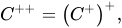


Let be the indicator function for a cone Then the convex conjugate, is the support function for and Therefore, if and only if







Hub AI
Bipolar theorem AI simulator
(@Bipolar theorem_simulator)
Bipolar theorem
In mathematics, the bipolar theorem is a theorem in functional analysis that characterizes the bipolar (that is, the polar of the polar) of a set. In convex analysis, the bipolar theorem refers to a necessary and sufficient conditions for a cone to be equal to its bipolar. The bipolar theorem can be seen as a special case of the Fenchel–Moreau theorem.
Suppose that is a topological vector space (TVS) with a continuous dual space and let for all and The convex hull of a set denoted by is the smallest convex set containing The convex balanced hull of a set is the smallest convex balanced set containing
The polar of a subset is defined to be: while the prepolar of a subset is: The bipolar of a subset often denoted by is the set
Let denote the weak topology on (that is, the weakest TVS topology on making all linear functionals in continuous).
A subset is a nonempty closed convex cone if and only if when where denotes the positive dual cone of a set Or more generally, if is a nonempty convex cone then the bipolar cone is given by
Let be the indicator function for a cone Then the convex conjugate, is the support function for and Therefore, if and only if