Hubbry Logo
Birmingham InterchangeBirmingham InterchangeMain
Open search
Birmingham Interchange
Community hub
Birmingham Interchange
logo
8 pages, 0 posts
0 subscribers
Be the first to start a discussion here.
Birmingham Interchange
from Wikipedia

Key Information

Birmingham Interchange is a planned High Speed 2 railway station in the Metropolitan Borough of Solihull, West Midlands, England,[2] with construction expected to finish in 2027.[3]

Unlike the city centre based Birmingham Curzon Street railway station, the interchange station will be a parkway, serving the east side of Birmingham and surrounding urban areas.[4]

History

[edit]

The station was designed by Arup, with support from Churchman Thornhill Finch, achieving BREEAM ‘Outstanding’ certification, the first railway station in the world to do so, with measures to maximise daylight, LED lighting, reusing rainwater from its roof, and air source heat pumps.[5] In June 2021, High Speed 2 invited companies to bid for a £370 million contract to build the station.[6]

Skanska, Unity (a joint venture with Sir Robert McAlpine and VolkerFitzpatrick, with support from WSP) and Laing O’Rourke were shortlisted. Laing O’Rourke was subsequently awarded the contract in July 2022 for its detailed design.[7] As of 2025, initial works are ongoing, including the building of a road bridge over the station, and main construction will commence in early 2026.[8]

The station will have 4 platforms, made of two 415m long platform islands. There will also be capacity for through-running services on two centrally placed tracks, leading to a total of 6 tracks. The station structure will be formed by a steel and glulam timber frame, with repeating structural forms on a 9 by 9 grid.[9]

Services

[edit]

Current service proposals suggest five trains per hour will stop at Birmingham Interchange, in each direction. Journey time from this station to London is planned to be 38 minutes.[4]

[edit]

A proposed 17 km (11 miles) long branch of the West Midlands Metro would terminate at this station, connecting it to the local tram network.[10]

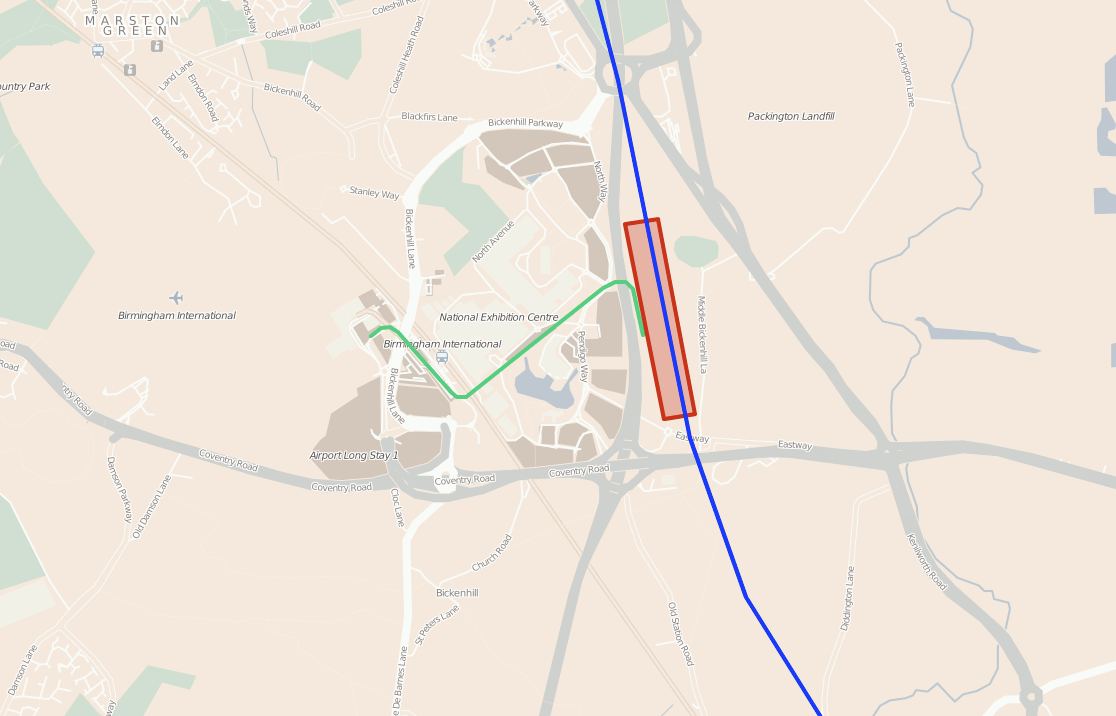
The station will be built on a triangular piece of land, surrounded by the M42 motorway, A446 and A45, and will be linked to the National Exhibition Centre, Birmingham Airport and Birmingham International railway station[11] by a people mover. The people mover will have a capacity of over 2,100 passengers per hour in each direction in the peak period.[4]

References

[edit]
Revisions and contributorsEdit on WikipediaRead on Wikipedia
from Grokipedia
Birmingham Interchange is a high-speed railway station under construction in the , West Midlands, , integrated into Phase One of the (HS2) network. Located adjacent to the (NEC) and Birmingham International Airport at the M6/M42 motorway interchange, the station is designed to function as a comprehensive facilitating seamless connections between , conventional rail services, the , bus networks, and an automated (APM) system extending to the NEC and airport terminals. Upon completion, it will enable travel to Euston in approximately 38 minutes, while promoting in the region through projected support for up to 30,000 jobs, 3,000 new homes, and over 70,000 square meters of commercial space. The project, however, reflects the wider HS2 initiative's difficulties, including repeated delays—now extending services beyond the original 2033 target—and substantial cost overruns, amid scrutiny over procurement decisions and scope changes that have escalated expenses without proportional advancements in delivery timelines.

Overview

Location and Strategic Role

Birmingham Interchange is situated in the , West Midlands, , on a 150-hectare site within a triangle of land bounded by the to the east, the A45 to the south, and the A452 to the west. The location positions the station approximately 10 kilometres southeast of , immediately adjacent to the (NEC) and Birmingham International Airport, enabling direct integration with major economic and transport assets in the region. Strategically, the station functions as a key gateway for the West Midlands, designed to capture demand from airport passengers, NEC event attendees, and regional commuters by linking HS2 high-speed services from with existing classic rail lines, trams, buses, and airport facilities. An automated system will connect the HS2 platforms to Birmingham International station, facilitating seamless transfers and reducing reliance on central Birmingham infrastructure like station. This interchange role supports broader connectivity to town centre, , and , positioning the site as a multimodal hub that enhances accessibility for international travel and freight logistics tied to the airport. The station's placement aligns with the Midlands HS2 Growth Strategy, which anticipates it contributing to £14 billion in regional and the creation or safeguarding of 100,000 jobs through improved links and associated development opportunities around the site. By serving as an entry point for HS2 Phase 1 services terminating in the West Midlands, it aims to alleviate capacity constraints on legacy networks while promoting regeneration in , including potential for new housing, employment zones, and sustainable urban extensions.

Design and Infrastructure Features

Birmingham Interchange station is designed with two island platforms, each measuring 415 metres in length, to accommodate high-speed trains and provide four platform faces for passenger services. These platforms are flanked by two central high-speed through lines, enabling non-stopping trains to maintain operational speeds without interruption. The overall track layout supports efficient integration into the HS2 network, with the station positioned on a 150-hectare site bounded by the M42, A45, and A452 motorways. Key infrastructure includes an automated people mover (APM) system spanning approximately 2.2 kilometres, connecting the station to the (NEC) and Birmingham International Airport via elevated guideways that cross diverse terrains such as motorways, car parks, and water bodies. This driverless system ensures frequent, high-capacity transit for passengers. The station design incorporates provisions for conventional rail connections, an extended Midland Metro tram network, bus interchanges, taxi ranks, pedestrian pathways, and cycle facilities with initial storage for 176 bicycles and capacity for expansion. Architectural elements emphasize and , featuring a lightweight roof structure assessed as Outstanding—the first for a rail station globally—through integrated design collaboration and advanced software modeling. Supporting encompasses internal networks, multi-storey car parks, and bridge structures, including a 63.5-metre bridge to facilitate vehicular access. Landscaping integrates varied grass seed mixes compliant with HS2 environmental standards to mitigate visual and ecological impacts adjacent to tracks.

Historical Development

Initial Proposal and Planning (2009–2013)

In January 2009, the government established HS2 Ltd to investigate options for a new line connecting to major cities in , with an initial focus on the -West Midlands corridor. The company conducted feasibility studies emphasizing capacity relief on existing lines, reduced journey times, and economic benefits, drawing on engineering assessments of potential routes that avoided urban congestion while linking key economic hubs like Birmingham International Airport and the (NEC). By December 2009, HS2 Ltd submitted initial proposals to the government, outlining a Y-shaped network with Phase 1 from London Euston to Birmingham, incorporating a dedicated station at the Interchange area to serve the airport and NEC without disrupting city-center traffic. In March 2010, the Department for Transport published the command paper High Speed Rail: London–West Midlands, formally proposing the 225 km route at speeds up to 360 km/h, with Birmingham Interchange as an intermediate station located 14 km southwest of Birmingham city center, designed to cut London-Birmingham Airport travel from 70 minutes to 40 minutes via high-speed services. The station site was selected for its greenfield location adjacent to the M42 motorway, enabling integration with regional transport and minimizing environmental impacts compared to urban alternatives. Planning advanced through 2011–2013 with detailed route optioneering, including geological surveys, noise modeling, and preliminary environmental assessments to refine the alignment around . A launched in 2011 gathered over 40,000 responses, addressing concerns on and connectivity, leading to minor adjustments such as optimized placements near the station. By 2013, HS2 Ltd completed the preferred route refinement, incorporating stakeholder input from local authorities like , which highlighted the station's role in unlocking 10 square miles of development land for jobs and housing, setting the stage for hybrid bill legislation. The High Speed Rail (London–West Midlands) Bill, authorizing Phase One of HS2 including the Birmingham Interchange station, advanced through parliamentary stages following its second reading approval in the House of Commons on 29 April 2014, despite opposition from 34 MPs. The bill was then referred to a Select Committee, which convened from December 2014 to examine over 1,300 petitions submitted by affected individuals, businesses, and local authorities, many raising concerns about the Interchange station's location near Solihull, including potential disruption to local traffic, agricultural land, and proximity to Birmingham Airport and the National Exhibition Centre. The committee's proceedings involved detailed evidence sessions, site visits, and amendments to mitigate specific impacts, such as noise barriers and landscaping around the station site; its interim report in March 2015 outlined initial decisions, with full deliberations extending into 2016. Opponents of the project, including the HS2 Action Alliance, mounted parallel judicial review challenges in the courts, primarily targeting procedural and environmental aspects of the Hybrid Bill process applicable to stations like Birmingham Interchange. In January 2014, the Supreme Court unanimously dismissed claims that the government's decision-making was unlawful due to inadequate strategic environmental assessment. A subsequent Court of Appeal challenge in December 2014 failed, upholding the bill's environmental statement and consultation processes against arguments of bias and insufficiency. These rulings affirmed the parliamentary hybrid bill mechanism's adequacy for balancing national infrastructure needs against local impacts, though petitioners near Interchange continued advocating through the Select Committee for route adjustments, few of which were granted due to the committee's emphasis on the project's overall strategic value. The bill completed its Commons stages in July 2016 after incorporating Select Committee recommendations and additional provisions, then moved to the for similar scrutiny, where further petitions addressed Interchange-related issues like compulsory purchase orders and ecological mitigation. was granted on 23 February 2017, formalizing powers for land acquisition and construction, including at the 450-hectare Interchange site. Post-assent legal actions up to 2018 remained limited and unsuccessful for Phase One, with courts rejecting appeals on grounds such as blight compensation and procedural fairness, enabling HS2 Ltd to proceed with preparatory works despite ongoing local reservations about the station's integration with regional transport.

Impact of HS2 Phase Cancellations (2019–2025)

The cancellations of HS2 Phases 2a and 2b, announced by Prime Minister on October 4, 2023, curtailed the project to Phase 1 between and the West Midlands, prompting reviews of the entire programme's value, including intermediate stations like Birmingham Interchange. Phase 2b, which would have extended high-speed services to and , was fully scrapped, while Phase 2a from the West Midlands to was deferred indefinitely, with the Birmingham-to-Handsacre link to the delayed by at least four additional years as of October 2025. These decisions followed earlier cost escalations and delays, with the National Audit Office noting in July 2024 that Phase 1 costs had risen significantly, though the government reaffirmed commitment to completing Phase 1 stations, including Interchange, without alteration to their core scope. For Birmingham Interchange, the truncated network diminished its projected role in facilitating seamless high-speed inter-regional travel, as northbound services from the station would revert to conventional speeds on the after Birmingham Curzon Street, rather than continuing on dedicated HS2 tracks. Original forecasts anticipated up to 10 million annual passengers at Interchange, leveraging connections to and the within a full national network; post-cancellation analyses, including a February 2024 report, indicated reduced benefits and a "very poor value for money" assessment for Phase 1 overall, with intermediate stations facing lower expected ridership from absent northern destinations. Despite this, local accessibility gains persist, with journey times to Euston projected to drop to around 30 minutes, supporting airport and connectivity independent of northern extensions. Construction at Birmingham Interchange proceeded uninterrupted by the phase cancellations, with site preparation and infrastructure works advancing through 2024 and into 2025, including completion of bridge beams over the by early 2025 and ongoing planning for a £185 million Automated system to link the station to the airport and . Design adjustments emerged, such as the September 2025 abandonment of platform edge doors to accommodate a mixed fleet of high-speed and conventional trains, reflecting operational shifts toward integration with existing networks north of Birmingham. Overall HS2 delays, now pushing Phase 1 passenger services beyond 2033—potentially to 2036 or later—indirectly affect Interchange's timeline, compounding earlier disruptions from 2020 that had already deferred enabling works. Revised economic projections for the Interchange area highlighted scaled-back growth stimulus, with the noting in 2023 that while local job creation and expansion benefits—estimated at thousands of positions—remain viable, the absence of northern legs erodes wider regional connectivity dividends originally modeled at £2-3 billion in annual economic uplift across the network. Critics, including the , argued that retaining all Phase 1 elements amid cancellations exacerbated opportunity costs, potentially diverting funds from alternative regional improvements like road and local rail upgrades promised under the "Network North" reallocation of £36 billion. Nonetheless, Council and HS2 Ltd emphasized sustained investment in the station's multimodal hub features, including integration with the M42 and future Midlands Rail Hub links, to mitigate reduced national throughput.

Construction and Engineering

Site Preparation and Key Milestones

Site preparation for the Birmingham Interchange station began with enabling works in early 2020, encompassing site clearance, utility diversions, archaeological investigations, and habitat creation across the 150-hectare site bounded by the M42, A45, and A452 roads near . These activities were undertaken by the LM , comprising Laing O’Rourke and J. Murphy & Sons, as part of HS2 Phase 1 enabling contracts covering the West Midlands. Initial milestones focused on reconfiguration, including the erection of modular bridges spanning the M42 and A446 motorways and the remodelling of local roads to enhance connectivity to the station and . These efforts mobilized a of approximately 200, projected to expand to 250 personnel. In April 2020, HS2 secured Schedule 17 planning consent for the elevated Automated People Mover (APM) , a 2.2 km structure rising to 14 metres in height, intended to link the station with Birmingham International Airport and the . A occurred in December 2023 with the tender for APM-specific enabling works, valued at up to £2 million and spanning 12 months, involving topographical surveys, ground investigations, and utility assessments; contracts were anticipated for award in early 2024, with on-site activities commencing in spring 2024. Structural progress advanced in October 2024 through the installation of 15 heavy bridge beams for elements at the station site, executed by a 20-person team. The subsequent phase, involving concrete deck placement and installation, is scheduled for completion in early 2025. In September 2025, executives from HS2 and convened to coordinate ongoing enabling works, infrastructure adjustments, and accelerated rail links. Full operational readiness for HS2 services at Interchange is forecasted between 2029 and 2033.

Contractors and Technological Innovations

Laing O'Rourke Delivery Limited was awarded the primary design and build contract for Birmingham Interchange station on July 11, 2022, with a value of up to £370 million, encompassing the station's core structure, commissioning, and associated works. The firm's design partner, , was appointed in September 2022 to support detailed engineering and integration. Arup led the initial architectural and engineering design, emphasizing and connectivity features. Balfour Beatty VINCI, serving as HS2's main works civil contractor for the West Midlands, has handled preparatory site works, including the October 2024 installation of 15 bridge beams totaling 565 tonnes to form a 63.5-meter-long, two-lane access bridge over the . This infrastructure supports site access and integrates with the station's elevated layout. Procurement for the Automated People Mover (APM) system—linking the station to , the , and Birmingham International station—advanced in 2025, with a £185 million civils contract notice issued in May and two firms shortlisted in February for supply, operation, and maintenance of the driverless vehicles. Technological innovations center on sustainable materials and digital processes. The station's roof employs beams spaced at 9-meter centers, forming interlocking curved "diamond leaves" with diagrid gutters for rainwater management, reducing embodied carbon by 400 tonnes relative to equivalents and achieving a projected 120-year lifespan. Passive environmental controls, including solar shading and natural ventilation, obviate mechanical systems, contributing to the structure's Outstanding rating—the first for a railway station worldwide—certified in summer 2020. Prefabricated "petals" utilize Design for Manufacture and Assembly () principles to minimize on-site labor risks and accelerate assembly. Digital engineering workflows integrate tools such as Speckle for data sharing, Rhino and for parametric modeling, and Revit for , enabling real-time collaboration across the design team and reducing errors in complex geometries. The APM incorporates autonomous electric vehicles on a 2.2-kilometer elevated guideway, designed for over 2,000 passengers per hour per direction, enhancing seamless multimodal connectivity without drivers.

Challenges and Delays Encountered

The construction of Birmingham Interchange station has encountered engineering constraints due to its location in a densely connected bounded by the M42, M6, and A45 highways, necessitating complex drainage designs to manage flood risks and comply with environmental standards. These challenges included adapting traditional railway drainage to limited near existing , incorporating sustainable urban drainage systems (SuDS), and coordinating with multiple stakeholders like , which extended design phases and required iterative approvals. Enabling works for highway modifications, such as realignments and upgrades to support station access, faced scope expansions and coordination issues among contractors, leading to revised timelines for initial site preparations starting in the early . Construction activities have involved frequent motorway closures, including multi-weekend disruptions on the M6 from spring 2024 onward for and gantry installations, contributing to local traffic delays and logistical complexities. Broader HS2 Phase 1 delays, driven by immature designs at construction onset, supply chain disruptions, and inflation, have postponed the station's operational readiness beyond initial 2031-2033 targets, with no firm new date as of mid-2025. Excessive costs for environmental compliance, including mitigation and habitat protection in the green belt area, have compounded these issues, with HS2 receiving over 1,200 complaints in 2024-2025 related to impacts. Local opposition, including early petitions citing and disruption, has persisted into the phase through ongoing community concerns, though no major lawsuits specific to the station have halted progress.

Planned Services and Connectivity

High-Speed Rail Operations

Birmingham Interchange station is engineered to support (HS2) operations with four platforms on two 415-meter-long island structures, complemented by two dedicated high-speed through lines for non-stopping trains. This configuration enables efficient handling of express services while providing capacity for stopping patterns, aligning with Phase 1's focus on London-to-West Midlands connectivity. Planned HS2 services at the station anticipate up to five trains per hour in each direction, facilitating peak-hour demand from commuters and intercity travelers. Journey times from station in to Birmingham Interchange are projected at 31 minutes, reducing current travel durations significantly via dedicated high-speed track. Northbound, stopping services will connect to Birmingham Curzon Street and onward to destinations like and on mixed HS2 and conventional lines following infrastructure integration north of the West Midlands. HS2 trains, manufactured by and capable of 360 km/h on purpose-built sections, will operate these routes with zero-carbon electric propulsion, emphasizing reliability and capacity over legacy networks. Service patterns prioritize frequency and speed, with through lines preserving end-to-end timings for longer-haul passengers while island platforms accommodate transfers, though actual timetables remain subject to final operator agreements and network-wide adjustments post-Phase 2a completion. The station's operational readiness ties to broader HS2 Phase 1 timelines, with services expected to commence between 2027 and 2028 pending construction milestones.

Integration with Local and Regional Transport

Birmingham Interchange Station is designed as a comprehensive hub integrating with regional networks in the West Midlands. Positioned on a 150-hectare site between the , A45, and A452 roads, it facilitates direct access to the motorway network via local road links and a new modular bridge spanning the M42, enhancing connectivity for vehicles, , cyclists, and pedestrians. Central to local integration is the Automated People Mover (APM), a 2.3 km elevated driverless system on a up to 12 meters high, linking the station to Birmingham International Station, the (NEC), , and in approximately six minutes. With a capacity of 2,100 passengers per hour per direction and services every three minutes using 20-meter-long vehicles, the APM—designs for which were unveiled in July 2019—bridges HS2 to existing regional rail, air, and business infrastructure. The station incorporates provisions for local bus services as part of its interchange facilities, alongside taxi ranks and private vehicle drop-offs, with a dedicated car park under development to support multi-modal access. Regional rail connectivity occurs primarily through the APM to Birmingham International Station, which handles up to five trains per hour on conventional lines, while broader West Midlands plans include alignment with Sprint faster bus corridors and road junction upgrades near the site. Tram integration ties into the proposed East Birmingham and Solihull extension of the , enhancing last-mile links without direct on-site tram infrastructure at Interchange itself. Active travel is prioritized with 176 cycle parking spaces, dedicated cycle routes from the north, west, and south-east, and pedestrian paths from the east, including the M42 bridge for non-motorized users. These elements aim to position the hub within a 45-minute radius of 1.3 million people as part of the Central growth strategy.

Accessibility and Capacity Projections

The Birmingham Interchange station is designed with comprehensive step-free access throughout, including four passenger lifts connecting the to platforms at 25% and 75% points, supplemented by evacuation lifts at platform ends for passengers with reduced mobility (PRM). Platforms measure 415 metres in length and 12 metres in width, featuring level train-platform interfaces, platform edge doors, and a maximum crossfall of 1:50 to facilitate safe boarding; seating is provided at intervals of 25-50 metres along PRM routes. A central 9-metre-wide pedestrian bridge incorporates slip-resistant concrete pavers and integrated drainage for universal accessibility, while facilities are available on platforms and the , alongside accessible toilets, multi-faith rooms, and clear systems with high-contrast signage. Integration with the automated people mover (APM) ensures seamless connectivity to and the (NEC), via a covered from the Interchange stop directly into the station , with the APM's three stops designed as fully accessible using color-coded guidance and operating on a up to 12 metres high. Parking provisions include 440 accessible bays (6% of total) in Car Park C South, each measuring 4.8 metres by 2.4 metres with 1.2-metre access strips, plus covered Blue Badge spaces in short-stay areas; charging points exceed 200, supporting inclusive multimodal access. Cycle facilities offer around 150-176 spaces east of the station, with dedicated routes from multiple directions accommodating disabled and adapted cycles, and potential expansion to 400 spaces assuming a 5% mode share. Capacity projections center on handling peak demand, with the station supporting up to five trains per hour in each direction on two island platforms, each with four sides and sized for potential expansion to nine trains per hour. The APM is engineered for 2,100 passengers per hour per direction, with services every three minutes completing the 2.3-kilometre route to the in six minutes, facilitating transfers to the and Birmingham International station. Overall station forecasts anticipate 23,000 daily passengers, potentially scaling to 50,000 depending on demand growth tied to regional and traffic, underpinned by 7,400 total parking spaces across multi-level car parks A, B, and C. These projections align with HS2's broader network capacity, where the Interchange-Old Common section is expected to see around 148,000 daily users, though actual utilization may vary with post-pandemic travel patterns and phase adjustments.

Economic and Regional Impacts

Projected Job Creation and Growth

The construction phase of Birmingham Interchange station is projected to directly support approximately 1,000 jobs over a five-year period, focusing on site works, , and integration with local such as the nearby Birmingham Business Park and airport connections. These roles encompass skilled trades including , rail systems installation, and environmental mitigation, with contracts awarded to firms like for the £370 million station build in . Longer-term economic growth centers on the UK Central hub, a planned 400-hectare development zone encompassing the station, which forecasts the creation or support of 70,000 jobs through commercial, logistics, and innovation clusters. This includes up to 650,000 m² of office and business space, alongside 5,000 new homes, projected to yield £6.2 billion in annual (GVA) by enhancing accessibility for 1.3 million people within a 45-minute commute. Sub-areas like Arden Cross, adjacent to the station, are estimated to deliver 16,000 net additional jobs and £1.4 billion in net GVA, driven by high-value sectors such as advanced and digital services. These projections, outlined in the West Midlands Combined Authority's HS2 Growth Strategy and HS2 Ltd assessments, assume coordinated public-private investment and full Phase 1 operationalization, though they remain subject to market conditions and policy shifts following HS2 Phase 2B cancellation. Independent analyses, such as those from , align with regional uplifts of around 31,000 jobs across West Midlands HS2 sites since 2017, underscoring Interchange's role in agglomeration effects but highlighting reliance on complementary infrastructure like upgraded local rail links.

Cost-Benefit Analysis and Fiscal Scrutiny

The Department for Transport's 2020 Full for HS2 Phase One, encompassing the line to Birmingham Interchange, calculated a central benefit-cost (BCR) of 1.2 including wider economic impacts, categorizing the scheme as low value for money with benefits of £32.8 billion against net government costs of £27.6 billion in 2015 prices. Transport user benefits totaled £26.2 billion in terms, primarily from reduced journey times (e.g., to Birmingham from 82 to 49 minutes) and capacity gains of 21,200 peak seats, supplemented by £6.6 billion in wider economic impacts such as agglomeration effects. An earlier 2011 economic assessment estimated a Phase One BCR of 1.4, rising to 1.6 after adjustments for £4.1 billion in wider impacts offset by landscape disbenefits, placing it at the lower end of medium value for money. Subsequent independent reviews have revised the BCR downward, with a 2023 Oxera citing 1.2 for Phase One standalone, reflecting diminished network effects after the 2023 cancellation of northern legs that were assumed to amplify benefits through onward connectivity. Birmingham Interchange-specific projections in the Full Business Case anticipate £2.1-4.1 billion in from the adjacent Central hub, supporting 35,000-77,500 jobs via induced development, though these rely on optimistic assumptions about freight release and not fully realized amid scope reductions. Fiscal scrutiny has centered on escalating costs, with Phase One estimates ballooning from an initial £20 billion target to £45-54 billion by 2024 for the London-Birmingham segment alone, driven by design changes, inflation, and supply chain issues. A 2025 Productivity Institute report documented a 134% real-terms cost escalation for Phase One completion estimates between 2012 and 2022, attributing it to immature designs at construction outset and inadequate risk provisioning in early business cases. Government acknowledgments in July 2025 confirmed overly optimistic baseline forecasts and rushed progression to site work, prompting ongoing investigations into procurement and governance failures. These overruns, funded primarily through public borrowing, have fueled debates on fiscal sustainability, with some projections warning of totals exceeding £80 billion in current prices absent further efficiencies.

Opportunity Costs and Alternative Investments

The allocation of public funds to Birmingham Interchange, estimated to contribute to the broader HS2 Phase 1 costs exceeding £45 billion as of 2023 updates, entails substantial opportunity costs by diverting resources from potential enhancements to the existing rail network. Critics, including economic analyses, contend that these funds could instead support upgrades to conventional lines, such as digital signaling and projects, which offer higher capacity gains per pound spent compared to new high-speed infrastructure. For instance, the HS2 Strategic Alternatives study evaluated upgrade packages for the , projecting they could alleviate bottlenecks at 20-30% of HS2's capital outlay, though proponents argue such measures fall short of long-term demand projections. Alternative investment strategies emphasize reallocating HS2-scale —originally budgeted at around £50 billion including contingencies—to dispersed regional initiatives yielding broader economic multipliers. One proposed framework suggests directing up to £3 billion per major core city toward urban rail expansions, including additional tracks and station improvements, to increase frequencies and connectivity without the land acquisition burdens of greenfield stations like Interchange. In the West Midlands context, this could prioritize integrations with the Midland Metro or enhancements to the , potentially delivering equivalent passenger throughput at lower fiscal risk, as evidenced by cost-benefit ratios for conventional upgrades often exceeding 2:1 versus HS2's revised figures below 1:1. Beyond rail-specific alternatives, opportunity costs extend to non-transport sectors strained by , where HS2 spending has been criticized for crowding out investments in local transport modes like or road maintenance, which provide immediate accessibility benefits to underserved populations. Recent assessments of northern extensions, including connectivity from Birmingham, highlight viable lower-cost options such as a Lichfield-to-High Legh new-build line linking residual HS2 segments to , estimated at 60-75% of comparable HS2 phasing costs, thereby preserving Interchange's role while mitigating overall expenditure. These alternatives underscore empirical trade-offs, with reviews acknowledging that while HS2 aims for transformative capacity, incremental upgrades could achieve 70-80% of projected journey time savings at significantly reduced .

Controversies and Criticisms

Environmental and Land Use Disputes

The Birmingham Interchange station site occupies green belt-designated farmland in Solihull, requiring the permanent acquisition of 93 hectares of agricultural land, of which 79.9 hectares comprises best and most versatile (BMV) soil grades 1, 2, and 3a. This conversion from rural agricultural use to a major transport interchange has fueled disputes over green belt integrity, with critics arguing it contravenes national planning policies aimed at preserving such land from development unless exceptional circumstances are proven. The project also involves temporary use of 176.2 hectares during construction, leading to field severance, farm unit fragmentation, and the demolition of two properties, alongside displacement of approximately 30 jobs from eight affected business units. Ecological concerns center on habitat losses, including 5 hectares of semi-natural woodland at Coleshill Pool Wood Local Wildlife Site (LWS), 0.2 hectares of wet woodland at Denbigh Spinney LWS, 15.6 kilometers of hedgerows, 12 ponds, and 4.7 hectares of rush pasture, alongside disturbance to protected species such as otters, bats, barn owls, diving beetles, and common toads. The 330-meter realignment of Hollywell Brook and diversion of an unnamed watercourse risk fragmenting aquatic and riparian ecosystems, with potential indirect effects on nearby Sites of Special Scientific Interest (SSSIs) like Coleshill and Bannerley Pools SSSI and River Blythe SSSI through groundwater-dependent habitat alterations. Although HS2's environmental statement outlines mitigations such as 33 hectares of native woodland creation, 1.6 kilometers of new hedgerows, replacement ponds, and 12.2 hectares of marshy grassland habitat, independent assessments by groups like The Wildlife Trusts assert that HS2 Ltd systematically undercalculates biodiversity losses across the route, with compensatory planting failing to offset irreversible damage to ancient woodlands and priority habitats. Landscape and visual disputes arise from permanent infrastructure like embankments, viaducts, and the station box, which will alter the rural heartland and M42 corridor character, introducing urban-scale elements into open countryside. Construction activities, including vegetation clearance and earthworks, are projected to cause moderate adverse effects on local character areas, with temporary visual intrusions from compounds and spoil heaps exacerbating concerns over recreational access to footpaths like those numbered M96 and M114. Mitigation proposals include shaped embankments, native shrub planting, and post-construction reinstatement, yet campaigners highlight the station's encroachment on adjacent to as a catalyst for broader urban fringe sprawl, undermining landscape separation between conurbations. Water resource conflicts involve floodplain disruption and potential contamination risks from nearby landfills, with the project's balancing ponds (22 in total) and sustainable drainage systems intended to manage runoff and maintain flood storage for 1-in-100-year events plus allowances. Opponents, drawing from HS2-wide critiques, question the efficacy of these measures amid evidence of underestimated hydrological impacts, arguing that realignments could degrade and in a minerals area overlapping the site.

Cost Overruns and Public Funding Concerns

The HS2 Phase 1 project, encompassing Birmingham Interchange station, has experienced substantial cost overruns, with estimates rising from an initial £26-32 billion (in 2009 prices) to £72-98 billion (in 2019 prices) by 2021, and further projections exceeding £80 billion by 2025 due to factors including design modifications, tunnelling requirements, and supply chain issues. These escalations have directly implicated the Interchange station, as station-specific costs—covering buildings, facilities, and utility diversions—are integrated into the overall Phase 1 budget without isolated public breakdowns beyond early estimates placing the station at approximately £370 million (2019 prices). By April 2025, cumulative expenditure on HS2 reached £40.5 billion in nominal terms, underscoring the fiscal pressures on components like Interchange amid broader programme delays pushing completion beyond 2033. Public funding for Birmingham Interchange relies entirely on government allocations from the taxpayer base, with no significant private investment contributions identified, amplifying concerns over fiscal accountability given the project's reliance on public borrowing and expenditure. Critics, including parliamentary reports, have attributed overruns to repeated policy shifts, inadequate initial risk modelling, and excessive compliance costs for environmental and planning approvals, arguing these reflect systemic mismanagement rather than inherent necessities. Legal challenges initiated by public bodies have incurred additional "significant" expenses, further straining the public purse dedicated to stations like Interchange. Opposition to the funding model highlights opportunity costs, with detractors contending that the ballooning public outlay—potentially surpassing £100 billion in current terms—diverts resources from regional upgrades or other needs offering higher returns on . Polling data indicates broad scepticism, with approximately 40% opposing HS2 overall due to its expense, a sentiment echoed in calls for enhanced cost controls and transparency specific to peripheral stations like Interchange, where recent design alterations reducing access points have prompted local queries on value for money. Despite these, statements maintain commitment to Phase 1 delivery, framing overruns as addressable through ongoing reforms while emphasising long-term economic benefits.

Local Community and Political Opposition

Local residents in , particularly those in the Meriden ward, have filed the highest number of complaints about HS2 construction activities, with data from Solihull Council indicating ongoing issues as of November 2024. Common grievances include nighttime noise from construction work and instances of , reflecting disruptions to daily life in areas adjacent to the Birmingham Interchange site. These complaints underscore community frustration with the tangible impacts of building the station, despite its planned integration with the and . Solihull councillors have raised political objections to key design alterations for the Interchange station, highlighting a perceived breach of earlier commitments. In February 2025, members voiced alarm over a significant reduction in the number of planned access points, arguing that this change undermines and connectivity promises made during the project's approval process. This criticism emerged amid broader scrutiny of HS2's evolving plans, with local leaders emphasizing the need for the station to serve regional needs effectively. While Metropolitan Borough Council granted for the station in 2020, the decision was not without acknowledged division, as the council leader noted controversy and harm to some livelihoods even while endorsing the project for its economic potential. Related opposition has extended to proposed housing developments nearby, such as garden communities, where councillors clashed in 2018 over pressures tied to the station's footprint. These local tensions highlight a gap between projected benefits and immediate community burdens, though organized protests specific to the Interchange have been limited compared to rural HS2 segments elsewhere.

Future Prospects

Completion Timeline and Phasing

Birmingham Interchange station forms part of (HS2) Phase 1, encompassing the London to West Midlands leg without independent sub-phasing from the broader line infrastructure. Construction activities are divided into enabling works and main station build phases, with the latter contracted to in summer 2022 for a value of £370 million. Enabling works, including site preparation and elements, advanced in 2024 with the installation of 15 bridge beams totaling 565 tonnes over the , forming the base for a 63.5-meter-long, two-lane bridge. The subsequent phase involves placing a deck atop these beams, followed by walls, with completion targeted for early 2025. These preparatory efforts integrate with wider tasks, such as remodeled road networks and links to and the (NEC). Full station construction, encompassing two 415-meter island platforms, four tracks (two for stopping services and two high-speed through lines), and a interchange, is scheduled to begin in early 2026. This phase is projected to generate 1,000 jobs over five years, focusing on modular design elements for efficiency. Operational opening aligns with HS2 Phase 1 services from to Birmingham , with forecasts ranging from 2029 to 2033 amid ongoing programme resets addressing productivity and cost controls. anticipates 2029 availability, though July 2025 government assessments signal potential slippage beyond prior 2033 benchmarks due to inherited delays and fiscal scrutiny. No segregated timeline for Interchange precedes , as track and signaling integration dictate synchronized commissioning.

Potential Expansions and Uncertainties

The Automated People Mover (APM) system represents a primary expansion element for Birmingham Interchange, comprising a 2.3 km viaduct-based link designed to connect the station directly to the (NEC), , and , with capacity for up to 20,000 passengers per hour. for the APM's works, valued at £185 million, was anticipated in 2025, enhancing multimodal access and supporting regional economic hubs without reliance on traditional road or rail shuttles. Further potential lies in integrating the station with the network, as outlined in expansion plans extending from Birmingham Eastside through to terminate at the HS2 Interchange core, alongside connections to Birmingham International and the . This 17.5 km route aims to bolster , with and planning funded through regional allocations as of August 2025, though implementation remains phased and contingent on securing full construction budgets. Uncertainties persist due to HS2 Phase 1's escalating costs, projected to surpass £100 billion with completion potentially delayed to 2039 amid ongoing legal challenges and supply chain issues. While revised station designs received Schedule 17 planning approval from on 8 May 2025, integration with legacy networks like the faces further postponements to at least 2033, risking reduced operational capacity and connectivity benefits. Metro extensions, though advancing in preliminary phases, are vulnerable to fiscal scrutiny and competing regional priorities, with no guaranteed timeline for reaching the Interchange. Overall, these elements hinge on sustained commitment amid broader reallocations.

References

Add your contribution
Related Hubs
User Avatar
No comments yet.