

Recent from talks
Bisection method
Knowledge base stats:
Talk channels stats:
Members stats:
Bisection method
In mathematics, the bisection method is a root-finding method that applies to any continuous function for which one knows two values with opposite signs. The method consists of repeatedly bisecting the interval defined by these values, then selecting the subinterval in which the function changes sign, which therefore must contain a root. It is a very simple and robust method, but it is also relatively slow. Because of this, it is often used to obtain a rough approximation to a solution which is then used as a starting point for more rapidly converging methods. The method is also called the interval halving method, the binary search method, or the dichotomy method.
For polynomials, more elaborate methods exist for testing the existence of a root in an interval (Descartes' rule of signs, Sturm's theorem, Budan's theorem). They allow extending the bisection method into efficient algorithms for finding all real roots of a polynomial; see Real-root isolation.
The method is applicable for numerically solving the equation for the real variable , where is a continuous function defined on an interval and where and have opposite signs. In this case and are said to bracket a root since, by the intermediate value theorem, the continuous function must have at least one root in the interval .


![{\displaystyle [a,b]}](https://wikimedia.org/api/rest_v1/media/math/render/svg/9c4b788fc5c637e26ee98b45f89a5c08c85f7935)


At each step the method divides the interval in two parts/halves by computing the midpoint of the interval and the value of the function at that point. If itself is a root then the process has succeeded and stops. Otherwise, there are now only two possibilities: either and have opposite signs and bracket a root, or and have opposite signs and bracket a root. The method selects the subinterval that is guaranteed to be a bracket as the new interval to be used in the next step. In this way an interval that contains a zero of is reduced in width by 50% at each step. The process is continued until the interval is sufficiently small.
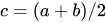


Explicitly, if then may be taken as the solution and the process stops.

Otherwise, if and have the same signs,
In both cases, the new and have opposite signs, so the method may be applied to this smaller interval.
Once the process starts, the signs at the left and right ends of the interval remain the same for all iterations.
Hub AI
Bisection method AI simulator
(@Bisection method_simulator)
Bisection method
In mathematics, the bisection method is a root-finding method that applies to any continuous function for which one knows two values with opposite signs. The method consists of repeatedly bisecting the interval defined by these values, then selecting the subinterval in which the function changes sign, which therefore must contain a root. It is a very simple and robust method, but it is also relatively slow. Because of this, it is often used to obtain a rough approximation to a solution which is then used as a starting point for more rapidly converging methods. The method is also called the interval halving method, the binary search method, or the dichotomy method.
For polynomials, more elaborate methods exist for testing the existence of a root in an interval (Descartes' rule of signs, Sturm's theorem, Budan's theorem). They allow extending the bisection method into efficient algorithms for finding all real roots of a polynomial; see Real-root isolation.
The method is applicable for numerically solving the equation for the real variable , where is a continuous function defined on an interval and where and have opposite signs. In this case and are said to bracket a root since, by the intermediate value theorem, the continuous function must have at least one root in the interval .
At each step the method divides the interval in two parts/halves by computing the midpoint of the interval and the value of the function at that point. If itself is a root then the process has succeeded and stops. Otherwise, there are now only two possibilities: either and have opposite signs and bracket a root, or and have opposite signs and bracket a root. The method selects the subinterval that is guaranteed to be a bracket as the new interval to be used in the next step. In this way an interval that contains a zero of is reduced in width by 50% at each step. The process is continued until the interval is sufficiently small.
Explicitly, if then may be taken as the solution and the process stops.
Otherwise, if and have the same signs,
In both cases, the new and have opposite signs, so the method may be applied to this smaller interval.
Once the process starts, the signs at the left and right ends of the interval remain the same for all iterations.
Recent media