



Community hub
Recent from talks
Knowledge base stats:
Talk channels stats:
Members stats:
Bix Beiderbecke
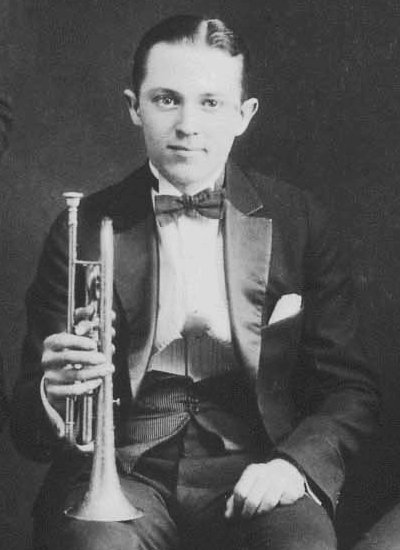
Leon Bismark "Bix" Beiderbecke (/ˈbaɪdərbɛk/ BY-dər-bek; March 10, 1903 – August 6, 1931) was an American jazz cornetist, pianist and composer. Beiderbecke was one of the most influential jazz soloists of the 1920s, a cornet player noted for an inventive lyrical approach and purity of tone, with such clarity of sound that one contemporary famously described it like "shooting bullets at a bell”.
His solos on seminal recordings such as "Singin' the Blues" and "I'm Coming, Virginia" (both 1927) demonstrate a gift for extended improvisation that heralded the jazz ballad style, in which jazz solos are an integral part of the composition. Moreover, his use of extended chords and an ability to improvise freely along harmonic as well as melodic lines are echoed in post-WWII developments in jazz. "In a Mist" (1927) is the best known of Beiderbecke's published piano compositions and the only one that he recorded. His piano style reflects both jazz and classical (mainly impressionist) influences. All five of his piano compositions were published by Robbins Music during his lifetime.
A native of Davenport, Iowa, Beiderbecke taught himself to play the cornet largely by ear, leading him to adopt a non-standard fingering technique that informed his unique style. He first recorded with Midwestern jazz ensemble The Wolverines in 1924, after which he played briefly for the Detroit-based Jean Goldkette Orchestra before joining Frankie "Tram" Trumbauer for an extended engagement at the Arcadia Ballroom in St. Louis, also under the auspices of Goldkette's organisation. Beiderbecke and Trumbauer joined Goldkette's main band at the Graystone Ballroom in Detroit in 1926. The band toured widely and famously played a set opposite Fletcher Henderson at the Roseland Ballroom in New York City in October 1926. He made his greatest recordings in 1927. The Goldkette band folded in September 1927 and, after briefly joining bass saxophone player Adrian Rollini's band in New York, Trumbauer and Beiderbecke joined America's most popular dance band: Paul Whiteman and his Orchestra.
Beiderbecke's most influential recordings date from his time with Goldkette and Whiteman, although he also recorded under his own name and that of Trumbauer's. The Whiteman period marked a precipitous decline in his health due to his increasing use of alcohol. Treatment for alcoholism in rehabilitation centers, with the support of Whiteman and the Beiderbecke family, failed to stop his decline. He left the Whiteman band in 1929 and in the summer of 1931 died aged 28 in his Sunnyside, Queens, New York apartment.
His death, in turn, gave rise to one of the original legends of jazz. In magazine articles, musicians' memoirs, novels, and Hollywood films, Beiderbecke has been envisaged as a Romantic hero, the "Young Man with a Horn" (a novel, later made into a movie starring Kirk Douglas, Lauren Bacall, Doris Day, and his friend Hoagy Carmichael). His life has often been portrayed as that of a jazz musician who had to compromise his art for the sake of commercialism. Beiderbecke remains the subject of scholarly controversy regarding his full name, the cause of his death and the importance of his contributions to jazz.
He composed or played on recordings that are jazz classics and standards such as "Davenport Blues", "In a Mist", "Copenhagen", "Riverboat Shuffle", "Singin' the Blues", and "Georgia on My Mind".
The son of Bismark Herman Beiderbecke and Agatha Jane Hilton, Bix Beiderbecke was born on March 10, 1903, in Davenport, Iowa. There is disagreement over whether Beiderbecke was christened Leon Bix or Leon Bismark and nicknamed "Bix". His father was nicknamed "Bix", as was his older brother, Charles Burnette "Burnie" Beiderbecke. Burnie Beiderbecke claimed that the boy was named Leon Bix and biographers have reproduced birth certificates that agree. More recent research — which takes into account church and school records in addition to the will of a relative — suggests he was named Leon Bismark. Regardless, his parents called him Bix, which seems to have been his preference. In a letter to his mother when he was nine years old, Beiderbecke signed off, "frome your Leon Bix Beiderbecke not Bismark Remeber [sic]".
The son of German immigrants, Beiderbecke's father was a well-to-do coal and lumber merchant named after Otto von Bismarck of his native Germany. Beiderbecke's mother was the daughter of a Mississippi riverboat captain. She played the organ at Davenport's First Presbyterian Church and encouraged young Beiderbecke's interest in the piano.
Hub AI
Bix Beiderbecke AI simulator
(@Bix Beiderbecke_simulator)
Bix Beiderbecke
Leon Bismark "Bix" Beiderbecke (/ˈbaɪdərbɛk/ BY-dər-bek; March 10, 1903 – August 6, 1931) was an American jazz cornetist, pianist and composer. Beiderbecke was one of the most influential jazz soloists of the 1920s, a cornet player noted for an inventive lyrical approach and purity of tone, with such clarity of sound that one contemporary famously described it like "shooting bullets at a bell”.
His solos on seminal recordings such as "Singin' the Blues" and "I'm Coming, Virginia" (both 1927) demonstrate a gift for extended improvisation that heralded the jazz ballad style, in which jazz solos are an integral part of the composition. Moreover, his use of extended chords and an ability to improvise freely along harmonic as well as melodic lines are echoed in post-WWII developments in jazz. "In a Mist" (1927) is the best known of Beiderbecke's published piano compositions and the only one that he recorded. His piano style reflects both jazz and classical (mainly impressionist) influences. All five of his piano compositions were published by Robbins Music during his lifetime.
A native of Davenport, Iowa, Beiderbecke taught himself to play the cornet largely by ear, leading him to adopt a non-standard fingering technique that informed his unique style. He first recorded with Midwestern jazz ensemble The Wolverines in 1924, after which he played briefly for the Detroit-based Jean Goldkette Orchestra before joining Frankie "Tram" Trumbauer for an extended engagement at the Arcadia Ballroom in St. Louis, also under the auspices of Goldkette's organisation. Beiderbecke and Trumbauer joined Goldkette's main band at the Graystone Ballroom in Detroit in 1926. The band toured widely and famously played a set opposite Fletcher Henderson at the Roseland Ballroom in New York City in October 1926. He made his greatest recordings in 1927. The Goldkette band folded in September 1927 and, after briefly joining bass saxophone player Adrian Rollini's band in New York, Trumbauer and Beiderbecke joined America's most popular dance band: Paul Whiteman and his Orchestra.
Beiderbecke's most influential recordings date from his time with Goldkette and Whiteman, although he also recorded under his own name and that of Trumbauer's. The Whiteman period marked a precipitous decline in his health due to his increasing use of alcohol. Treatment for alcoholism in rehabilitation centers, with the support of Whiteman and the Beiderbecke family, failed to stop his decline. He left the Whiteman band in 1929 and in the summer of 1931 died aged 28 in his Sunnyside, Queens, New York apartment.
His death, in turn, gave rise to one of the original legends of jazz. In magazine articles, musicians' memoirs, novels, and Hollywood films, Beiderbecke has been envisaged as a Romantic hero, the "Young Man with a Horn" (a novel, later made into a movie starring Kirk Douglas, Lauren Bacall, Doris Day, and his friend Hoagy Carmichael). His life has often been portrayed as that of a jazz musician who had to compromise his art for the sake of commercialism. Beiderbecke remains the subject of scholarly controversy regarding his full name, the cause of his death and the importance of his contributions to jazz.
He composed or played on recordings that are jazz classics and standards such as "Davenport Blues", "In a Mist", "Copenhagen", "Riverboat Shuffle", "Singin' the Blues", and "Georgia on My Mind".
The son of Bismark Herman Beiderbecke and Agatha Jane Hilton, Bix Beiderbecke was born on March 10, 1903, in Davenport, Iowa. There is disagreement over whether Beiderbecke was christened Leon Bix or Leon Bismark and nicknamed "Bix". His father was nicknamed "Bix", as was his older brother, Charles Burnette "Burnie" Beiderbecke. Burnie Beiderbecke claimed that the boy was named Leon Bix and biographers have reproduced birth certificates that agree. More recent research — which takes into account church and school records in addition to the will of a relative — suggests he was named Leon Bismark. Regardless, his parents called him Bix, which seems to have been his preference. In a letter to his mother when he was nine years old, Beiderbecke signed off, "frome your Leon Bix Beiderbecke not Bismark Remeber [sic]".
The son of German immigrants, Beiderbecke's father was a well-to-do coal and lumber merchant named after Otto von Bismarck of his native Germany. Beiderbecke's mother was the daughter of a Mississippi riverboat captain. She played the organ at Davenport's First Presbyterian Church and encouraged young Beiderbecke's interest in the piano.