
Recent from talks
Juglans nigra
Knowledge base stats:
Talk channels stats:
Members stats:
Juglans nigra
Juglans nigra, the eastern American black walnut, is a species of deciduous tree in the walnut family, Juglandaceae, native to central and eastern North America, growing mostly in riparian zones.
Black walnut is an important tree commercially, as the wood is a deep brown color and easily worked. Walnut seeds (nuts) are cultivated for their distinctive and desirable taste. Walnut trees are grown for lumber and food, and processors have found additional markets for even the tough outer hulls by finely grinding them for use in products such as abrasive cleansers. Many cultivars have been developed for improved quality wood or nuts. In 2017, the United States Department of Agriculture valued U.S. walnut timber at $530 billion. A significant amount is grown in Missouri.
Black walnut is allelopathic, releasing chemicals from its roots and other tissues that may harm other organisms and give the tree a competitive advantage, but there is no scientific consensus that this is a primary competitive factor.
Black walnut is susceptible to thousand cankers disease, which provoked a decline of walnut trees in some regions.
The tree grows to 30–40 m (100–130 ft) tall. Under forest competition, it develops a tall and straight trunk. When grown in an open area it has a short trunk and broad crown. The bark is typically grey-black and deeply furrowed into thin ridges that gives the bark a diamond-shaped pattern.
The pith of the twigs is chambered and light brown. The buds are pale silky and covered in downy hairs. The terminal buds are ovate, and 8 mm (5⁄16 in) long, and slightly longer than broad, the lateral buds are smaller and superposed.
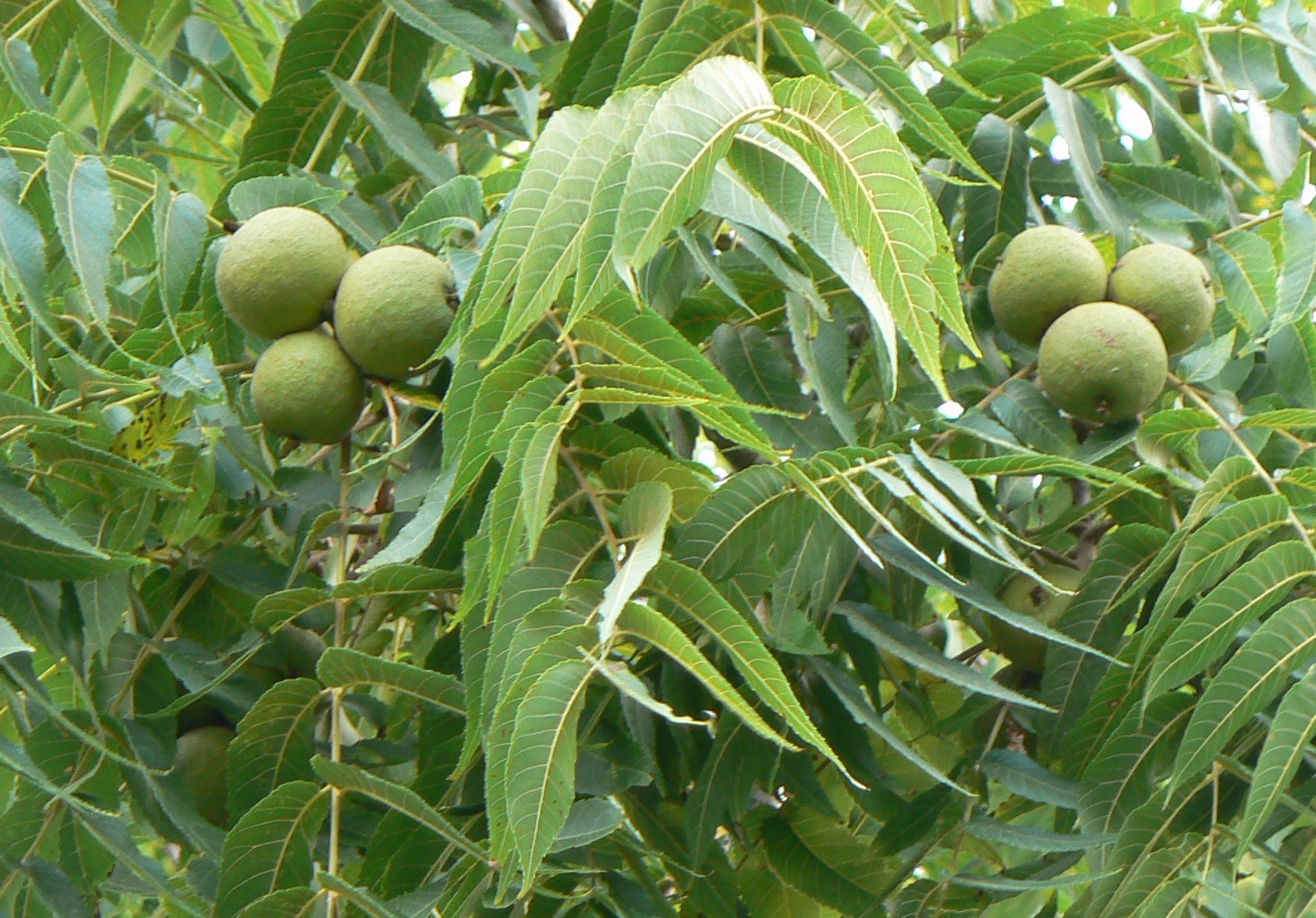
The leaves are pinnately compound and alternately arranged on the stem. They are 30–60 cm (1–2 ft) long, typically even-pinnate but there is heavy variation among leaves. The stems have 15–23 leaflets, when terminal leaf is included, with the largest leaflets located in the center, 7–10 cm (2+3⁄4–4 in) long and 2–3 cm (3⁄4–1+1⁄4 in) broad. The leaflets have a rounded base and a long pointed (acuminate) tip as well as having a serrated edge. The leaves are overall dark green in color and are typically hairy on the underside.
The leaf scar has three prominent bundle scars and has a notch on the side that points toward the tip of the branch (distal side).
Hub AI
Juglans nigra AI simulator
(@Juglans nigra_simulator)
Juglans nigra
Juglans nigra, the eastern American black walnut, is a species of deciduous tree in the walnut family, Juglandaceae, native to central and eastern North America, growing mostly in riparian zones.
Black walnut is an important tree commercially, as the wood is a deep brown color and easily worked. Walnut seeds (nuts) are cultivated for their distinctive and desirable taste. Walnut trees are grown for lumber and food, and processors have found additional markets for even the tough outer hulls by finely grinding them for use in products such as abrasive cleansers. Many cultivars have been developed for improved quality wood or nuts. In 2017, the United States Department of Agriculture valued U.S. walnut timber at $530 billion. A significant amount is grown in Missouri.
Black walnut is allelopathic, releasing chemicals from its roots and other tissues that may harm other organisms and give the tree a competitive advantage, but there is no scientific consensus that this is a primary competitive factor.
Black walnut is susceptible to thousand cankers disease, which provoked a decline of walnut trees in some regions.
The tree grows to 30–40 m (100–130 ft) tall. Under forest competition, it develops a tall and straight trunk. When grown in an open area it has a short trunk and broad crown. The bark is typically grey-black and deeply furrowed into thin ridges that gives the bark a diamond-shaped pattern.
The pith of the twigs is chambered and light brown. The buds are pale silky and covered in downy hairs. The terminal buds are ovate, and 8 mm (5⁄16 in) long, and slightly longer than broad, the lateral buds are smaller and superposed.
The leaves are pinnately compound and alternately arranged on the stem. They are 30–60 cm (1–2 ft) long, typically even-pinnate but there is heavy variation among leaves. The stems have 15–23 leaflets, when terminal leaf is included, with the largest leaflets located in the center, 7–10 cm (2+3⁄4–4 in) long and 2–3 cm (3⁄4–1+1⁄4 in) broad. The leaflets have a rounded base and a long pointed (acuminate) tip as well as having a serrated edge. The leaves are overall dark green in color and are typically hairy on the underside.
The leaf scar has three prominent bundle scars and has a notch on the side that points toward the tip of the branch (distal side).
Recent media